

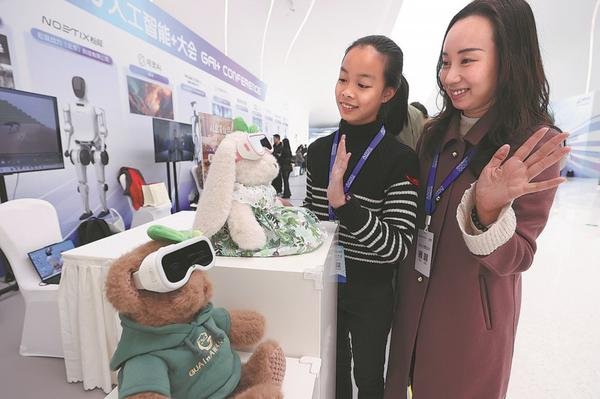

Guests interact with artificial intelligence companion toys on November 16 at the AI+ 2025 global conference in Beijing. (PHOTO / FOR CHINA DAILY)
Eager to tap into a huge potential customer base, industry players are accelerating their push into the AI-powered toy market, hoping to unlock further growth as supportive policies inject fresh impetus into the sector.
Experts and business leaders have noted that AI toys, created to provide emotional support and companionship, are well-positioned to spark the next wave of consumer trends by using advanced technologies to foster emotional connections with consumers.
“Young consumers are increasingly paying more for emotional value, and AI companionship is emerging as a key early use case,” said Sun Zhaozhi, founder and CEO of Robopoet, a Shanghai-based AI toy startup.
“This attracts more businesses, including large corporations, to this area,” Sun said.
According to data from the Ministry of Industry and Information Technology, China’s AI toy market was valued at 24.6 billion yuan ($3.49 billion) in 2024, and is expected to reach 29 billion yuan this year.
The growth momentum is supported by an action plan released last month by the Ministry of Industry and Information Technology, the National Development and Reform Commission, the Ministry of Commerce, the Ministry of Culture and Tourism, the People’s Bank of China and the State Administration for Market Regulation, in which collectible toys were listed as a priority supporting consumption category for the first time, making it one of 10 consumer segments targeted to surpass the mark 100 billion yuan by 2027.
“The deep integration of AI with traditional toy manufacturing is reshaping product forms and value chains, making AI toys a new driving force for high-quality industrial development,” said He Yaqiong, head of the consumer products industry department at the Ministry of Industry and Information Technology.
Priced at 399 yuan, Fuzozo, Robopoet’s flagship AI plush toy, which speaks and makes eye contact with users, sold more than 1,000 units in the first 10 minutes of the pre-sale of the “618” shopping festival and ranked No. 1 in sales of AI toys on JD and Tmall during this year’s Double 11 shopping festival, Sun said.
The senior executive added that the product has sold about 100,000 units so far this year and is targeting 1 million next year, with a target of a gross merchandise value of 400 million to 500 million yuan.
As consumer demand diversifies, more companies are turning to AI-powered pet companions.
“Unlike conventional robots designed to serve humans, our product simulates a living pet that needs care. The care process provides users with a sense of healing, helping them cope with anxiety and loneliness,” said He Jiabin, co-founder and CEO of AI robot pet maker Ropet.
He added that AI-powered robot animals are more suitable for the lifestyle of today’s youth as challenges such as allergies, time constraints and the training process are not present.
Supported by a large emotional language model and behavioral learning, Ropet can continually adapt to users’ habits and gradually develop distinctive traits, allowing it to interact more like a personalized pet, the executive said.
After its national debut on JD in late October, the AI pet product quickly made its way into the platform’s top three in the robot category in terms of sales volume during the Double 11 shopping festival.
“Our business logic is simple: first create an attractive hardware product, then use high utilization rates to accumulate behavioral data, and finally leverage that data to deliver real intelligence,” he said.
As domestic momentum strengthens, Chinese AI toys are also finding strong popularity overseas.
In 2024, China’s domestic toy retail market accounted for 97.85 billion yuan, up 25.5 percent from 2020, while toy exports totaled $39.87 billion, up 19.1 percent from 2020, the Ministry of Industry and Information Technology said.
“Consumers in the United States and Europe have shown great acceptance of AI robots with visual understanding and personalized interaction. Many describe our products as ‘small office creatures’, ‘AI pets’ or ’emotional charging station’,” said Yi Qi, marketing director at Shenzhen-based AI hardware company TangibleFuture.
The company’s LOOI robot, priced at around $150, differs from typical companion robots in its phone dock format. Once a smartphone is placed on it, the device activates intelligent interaction and obstacle detection functions.
Since the start of mass production in November 2024, more than 10,000 units have been shipped, 90% of which are overseas. The product even received an endorsement from Tesla CEO Elon Musk on social media.
“Benefiting from the world’s most complete toy industrial chain, strong manufacturing capabilities and a highly skilled workforce, China is now able to offer more high-quality and more attractively priced toys to global consumers,” said He Yaqiong of the Ministry of Industry and Information Technology.

