

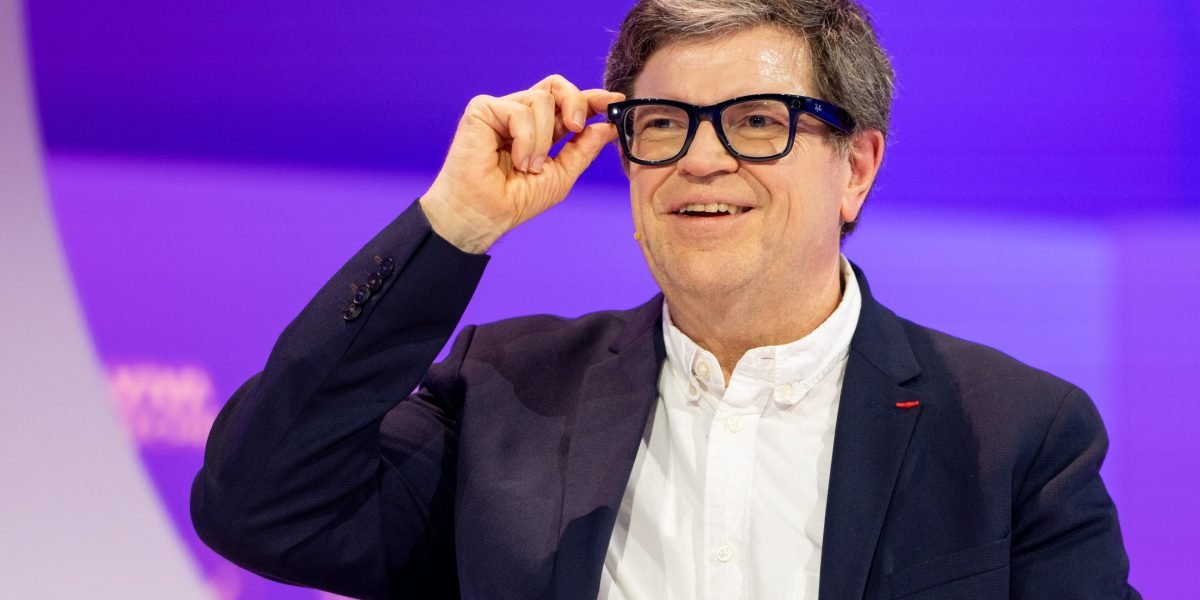
Yann LeCun, the legendary artificial intelligence researcher who helped build and shape Meta’s AI strategy, is already on his way to his next big project. Less than a month after announcing his departure from Mark Zuckerberg’s social media empire, Turing Prize winner, 65 launched fundraising discussions that would value his new company at around $3.5 billion before it even launches.
The startup, Advanced Machine Intelligence (AMI) Labs, aims to create what LeCun calls “world models”: AI systems that understand physics, maintain persistent memory, and plan complex actions rather than simply predicting the next word. The company plans to establish its headquarters in Paris early next year, with LeCun as executive chairman. He has even already chosen the CEO: Thursday, LeCun announced on LinkedIn that it chose Alexandre LeBrun, founder of French health tech startup Nabla, to take on the role of chief executive.
Why LeCun is abandoning Silicon Valley
The funding target of €500 million (~$586 million) would be one of the largest pre-launch raises in AI history, reflecting investors’ confidence in LeCun’s vision to move beyond today’s major language models.
“Silicon Valley is completely mesmerized by current models of generative AI,” LeCun explained earlier this month at the AI-Pulse conference. “To pursue this type of new research, we need to get out of the Valley, to Paris.”
LeCun’s departure from Meta after 12 years – five years as founding director of Facebook AI Research and seven years as chief AI scientist –the rumor had been circulating for weeks before confirming it on November 18. His departure coincides with The strategic pivot of Meta towards more powerful LLM-based models under the new director of AI, Alexandr Wangthe twenty-something founder of Scale AI.
Although Meta will not invest in AMI Labs, the companies plan to form a partnership, allowing LeCun to continue his research while maintaining ties to his former employer.
The AI bubble is growing
A pre-revenue startup’s spectacular valuation has amplified concerns about an AI investment bubble. Industry leaders have warned that enthusiasm around AI could outpace business fundamentals, and LeCun’s fundraising could test whether even the most respected names in the field can command premium valuations without proven commercial traction. The startup faces competition from well-funded European competitors like Black Forest Laboratoriesvalued at $4 billion, and Quantex at $2.6 billion.
LeCun’s skepticism about the current direction of AI is clear. Earlier this year, during an appearance on Alex Kantrowitz’s show Great technology podcasthe said: “We will not get to human-level AI simply by scaling LLMs”, arguing that they can’t reach this stage because they simply predict the text rather than truly understanding the world. His startup, AMI Labs, aims to develop systems that observe and interact with the physical environment as humans do, potentially revolutionizing robotics, transportation and healthcare.
A return to European roots
The French computer scientist, who won the 2018 Turing Prize alongside Geoffrey Hinton and Yoshua Bengio, has long championed European talent in AI. He convinced Meta to open his FAIR lab in Paris in 2015 and now says the city offers the ideal environment for its next-generation research.
LeCun’s social media post the announcement of his departure emphasized continuity: “I am creating a startup to continue the Advanced Machine Intelligence (AMI) research program that I have been pursuing for several years with colleagues at FAIR, NYU and beyond. He described the goal as “the next big revolution in AI: systems that understand the physical world, have persistent memory, can reason, and plan complex action sequences.”
The partnership with Nabla provides immediate applications for AMI’s technology. The health technology company will gain first access to global model technologies, enabling it to develop FDA-certified AI systems for healthcare. LeBrun’s transition from CEO of Nabla to CEO of AMI Labs signals a deep integration between the two companies, although he remains president and chief AI scientist at Nabla.