

Nvidia has unveiled a new technology platform for self-driving cars as the world’s top chipmaker seeks more physical products into which to integrate AI.
Speaking at the annual CES technology conference in Las Vegas, boss Jensen Huan said the system – called Alpamayo – would bring “reasoning” to autonomous vehicles.
This would allow cars to “think through rare scenarios, drive safely in complex environments and explain their driving decisions,” Huang said.
He said Nvidia was working with Mercedes to produce a driverless car powered by the technology, which would be released in the United States in the coming months before being rolled out in Europe and Asia.
Nvidia’s chips have helped fuel the AI revolution, although most attention so far has focused on the software they power, such as ChatGPT.
However, large technology companies are now increasingly looking for hardware, that is, physical products such as cars, in which AI could be used.
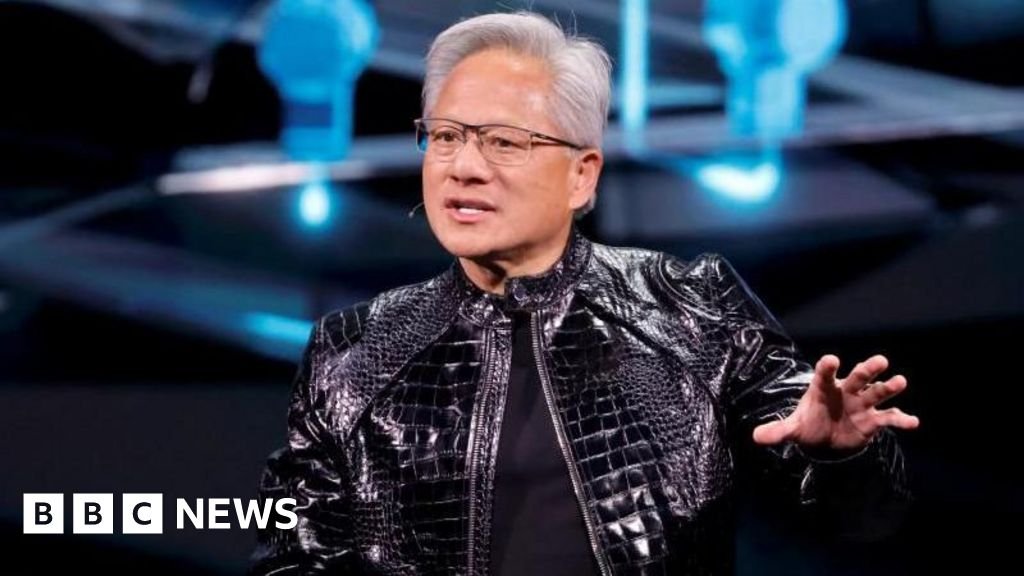
Wearing his famous black leather jacket, Huang told hundreds of people that the project had taught Nvidia “an enormous amount” about how to help its partners build robotic systems.
“The ChatGPT moment for physical AI is almost here,” Huang said.
“NVIDIA’s pivot to AI at scale and AI systems as differentiators will help it stay ahead of competitors,” said Paolo Pescatore, an analyst at Las Vegas-based PP Foresight.
“Alpamayo represents a profound shift for NVIDIA, moving from primarily computing to a platform provider for physical AI ecosystems.”
Shares of the AI chip designer rose slightly in after-hours trading following Huang’s presentation.
It featured a video demonstration of the AI-powered Mercedes-Benz driving through San Francisco while a passenger, seated behind the wheel, kept his hands on his knees.
“He behaves so naturally because he learned directly from human protesters,” Huang said, “but in every scenario… he tells you what he’s going to do, and he reasons about what he’s about to do.”
Alpamayo is an open source AI model, the underlying code of which is now available on the Hugging Face machine learning platform, where autonomous vehicle researchers can access it for free and retrain the model, Huang said.
“Our vision is that one day every car, every truck will be autonomous,” he told the audience.
The project could pose a threat to companies like Elon Musk’s Tesla, which offers driver assistance software called Autopilot.
“Well, that’s exactly what Tesla is doing,” Musk said on social media after Alpamayo’s announcement. “What they’ll find is that it’s easy to get to 99%, then very hard to solve the long tail of distribution.”
Like Tesla, Nvidia is also planning to launch a robotaxi service by next year in conjunction with a partner, but declined to name the partner or say where it will be located.
Nvidia is the world’s most valuable publicly traded company, with a market capitalization of more than $4.5 billion (£3.3 billion).
It became the first company to hit $5 trillion in October, but has lost value amid concerns about whether demand for AI is overrated.