

“The expected increase in freight transport will lead to complete congestion on our roads in the near future,” warns Professor Achim Kampker, Director of the Chair of Production Engineering for Electric Mobility Components (PEM) at RWTH Aachen. The ViDeLL project therefore focuses on logistics and the intelligent management of its traffic flows. Specifically, it examines urban last-mile and retail logistics, as well as industrial logistics between production sites located in urban areas.
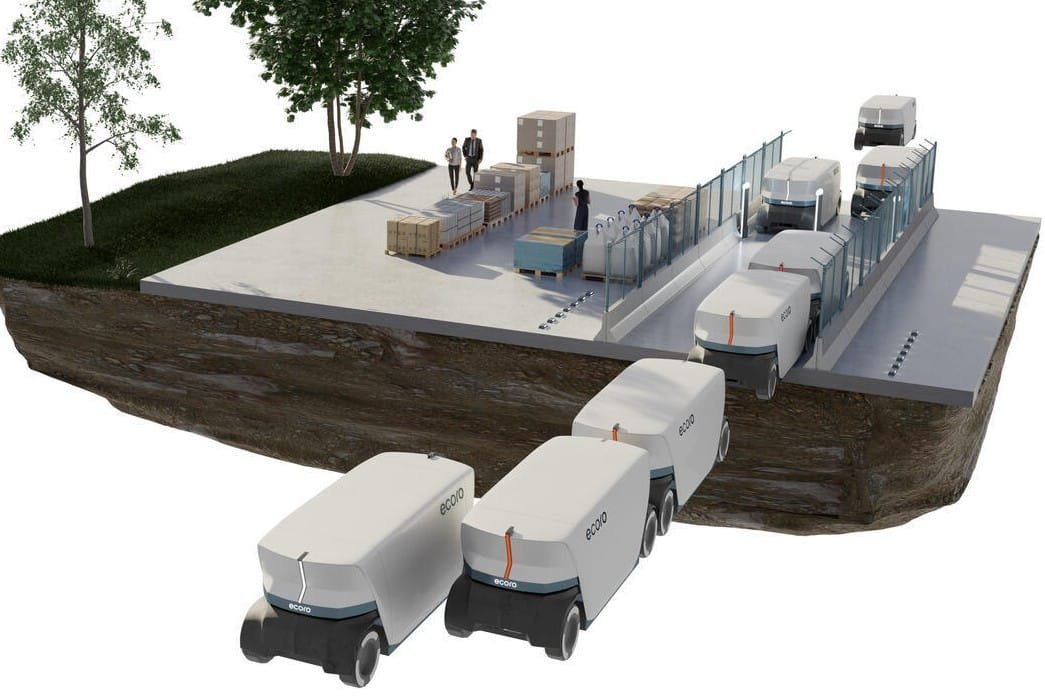
A look at the project partner Ecoro reveals that the initiative does not only concern conventional trucks or vans. The Munich start-up specializes in automated freight transport and has developed an autonomous electric shuttle for freight transport, capable of transporting four pallets with a capacity of 2.4 tonnes at speeds of up to 60 km/h. It resembles AGVs (Automated Guided Vehicles) – driverless, autonomous transport vehicles used for internal logistics, such as in automobile factories – but can also be deployed externally.
ViDeLL stands for “Dedicated Virtual Logistics Lanes”. The project aims to fundamentally improve the flexibility and efficiency of road space through innovative technologies. One idea involves “smart road markings” within an integrated system including automated vehicles, infrastructure sensors and a central control system.
“Flexible virtual solutions using optical components are economically attractive, as they enable efficient use of existing road space and require significantly fewer construction measures than physical lanes for specific vehicle groups,” explains Tarik Hadzovic, project manager at PEM.
The project partners aim to analyze suitable use cases for virtual logistics routes in urban areas and their surroundings, and to design an overall system including the installation of on-site sensors to secure the virtual road sections. According to project managers, such sensor technology is much more cost-effective to implement than equipping the vehicles themselves with sensors. Algorithms for dynamic allocation and control of virtual logistics routes based on real-time traffic data will then be developed. In addition, the researchers plan to study the interaction between automated logistics vehicles and other road users, develop a safety concept and propose solutions to regulatory challenges, as well as recommendations for adjustments to existing regulations.
The project is financed by the German state of North Rhine-Westphalia and the EU under the FEDER innovation competition “NeueWege.IN.NRW” and is expected to last until December 31, 2028. Consortium leadership for ViDeLL rests with TH Köln, together with other partners including Ecoro, the specialist supplier of ETO sensors from Stockach in Baden-Württemberg, the PEM chair of RWTH Aachen and the RWTH spin-off PEM Motion.