

As computer science student Kavya Raval learns Java programming this term, she can ask an AI chatbot to break down a tricky concept or create practice problems for her before exams. She could even ask him to give his opinion on his answers.
“It’s like I have a tutor available at any time and I can clear my doubts instantly,” said the 18-year-old.
Yet the first-year Toronto Metropolitan University (TMU) student also knows the need to be balanced and careful in using artificial intelligence tools — concepts highlighted in new TMU Library Services workshops she recently took to earn an AI badge.
Having attended “truly traditional” schools in India that banned electronic devices, Raval previously avoided AI. Now in Canada, she is happy that the workshops taught her how to leverage technology responsibly.
“AI is embedded in every area that we see, so it’s very important for us to understand what the right use of it is,” she said.
Librarians in schools and higher education already help students with their research strategies and their education in media, copyright and new technologies. This makes them perfect for teaching the power and pitfalls of AI and how to use it ethically to boost rather than undermine learning.
Yet students – from K-12 to post-secondary – lose this valuable expertise if librarians are neglected as the education sector tackles AI.

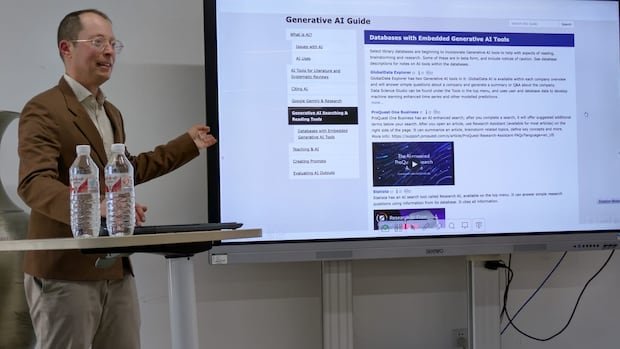
Toronto Metropolitan University Library’s learning services manager and two students provide insight into the school’s recently launched artificial intelligence workshops.
Steven Guirguis, an MBA student at TMU who juggles working in health care at the Princess Margaret Cancer Center in Toronto, said he found the library-led sessions a welcoming, stress-free space to learn, ask all kinds of questions and take time to think deeply about the concepts discussed and explored in assignments. Because they are not mandatory, he believes participants are more engaged learners.
“Any time you volunteer to learn, you naturally become invested in it,” he said. “You can approach it without having to worry about grades or anything. You can let it sink in and think about it a little better on a personal level.”
Although instructors and faculty address generative AI in courses, library workshops — inspired by growing questions from students and faculty and identified as a need by library staff — provide “an additional opportunity” and a more flexible framework for delving deeper into AI, said Reece Steinberg, TMU Library learning services manager.
“We’re really providing a way to think about using AI in a way that’s sort of separate from any specific grading or projects, so (students) can think about it and use it to apply on their own,” he said, noting a high number of registrations for upcoming sessions after an enthusiastic response from about three dozen inaugural attendees late last fall.
“Just another tool”
Known for helping people find, evaluate and use information effectively, librarians have seen their work expand to guiding people through “complex digital environments and misinformation — and mastering AI is a natural extension of that,” said Janice Kung, who recently completed a stint at the Canadian Association of Research Libraries as a visiting program officer for AI and library services.

Janice Kung, health sciences librarian at the University of Alberta, describes her approach to teaching AI knowledge.
Along with workshops like those at TMU, other Canadian higher education librarians are preparing tips on AI for instructors, developing online resources and creating modules on the topic for both faculty and students, Kung said, adding that many libraries are also working on upskilling and professional development for staff — an ongoing challenge given how quickly AI is evolving.
“We’ve been doing this forever, and that’s why I think we’re well equipped to support students in today’s AI landscape…because it’s just another tool.”
Yet Kung, a health services librarian at the University of Alberta, laments that libraries are often left out of discussions about AI knowledge.
“The library is often overlooked as a key partner,” she said from Edmonton. “We need to remind people that we have expertise. AI mastery is information mastery. It’s our wheelhouse. We’re part of the conversation.”
Reduction of teacher-librarians
Similarly, in elementary and secondary schools, teacher-librarians serve as information and media specialists, helping students and educators “unravel” and make sense of the world and what children see and hear, while also helping young people create, said Joseph Jeffery, president of the nonprofit Canadian School Libraries.
“To teach students good information skills and be able to determine what’s real and what’s not, we need to be aware of these things…and so there’s a huge appetite among teacher-librarians to learn (AI) skills so that they can keep up with the students,” he said from Prince George, B.C., where he is also a district-level teacher-librarian.

While classroom teachers tend to change each year as students progress, librarians are more consistent, Jeffery said, with some young people choosing to seek help and advice “in ways that they sometimes wouldn’t with their teachers.”
Yet budget cuts and reallocations have led to fewer dedicated library educators and a diminished role for teacher-librarians. This has contributed to a widening information and media literacy gap between those who have these specialist educators and those who do not, he said.
“Teacher-librarians don’t get enough face time with students,” Jeffery said.
“Using us for anything other than reading books, which many elementary schools do because they can’t afford a library clerk… takes away that opportunity to work with students on those kinds of things. The same is true in secondary schools, where support from teachers and librarians is often very limited.”

Toronto teacher-librarian Diana Maliszewski explains how she approached artificial intelligence in a social studies class for sixth graders, which analyzed AI-generated photos of a “typical Canadian.”
Adults may not even notice how much AI surrounds us today, said Diana Maliszewski, a teacher-librarian at a Toronto elementary school, making it even more important to introduce the topic to students — even when they’re young — in order to build a solid knowledge base.
“By addressing this problem before they’re even able to use it, we hope to give them the essential skills to be aware of it…how to deal with it and how to name it and notice it,” she said, noting that even kindergarten students can learn valuable lessons and concepts about algorithms and AI.
Maliszewski said she felt especially happy when she heard elementary or middle school students “using these naming and recognition tools” that she had taught them years before, saying, “‘I think it’s an algorithm’ or ‘the algorithm is the thing that generates this’ (from a lesson that was given in kindergarten and 1st and 2nd grade,” said Maliszewski, who is also vice president of the Association for Media Education.
“I’m excited when the speed (of AI) no longer impresses them in the same way, because they look at it and say, ‘Well, that’s good, but it looks fake,’ or ‘That gave a result, but I don’t know if I can use it.’ That’s when you know you’ve made a difference. »