

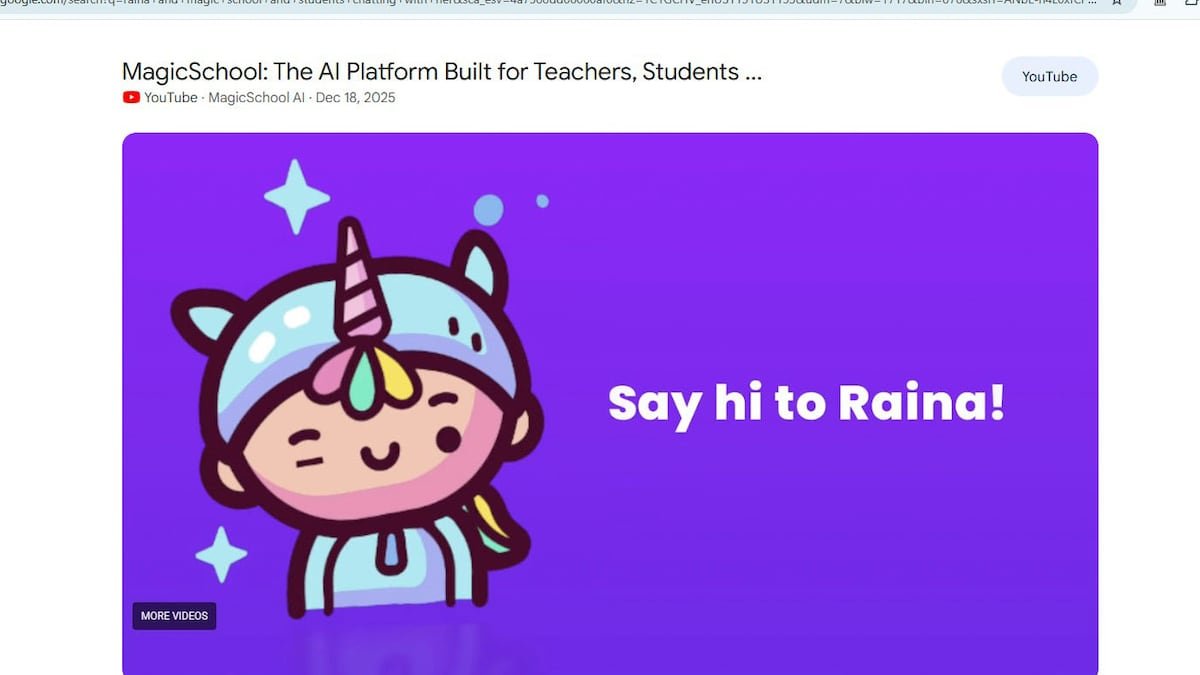

YouTube screenshot of a MagicSchool promotional video showing the AI chatbot, Raina, February 12, 2026.
Screenshot
Last month, a tech company catering to school districts removed an AI chatbot named Raina from all student-facing platforms over concerns that the companion-like robot could lead children to form unhealthy relationships with it.
Bend La-Pine Schools introduced the robot into classrooms earlier this year, but the district’s technology manager was unaware of Raina’s Jan. 28 retirement as he defended the robot in the face of public outcry this week.
Parent protests against Raina dominated a Feb. 10 school board meeting. In interviews with OPB after that meeting, the school district’s IT director, Scott McDonald, called the district’s technology approach intentional and supported students’ use of a generative AI chatbot without knowing that it had already been disabled on student iPads by MagicSchool, the Boulder, Colorado-based technology company that created it.
A group of parents recently organized a petition to protest what they see as a trend of too-rapid adoption of educational technology at BLS, Oregon’s largest school district outside the Willamette Valley. The place of AI in schools is widely debated nationally, with some districts moving toward new technologies while others moving away from them. In Oregon, each district makes its own policies. Critical parents say Bend’s overall AI policy puts responsibility on tech companies to decide what’s safe for children, although the district says control is ultimately in the hands of teachers.
MagicSchool declined to say how many other school districts across the country have Raina in classrooms interacting with students. In an email, the company said the issues raised by Bend parents are the same ones that led it to remove the student-facing robot.
“The concerns expressed by Bend La-Pine parents about how chatbots normalize unhealthy relationships during critical brain development are valid, and that’s precisely why we removed Raina from the student-facing platform last month, and it is now exclusively a tool for teachers,” said MagicSchool spokesperson Kirsten Underwood.
A “new best friend”
In its promotional videos, MagicSchool initially introduced Raina, a rainbow-haired character wearing a unicorn hat, as the “new best friend” for teachers and students.
The school district’s top technology manager learned the student robot had been shelved through OPB reporting this week, according to interviews and emails.
Before OPB contacted MagicSchool, the district’s IT director McDonald said in interviews that Raina was available to students when a teacher allowed it, even though in reality the robot had already been missing for weeks.
Usage of Raina was mixed, according to McDonald, but sufficient to “support investment in the tool.” MagicSchool’s entire platform of AI tools costs BLS$4 per student per year, according to McDonald. With more than 16,000 students currently enrolled, he said, the annual cost of the platform is estimated at more than $64,000.
McDonald disagrees with parents who say the district is rolling out new technology too quickly.
“We’ve looked carefully at all the tools we can use intentionally, and we’ve certainly moved slowly until most AI is blocked on student devices,” he said.
The district doesn’t allow student iPads to use a host of well-known tools like ChatGPT or Google’s Gemini, he added.
McDonald later confirmed that MagicSchool informed district officials of the changes to Raina in a January company newsletter.
The robot is still available for teachers, the company said. But students can only interact with a version that is not personified and has a neutral, robotic voice.
McDonald wrote in response to emailed questions that teachers can still “create and assign a chatbot that does not rely on live internet and instead responds using content curated exclusively by Magic School.”
At a crowded school board meeting in Bend on Feb. 10, parents presented Bend leaders with a letter expressing “increasing concern” about “the reliance on screens in classrooms, including individual student iPads, educational technology applications, and generative AI tools for students.” In about three weeks, parent groups collected more than a thousand signatures in support of their cause.

Parents are hosting a Bend La-Pine Schools board meeting on February 10, 2026 to push the district to reconsider technology and screens in classrooms.
Jen Baires / OPB
Parents and district technology leaders alike were unaware that Raina had already been removed from student-facing platforms before the contentious school board meeting.
“The fact that the district was unaware of this pushback further undermines the credibility of those who continue to claim that the products given to our students are well-vetted and safe,” two parents leading the charge, Natalie Houston and Annelise Cappy, said in an emailed statement to OPB.
Houston is a licensed professional counselor who works with children and adults in her Bend practice.
“One of my biggest concerns about children interacting with chatbots is that children are naturally predisposed to believe things that aren’t real, especially if they look like humans,” Houston said after the meeting.
“Run against a brick wall”
In 2023, the Oregon Department of Education announced guidelines around generative AI in schoolsbecoming the first public education agency in the country to do so. But these guidelines are not rules. The state doesn’t track which AI tools districts adopt, a spokesperson said.
State lawmakers bringing arguments about youth access to the forefront are currently considering a bill to regulate AI programs, as the bill calls for. The Oregon Capital Chronicle reported. The bill would require programs like ChatGPT to remind users more regularly that they are talking to a machine, not a human.
School board member Amy Tatom said at the Feb. 10 meeting that she was “definitely concerned” about technology in classrooms.
She highlighted iPad misuse and its ability to distract students from work as a widespread problem in schools. She said the advisory group that helps the district write technology policy should involve more expertise, including parents like Houston who know the potential pitfalls of AI.
“As someone who participated in the IT Stakeholder Working Group,” Tatom said, “it doesn’t seem like the knowledge and expertise of the people in this room are really being considered.”
Brendan Bouffard is a father of two in the district and a lawyer for Fair playa national nonprofit organization focused on children’s online safety and privacy. He is part of the district’s IT stakeholder group. Like Tatom, he felt that while the district was listening to concerns, it was not putting them into action.
“It seems like in every possible step, in every possible decision to reduce technology, we’re hitting a brick wall,” Bouffard said after the meeting. “The answer is always: invest more money in technology rather than in human relationships. And that’s very frustrating.”
Parents like Houston and Bouffard say they would like to see more options for parents who want to reduce their children’s technology use, such as tracking iPad use at school and limiting screens during class.
The district said it was in the process of collecting data on students’ iPad use, but did not have a way to track individuals’ screen time.