

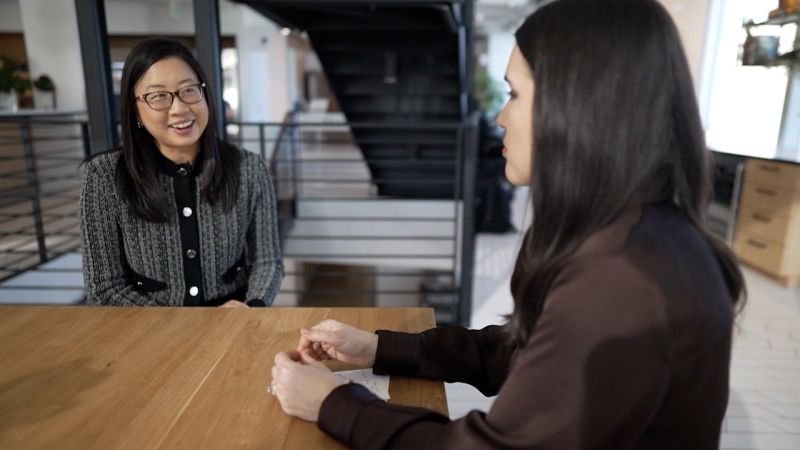
Dr. Alice Chiao taught emergency medicine to students at Stanford University School of Medicine. Today, she teaches chatbots based on artificial intelligence to think, diagnose and prescribe like her.
Chiao is part of a burgeoning new economy of professional experts in their fields who train AI through a process called reinforcement learning, essentially evaluating the AI’s responses and teaching models to improve them through trial and error. This is a rapidly growing service sector for pioneering AI labs, estimated to be worth at least $17 billion, according to Pitchbook senior AI analyst Dimitri Zabelin.
Chiao is one of tens of thousands of experts working with Mercor, one of the companies that helps run reinforcement learning for major AI companies. Mercor has contracts with experts in fields ranging from medicine, law and finance to comedy, sports and even wine. Experts can earn up to hundreds of dollars per hour by teaching AI to do its own work.
“AI is going to be the new Doctor Google, the new WebMD that people will turn to for medical information. I knew I had to be a part of that to make sure that the information is accurate, that it’s safe and that it makes sense to the person using it,” Chiao told CNN.
AI models are trained on huge amounts of data. But this training is useless without this reinforcement learning. Companies like OpenAI, Google, and Anthropic use what Mercor CEO Brendan Foody described as “large armies of people” to do just that.

Uncertainty about how AI will reshape various industries has reached a fever pitch over the past two weeks. Software stocks plunged in early February following the release of a new tool of Anthropic which adapts its model to work in specific sectors like law and finance. Then, a viral A tech CEO’s essay has swept the internet with blunt claims about how AI could disrupt employment. And some say Mercor is causing job losses, replacing stable, full-time careers with on-demand jobs that will contribute to AI eliminating human jobs.
But Chiao doesn’t see his job at Mercor as teaching the AI how to do its job. Instead, she sees it as ensuring that AI models are safe and capable enough to help doctors spend more time with patients and less time filling out forms. She sees AI potentially helping doctors read exams, fill out charts and take notes.
“The doctors were selected because we really want to help people. We want to heal. We want to spend time talking to people, listening to them and engaging them,” Chiao said. “I don’t want to see AI taking over our jobs. I want to see this as AI taking over the aspects of our jobs that prevent us from being good doctors, good healers, and good listeners.”
When Chiao trains AI models, she uses real-world scenarios she has encountered during her decades as a primary care and emergency medicine physician. This involves asking questions from both the patient’s and the doctor’s perspective. A patient, for example, might ask if their child should see a doctor for a cough or fever. But the system also needs to know how to respond when presented with medical jargon, like what a doctor might see on an intake form.
The AI model sometimes provides answers that Chiao wouldn’t have thought of herself, she said. But other times, she feels it’s necessary for professionals like herself to step in.

“Sometimes there are things that don’t really make sense, and I think, ‘Oh, that might be misleading,’ or ‘That might be alarmist,’ or ‘That’s not entirely safe to answer,'” Chiao said. “And that’s where I step in and say, ‘OK, this is where I need to create something that makes this safe, accurate and applicable to the user in question.'”
Mercor experts score a model’s response using a rubric they created after consulting with a team of other experts in their field. These responses are fed back into the model, which is trained to aim for good grades.
As for AI in medicine, Chiao said patients should use current AI model tools as a starting point before talking to a doctor. Technology does not replace a doctor like her who has 20 years of experience in the field.
“There’s an intuition that comes with experience, that comes from sitting down with a patient, looking into their eyes and seeing something that goes beyond their history, their lab values, the words that come out of their mouth,” Chiao said. “So that’s where it’s really important to know that AI is not a doctor, it’s not a human being.
The most popular experts Mercor hires are in software engineering, followed by finance, medicine and law, Mercor CEO Foody told CNN. Job postings on Mercor can vary widely, calling for everything from journalists to mechanics.

But Foody notes that not everything can be taught, and the more subjective the task, the harder it is for AI to master.
An example is comedy. Mercor tried to train an AI model to be funnier by hiring comedians from the Harvard Lampoon, an iconic humor publication from Harvard University.
“They were making all these jokes and writing all these columns about making the models better and how funny they are,” Foody said.
The problem, however, is obvious to humans but not so much to machines: people have different opinions about what’s funny.
“What you really need is better localization of how humor varies by geography, and (answering) how can we have experts who can understand what the jokes are in all these different areas,” Foody said.
Before Foody and his co-founders at Mercor set out to improve AI models in human jobs, the company had a very different goal: helping people get hired.
Mercor, which Foody co-founded three years ago at the age of 19 with his friends Adarsh Hiremath and Surya Midha, started as a recruitment and human resources platform. When they shifted the company’s focus to AI, their resume directory was the perfect starting point to find the AI experts companies were looking for.
Foody said Mercor was now paying more than $1 million a day to thousands of experts and in less than two years its revenue had grown from $1 million to more than $500 million. Pitchbook’s Zabelin said the company is valued at more than $10 billion, adding that the high values of Mercor and its competitors show investors that services such as human feedback and expert testing of AI models are becoming a permanent and essential part of how AI systems are built and improved.

Mercor is not the only company in this area. Last year, Meta invested $14 billion in Scale AI — which operates in a similar space to Mercor — bringing in its then-28-year-old founder, Alexandr Wang, as chief AI officer. Other competitors like Surge AI, Handshake and Micro1 have helped create a new class of ultra-rich young tech founders.
Although valuations fluctuate, Foody, 22, and his co-founders are likely among the youngest tech founders to make the Forbes list of billionaires since Mark Zuckerberg, who made the list at age 23.
“We were of course ambitious about what we wanted to do, but we could never have imagined something like this, especially so quickly. So it seems very surreal,” Foody said.
Foody enjoyed some perks as a young billionaire (he said he gifted his family SuperBowl tickets). But he remains focused on growing a company he sees as key to shaping the future of work, despite growing concerns about AI displacing jobs.
He says Mercor’s work is a step toward solving bigger problems.
“We have to cure cancer. We have to solve climate change,” he said. “And making everyone 10 times more productive so they are able to work better on these key issues will be a huge benefit to how we move forward as a society.”