


Content processing
- Key insight: The banking industry has underestimated the structure AI needs to be useful at scale.
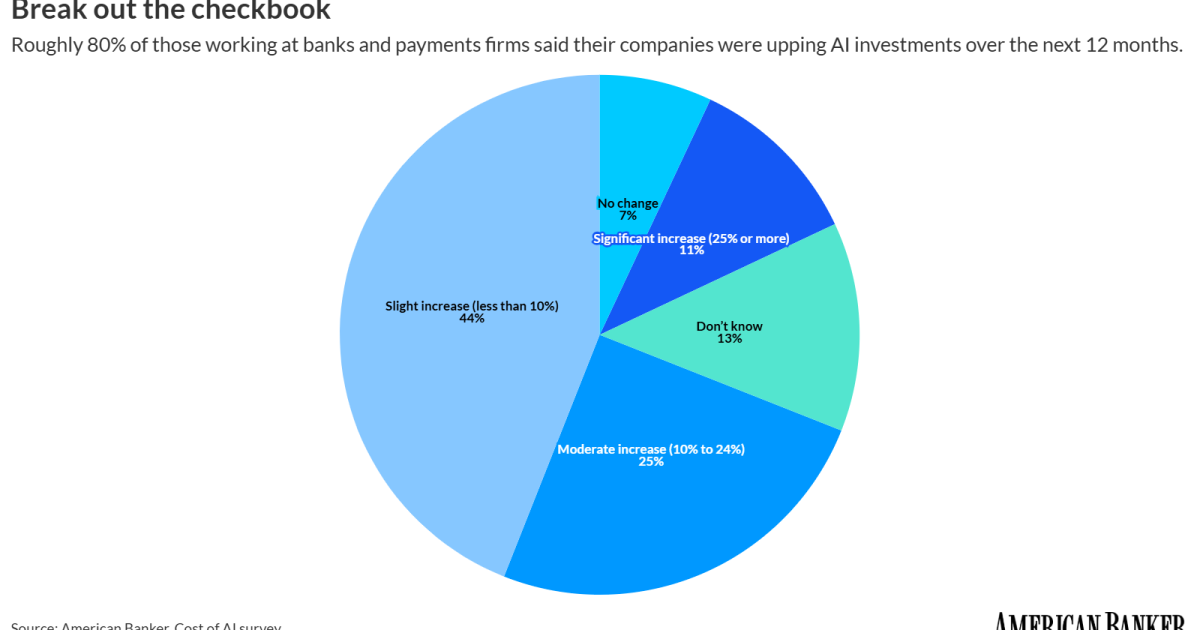
- Supporting data: Eighty percent of U.S. banks plan to increase their spending on AI.
- Prospective overview: Until perspectives and expectations change, the most powerful AI technology will fall short.
Leaked Nvidia emails reveal Bank of America employees
But Bank of America’s experience doesn’t prove that enterprise AI doesn’t work. The banks are
One of the biggest failures I see is
AI is not like traditional software. Two analysts can use the same model, with the same access to data, and achieve different results. Not because one is wrong and the other is right, but because experience dictates how the question is phrased, what assumptions are built into the prompt, and how the outcome is interpreted.
Training, like the deployment of Citi
You can teach employees to write better prompts, but you can’t eliminate subjectivity, and every bank and lender will have different policies. Institutional knowledge that AI will only know if it is integrated. When results are highly dependent on individual skills, you don’t get scalable productivity, you get variance from one analyst to another.
This inconsistency is compounded by how individuals respond to the technology itself. Some employees view AI as amplifying their capabilities, while others view it as a threat to their expertise or as increased complexity without any obvious benefit. When adoption is optional or implementation is unclear, skeptics often shape the narrative and promising pilot projects fail before reaching meaningful scale.
What’s wrong is that banks deploy extremely powerful systems but expect generalist employees to operate them securely and consistently without rethinking workflows around the technology. The result is impressive demonstrations, followed by hesitation, uneven adoption, and internal concerns about reliability.
The real risk is not that AI produces wrong answers. That’s because it produces answers that seem reasonable, but are arrived at through undocumented logic, inconsistent prompts, and ad hoc usage. If two analysts come to different conclusions using the same AI system, which one is correct? What hypotheses are approved? Which process is defensible?
These are not hypothetical concerns. These are exactly the questions regulators will be asking as AI becomes integrated into credit decisions, risk assessments and investment analysis.
Seen in this light, Bank of America’s fight is not unique. Most banks experimenting with enterprise AI face the same frictions.
The solution does not lie in more training or better prompts. It’s a reframing of responsibility. In banking, AI should not behave like a blank canvas. It must be constrained, produced and integrated into workflows in a way that minimizes individual interpretation. The system must adapt to the consistency and explainability requirements of the banking sector, and not the other way around.
This means fewer general-purpose tools and more domain-specific AI systems. More guardrails, not fewer. And move away from the idea that each employee must become an expert speed engineer.
The lesson is not that AI is too complex for banking. This is because the banking industry has underestimated the structure that AI needs to be useful at scale. Until perspectives and expectations change, even the most powerful AI technology will fail.
However, here’s the kicker; those who master this now will unlock unprecedented growth in ways that others struggle to understand or match. New market leaders will emerge as major disruptors, not because AI failed to support GPs, but because others saw AI as a fundamental change in the way they operate. They avoided treating it as an add-on and embraced the idea that people management and the way our organizations are designed are at the heart of the success of any major digital transformation.
Editor’s note: An earlier version of this story incorrectly stated that the emails came from Bank of America employees. The emails were internal Nvidia communications.