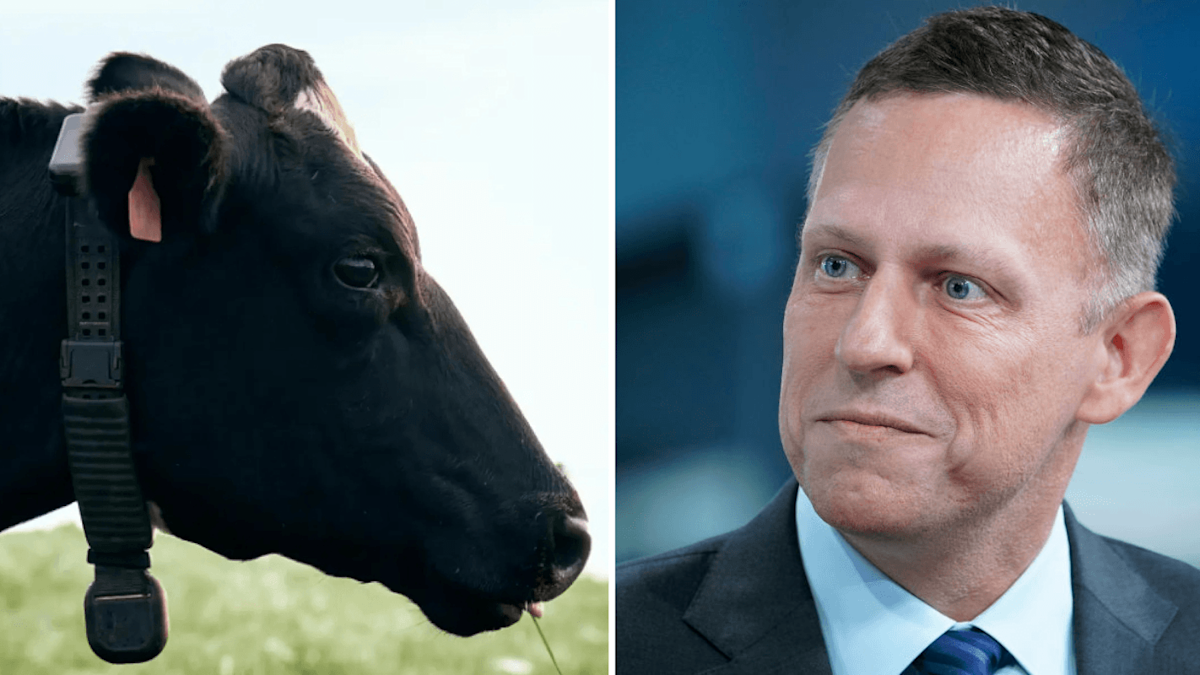
An artificial intelligence startup that makes cow collars is poised to be worth more than $2 billion — and some of the biggest names in venture capital are fighting to get in.
Halter, a New Zealand-based company that makes AI-powered smart collars for livestock, is in talks to raise a new funding round led by billionaire Peter Thiel’s founders’ fund that would double its valuation to more than $2 billion, Bloomberg reported (1). The deal is reportedly oversubscribed, with so much investor interest that the final size of the round has not yet been determined.
Halter’s solar-powered collars use AI to create virtual fences for livestock, eliminating the need for physical barriers. The collars connect to a farmer’s phone, allowing ranchers to monitor their herd’s location and health indicators through an app – and even move livestock remotely using the devices’ vibrations and audio signals.
It’s a step beyond the typical livestock monitoring collar, which typically focuses on tracking digestion or reproductive cycles. Halter’s pitch: complete herd management from a smartphone, from $5 to $8 per animal per month.
“The goal was to make pasture farming more sustainable and productive through technology,” founder Craig Piggott told Bloomberg in 2024 (1).
The company’s latest funding round raised $100 million at a valuation of around $1 billion in June, led by BOND. Halter has since opened an office in Colorado and said it is prioritizing expansion in the United States.
Halter’s momentum is notable because agtech has had a rough few years. A wave of agtech startups has declared bankruptcy and venture capital firms have largely pulled out of the sector as companies struggle to convince farmers to adopt their products amid high operational costs.
But precision agriculture – the broader push to use technology to manage farms more efficiently and reduce labor requirements – remains a rapidly growing market. Industry estimates put the global precision agriculture market at approximately $9.5 billion in 2025, and is expected to exceed $17 billion by 2031 (2). More efficient agriculture could ultimately translate into more stable food prices for consumers, although this link is still playing out.
Halter is private, so you cannot buy shares directly. But several publicly traded companies are already deeply entrenched in precision agriculture — and could benefit as the same tailwinds lift the sector.
Deere & Co. (NYSE: DE) is the closest thing to a precision agricultural indicator on the public markets. The company has an entire business sector – Precision Manufacturing and Agriculture – dedicated to space. Its See & Spray technology uses cameras and machine learning to identify and target weeds in real time, reducing the use of non-residual herbicides by nearly 50% on more than 5 million acres in 2025 (3). Deere is also getting into autonomous tractors and AI-based terrain analytics, making it the most direct large-cap play in the industry.
Learn more: 5 Essential Financial Moves to Make Once You’ve Saved $50,000
Learn more: Young millionaires are abandoning stocks. Why Older Americans Should Take Note
Merck & Co. (NYSE: MRK) is a name you might not associate with cow collars, but the pharmaceutical giant already makes them. Merck’s Allflex and SenseHub divisions reached the milestone of 2 million dairy cows monitored worldwide in November 2025, and the company sells more than 500 million animal identification tags annually (4). Merck paid $2.4 billion to acquire this technology through its acquisition of the Antelliq group in 2019 (5). While it’s only a small part of Merck’s overall business, it’s the most direct public comparison to what Halter is building — although Halter’s virtual closing capability is what sets it apart.
For broader exposure to the theme, AGCO Corp. (NYSE: AGCO) manufactures agricultural equipment and owns Precision Planting, a division focused on planting and application technology for row crops. CNH Industrial (NYSE: CNH) is similarly investing in digital agricultural tools through its Case IH and New Holland brands. And Corteva (NYSE: CTVA) focuses on crop protection and precision application technologies, including partnerships with satellite imaging and data analysis platforms.
Agtech may be in decline across the board, but noteworthy companies are still attracting significant capital. Thiel’s bet on Halter indicates that investors view precision agriculture as more than a niche, even as the industry determines which business models actually work. Between a cow-collar startup doubling its valuation in less than a year and billions flowing into public players like Deere and Merck, it’s a space worth watching.
Join over 250,000 readers and get Moneywise’s best stories and exclusive interviews first – clear information curated and delivered every week. Subscribe now.
—
We rely only on verified sources and credible third-party reports. For more details, see our ethics and editorial guidelines.
Bloomberg (1); ResearchAndMarkets (2); John Deere (3); Merck Animal Health (4); Merck (5)
This article provides information only and should not be considered advice. It is provided without warranty of any kind.