

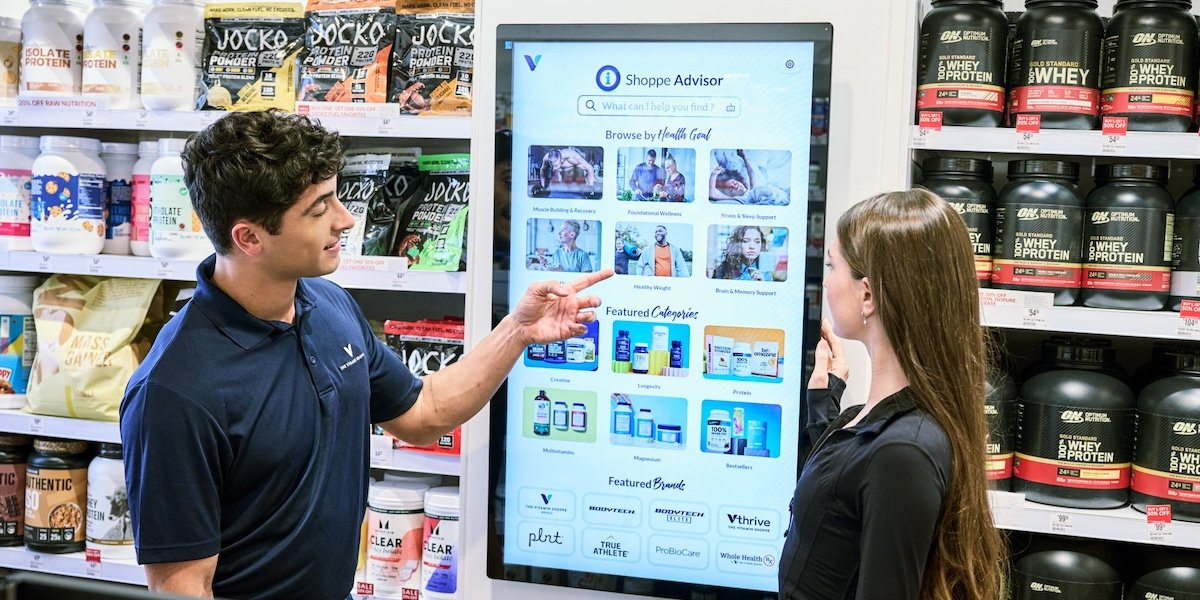
The application of artificial intelligence as a customer-facing element in physical stores is far from universal.
In February, The Vitamin Shoppe opened an “innovation store” on New York’s Upper East Side, complete with a “Shoppe Advisor” touchscreen. The AI-powered display provides product information, wellness articles and videos, and in-store and online inventory information. It aims to enable “more informed and interactive conversations throughout the shopping experience,” according to Retail Diving.
Last summer, Guitar Center launched Rig Advisor, an AI sales assistant used by customers in the store to explore and compare equipment. Customers can scan a QR code in the store and enter a question, and Rig Advisor will recommend products in stock at that specific location. Guitar Center CEO Gabe Dalporto told Modern Retail in December that Rig Advisor was designed to fill the void when a customer walks into a store and associates are too busy with other guests to help. “It’s basically everything an associate can do, on your app or on your mobile device,” Dalporto said.
These two examples alone show how AI use cases for in-store shopping, across discovery, search, and payment, can vary. Without even considering behind-the-scenes use cases, like supply chain technology and employee assistants, retailers are finding all sorts of ways to bring technology into physical stores. These range from large kiosks to mobile application capabilities, audio summaries or computer vision..
Additionally, some retailers have started deploying AI-powered screens in fitting rooms. For example, Crave Retail demonstrated its smart fitting rooms in January at the NRF conference in New York, according to a press release. Its fitting rooms feature Zebra Technologies screens where customers can get AI-based recommendations, as well as request different sizes, style assistance or product information, according to the release. The company said these screens have been deployed in fitting rooms at Victoria’s Secret, Under Armor and Foot Locker stores.
Another use of AI designed in part for use in stores is Walmart’s launch of AI-generated audio summaries on its website and app. Last year, the retailer added such audio summaries to its app’s product pages for more than 1,000 premium beauty products. The company said summaries are short, conversational sound bites that help customers compare items and make decisions with confidence, and are ideal for mobile or aisle shopping.
Yet there are not yet consistent, widespread uses of AI in physical stores. Greg Carlucci, a senior managing analyst at Gartner who consults with CMOs and digital commerce and marketing executives, said he believes there is potential in consumers’ ability to connect with salespeople in stores who can suggest products to them. According to a Gartner study, about 44% of consumers – online or in-store – are willing to let AI help them with shopping tasks, such as researching, selecting products or rearranging items.
“Brands are still trying to figure out what consumers want because it’s such a new technology,” Carlucci said. “There is currently this hesitation of the first comer to understand what will be received positively and also what creates added value. »
However, most examples of using “AI” in stores do not solely use AI technology, or it can be difficult to determine if and where AI can take into account certain shopping features.
RFID scanners like those found in Uniqlo’s self-checkout areas, for example, likely use some AI behind the scenes, said Melissa Minkow, global director of retail strategy and insights at CI&T. “You would have to use AI on the back end to quickly analyze that data and take into account replenishment needs and those kinds of things,” Minkow said.
“AI has been used for two decades in retail; it’s used in many processes, but it’s not a very front-end tool,” Minkow added. “It’s a tool to help you achieve something head-on.”
Minkow sees opportunities in areas such as color matching for further improvement. Sephora has offered skin tone matching features in stores and on its website for over a decade to help customers find the best foundation and concealer for their skin tone. In storesan associate can take photos of a customer’s face and skin to recommend products that match their skin tone.
“I personally couldn’t match colors (with AI), and yet I went to a store and asked a person, a human salesperson, to find the right match for me,” Minkow said. “This technology is iterative and requires as many inputs as possible to aggregate and become smarter. It is still in the growth phase.”