

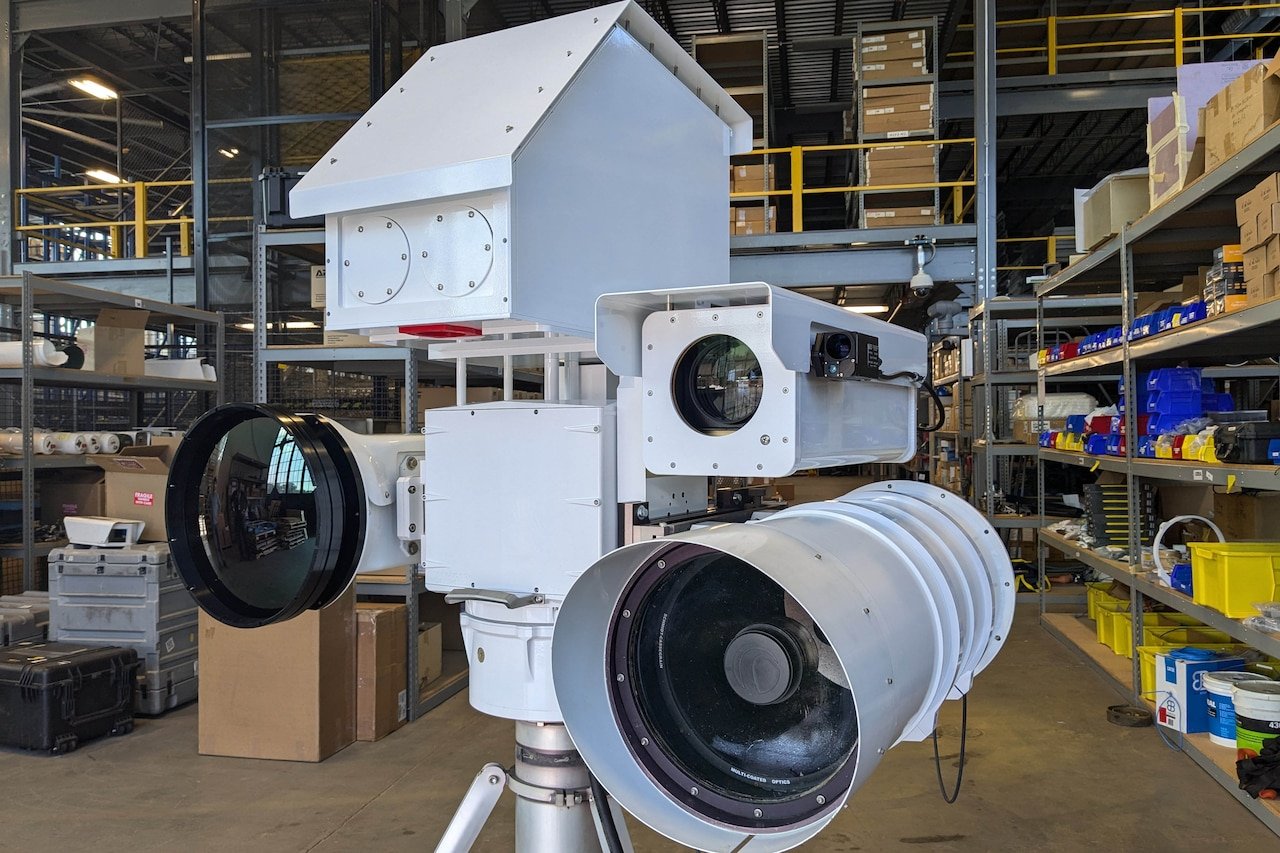
Around Washington, D.C., the National Capital Region is partially protected by an integrated air defense system installed after 9/11 to keep an eye on the skies and defend against aerial threats. It is monitored using a network of cameras and lasers currently being upgraded.
The new artificial intelligence-based visual recognition and identification system is widespread across the NCR and offers an exponential increase in capacity compared to the old system. Known as the Enhanced Regional Situational Awareness System, the ERSA system is closely monitored by the Eastern Air Defense Sector in Rome, New York.
“If we need to validate some radar data that we can’t say for sure what it is, we can use the camera system as an asset to look at that defined location to help with the validation process,” said Air Force Master Sgt. Kendrick Wilburn, New York Air National Guard member and noncommissioned officer in charge of capabilities and requirements at the Joint Air Defense Operations Center at Joint Base Anacostia-Bolling in Washington, D.C.
JADOC hosts an EADS National Guard squadron which, in partnership with the Army, operates ERSA. When there are perceived threats in the NCR, JADOC ERSA operators act as an extension of the sector to quickly assess the situation and determine whether they need to warn unauthorized air traffic to leave the Special Flight Rules area of the NCR. NCR.
The new ERSA cameras each offer a naked-eye type view called electro-optical visual, as well as an infrared view of the landscape. Made by small technology company Teleidoscope, they replace a system installed in 2002, which replaced the initial cameras installed after 9/11.
Wilburn said the new AI-enabled cameras are a huge improvement over the existing system.
“You have extended reach, you can see further. We’ve gone from standard definition to high definition. The fidelity is incredible,” Wilburn said. “On the infrared side, you have several enhanced features such as IR colorization. For example, you can use an RGB (red, green, blue) filter where… the object we’re tracking stands out via the heat signature.”
A laser rangefinder allows operators to fire an eye-safe laser at an object to measure its altitude and distance. The system also has some machine learning elements, such as an enhanced auto-tracking feature that has different locking modes.
“The system itself tries to identify what it thinks is the target, and the operator can then evaluate whether to ignore it or refine it,” Wilburn said. “The more the feature is used, the better it will become.”
He said there had been some growing pains, but that was to be expected.
“The camera itself is amazing. We were able to acquire small targets like a bird flying in all sorts of patterns. It locked on to them and held that lock,” Wilburn said. “With legacy (cameras), you would have a harder time getting the system to do that.”
“You can imagine looking at the camera quality on your iPhone from 2011 to today,” said Marine Corps Maj. Nicholas Ksiazek, Defense Innovation Unit project manager involved in the project. upgrade. “Instead of trying to stay steady in the plane…(operators) can spend more time on things that are more convenient for them…like trying to think through the intent of the plane.”
The cameras also incorporate a visual warning system, which is a laser capable of illuminating a plane’s cockpit. The new lasers are used on aircraft that are not following an assigned flight plan and are not in radio contact or in compliance with Federal Aviation Administration special flight rules.
“Non-compliant aircraft are aware that when they see the red-green laser, they should move away from the center of the flight restriction zone, or SFRA, as soon as possible and contact the FAA immediately to try to understand why we give them sparks,” Wilburn said, referring to visual warning system lingo when it’s used. “There are times when I have used it…and (offenders) react to it.”
Without this option, military aircraft would have to be deployed to investigate – a much more expensive alternative.
The Teleidoscope cameras were tested by air defense operators during the acquisition process. Two other companies were selected to create prototypes based on developed and commercially available technologies. All three systems were installed and tested in 2022.
“They were able to see what worked best in their unique scenario,” Ksiazek said.
Wilburn said the Teleidoscope’s software improvements are what set its cameras apart.
“This camera (system) felt like an upgrade, compared to the others (which) were kind of a refresh,” he said.
The Defense Innovation Unit helped Teleidoscope secure funding from the Army and Air Force. Accelerate the acquisition and implementation of innovative technologies program to quickly deploy the new camera system.
Two of the new cameras have been installed and are operational. The team is working to install seven new cameras per year in the future.