

Artificial intelligence is quietly reshaping healthcare, not by replacing doctors, but by giving them back time to focus on patients.
That was the central message delivered by Dr. Monique Diaz, regional chief medical officer for California Dignity Health, at EconAlliance’s annual dinner/future forum Thursday at Santa Maria Country Club.
In his presentation titled “AI in Healthcare,” Diaz emphasized that AI should be viewed as a practical tool that removes distractions from clinicians’ daily work.
She explained that groups like Dignity Health are using AI to automate administrative tasks, summarize massive amounts of patient data, and search for relevant medical research in real time, while prioritizing patient privacy and ethical use.
Diaz emphasized that AI is not a flashy substitute for human care, but a tool designed to allow providers to spend more time with patients.
“Doctors continue to verify information with patients, but technology saves time and helps patients feel heard,” she said, emphasizing the human connection it supports through AI.
“What we can do now is take this grainy scanned document, upload it and have it summarize the patient journey and highlight the things that were really important,” Diaz said, describing how AI condenses lengthy medical records into clear, usable summaries.
She also highlighted AI’s ability to reduce documentation burden through tools like ambient clinical scribes, which listen to patient-provider conversations, with their consent, and automatically generate clinical notes.
Diaz shared the story of a provider fully engaging with a patient suffering from depression while the AI captured every detail of the encounter:
“She looked and the entire note was written for her. It stated why the patient was there, the conclusions they made, the assessment, the plan, it was all there.”
Diaz noted that these tools are already showing measurable improvements in provider satisfaction, allowing clinicians to focus on listening and caring for patients rather than paperwork.
Beyond the summary and documentation, Diaz explained how AI can support research and clinical decision-making.
Sign up to receive headlines in your inbox!
Latest news | Local sports | Daily Headlines | Local Obituaries | Weather | Local offers
Dignity Health developed its own large, “local” internal language model through its parent organization, CommonSpirit Health, allowing clinicians to ask complex questions and receive evidence-based advice tailored to each patient, she said.
“It takes information from our medical journals, it takes information about our patients and allows our doctors, our providers, to go in there and say, ‘Hey, how should I treat this patient who is quite medically complex?’” Diaz explained.
She also discussed digital matching, in which AI compares a patient to previous cases with nearly identical characteristics to guide treatment decisions, while warning that biased data can lead to biased results.
“Every time you do anything with AI, you’re magnifying the data that you have, and if your data is biased, you’re going to amplify that bias. So I always say treat these shiny objects like any other tool at the end of the day. Will it help patients, does it pass the sniff test, and then we go from there.”
Diaz added that because AI operates on massive data sets, health systems must carefully consider privacy, consent and data management before deploying new tools.
“To participate in this type of thing, you’re expected to share your data. So I want to let you know that we’re very, very careful about this and we don’t enter into deals without really thinking about how we’re going to protect that, because we know that privacy is of the utmost importance,” she told a gathering of about 200 people.
Diaz presented AI as a practical tool that is already changing healthcare delivery quietly, responsibly and with patients at the center, rather than as a futuristic concept.
The annual dinner also recognized local organizations and businesses that are making a lasting impact on northern Santa Barbara County.
People’s Self-Help Housing received the EconAlliance Northern Santa Barbara County Impact Award for providing affordable housing and wraparound services to thousands of residents. Santa Barbara County 3rd District Supervisor Joan Hartmann presented the award, recognizing the organization’s decades-long contributions.
“For more than 50 years, People’s Self-Help Housing has done much more than build affordable housing. They provide pathways to stability, opportunity and dignity for thousands of families across the Central Coast,” she said.
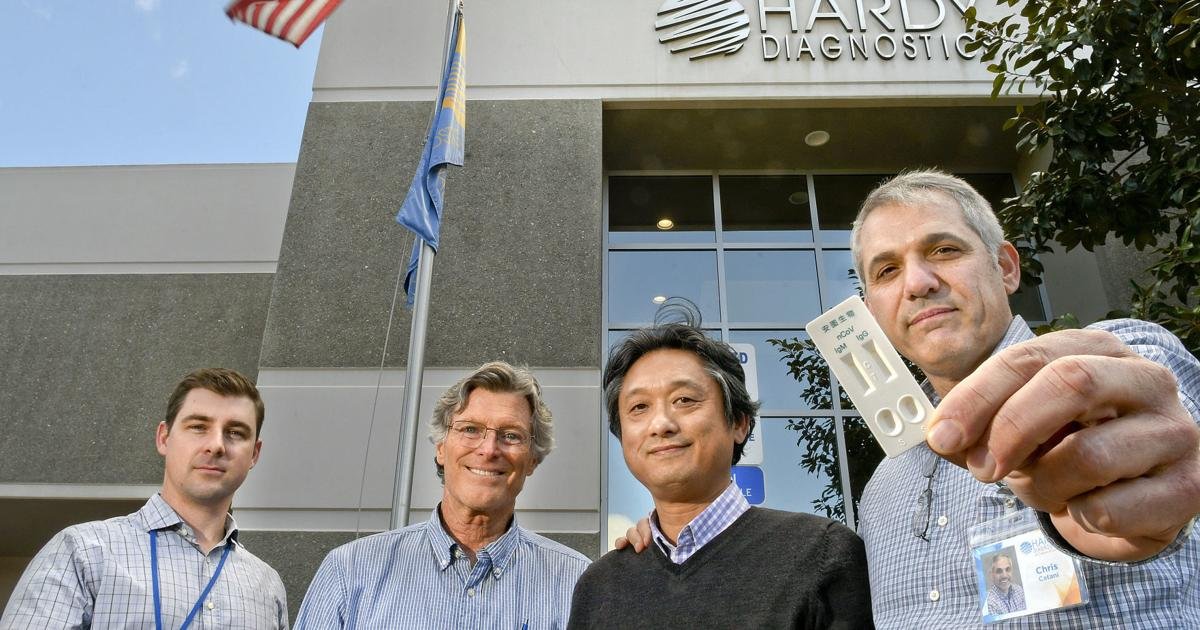
The EconAlliance Innovation Award was presented to Hardy Diagnostics, a Santa Maria-based manufacturer serving the clinical, pharmaceutical and food industries.
Founder Jay Hardy reflected on the company’s growth and its importance to the regional economy, saying “manufacturers are really, really essential to a healthy economy in the community. We import money from all over the world…and that’s what helps our entire community, allowing us to provide living wage jobs.”