

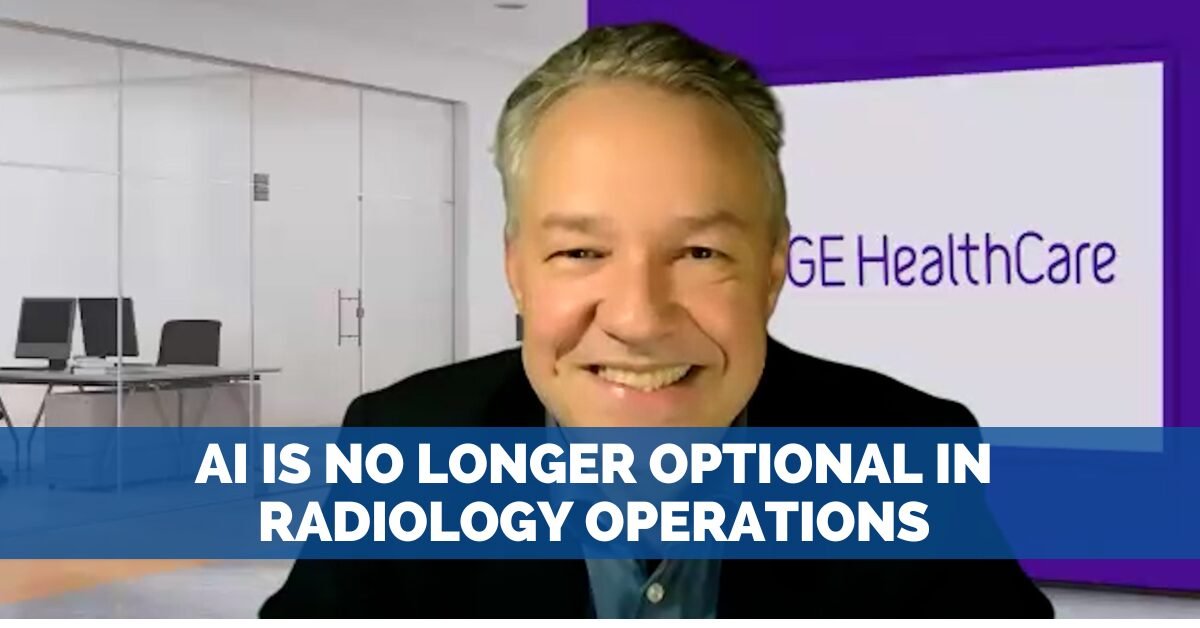
Health systems are not limited by lack of technology. They are constrained by staff shortages, growing demand and limited capacity. In imaging, these pressures are changing the way AI is evaluated and adopted.
What this conversation revealed
AI in imaging has crossed a threshold according to Roland Rott, CEO and president of Imaging at GE Health. AI is no longer a complement to efficiency, it has become a necessity for maintaining access and operational stability. To accelerate AI capabilities, healthcare must unlock the potential of dormant health data.
From optional tool to operational requirement
The adoption of AI in imaging is now driven by necessity. Rott explained it this way: “There is enormous interest and growing confidence (in AI). There is an openness on the part of health practitioners, but also health systems, to say that without AI, I can’t imagine running my operation.”
This is a significant shift in attitude towards AI in healthcare. Only a few years ago, AI was viewed with skepticism because its claims far exceeded its actual capabilities. However, faced with the reality of short staffing and growing waitlists, AI, with its power to automate administrative tasks and remove friction from clinical workflows, has become fundamental.
“Radiology teams need to save time,” Rott said. “As a leader, there is nothing I can do. It is imperative that I give my users the tools to help them care for their patients faster.”
Transform dormant data into capacity
AI is powered by data and healthcare has plenty of it. Rott, however, pointed out an interesting fact about health data: “We learned that 97% of all health data was unused until recently. »
To improve AI algorithms, researchers and companies are turning to these previously untapped data sources in healthcare.
“The beauty of AI is that it is able to process large amounts of data,” Rott said. “We can apply smarter solutions to various challenges. One of them may be (clinical) workflow optimization.”
GE Healthcare, for example, leverages DICOM data with AI tools to optimize the time of each appointment. The system reviews that patient’s history and is able to suggest extending or shortening the time frame. This means that patients who need more time are not rushed while those who can be seen more quickly create openings for other patients.
Best of all, there is no additional burden on staff. GE Healthcare’s AI tools do most of the work.
To learn more about this feature, be sure to read/watch GE Healthcare uses DICOM data and image clarity to improve radiology workflows.
What Healthcare IT Managers Ask
1. Why is AI becoming a requirement in radiology operations?
Staffing shortages, increased imaging volumes and patient access pressures exceeded what manual workflows could support. AI is increasingly being used to absorb operational pressure by reducing wasted time, automating routine tasks and improving throughput without adding staff.
2. What problems does AI actually solve for radiology departments?
AI is applied to reduce exam times, optimize appointment times, reveal workflow inefficiencies, and help teams manage more patients with the same or fewer resources. Value shows up in access, throughput, and staff workload, not just analytics.
3. How does AI use DICOM imagery and data to improve capability?
By analyzing past exam data, patient history, and scan characteristics, AI can recommend more accurate appointment times. This reduces overbooking and underutilization, helping radiology departments open capacity without extending hours.
Listen and subscribe to Health IT Today Interviews Podcast to hear all the latest information from health IT experts.
And for an exclusive sneak peek at our best stories, subscribe to our newsletter And YouTube.
Tell us what you think. Contact us here or on Twitter at @hcitoday. And if you want to advertise with us, discover our different advertising packages and ask our Media kit.
Receive new health and IT stories daily
Join thousands of your healthcare and HealthIT peers who subscribe to our daily newsletter.