

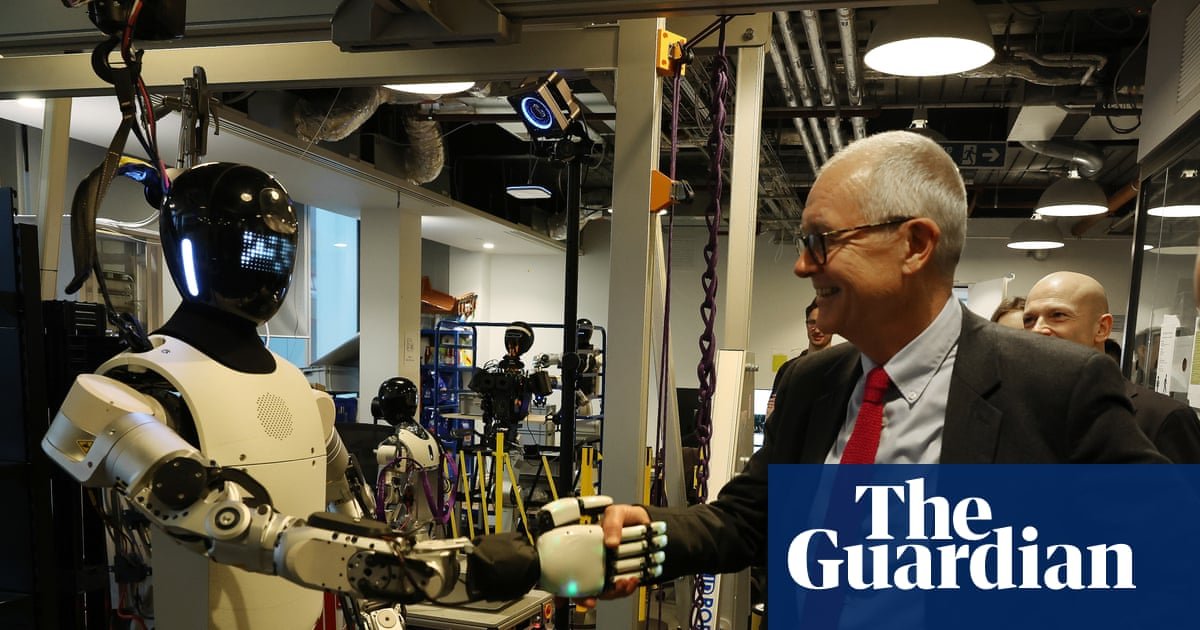
Advances in AI and robotics will transform human jobs, starting with roles in warehouses and factories, Britain’s science minister said, as the government announced plans to cut red tape for robotics and defense technology companies.
Patrick Vallance said technological progress was creating a “whole new field” for robots. “What’s really changing now is the combination of AI and robotics. It opens up a whole new area, especially in areas like humanoid robotics. And it will increase productivity, it will change human work,” he told the Guardian.
Lord Vallance spoke as a government unit helping to roll out new technology in Britain announced robots and defense would be new sectors to benefit from its support.
He said factories and warehouses, already at the forefront of robot deployment, will see further changes thanks to the new generation of humanoid robots.
“Activities that require movement in warehouses and factories, or those kinds of things that can be robotized, will become robotic. I think they will be robotized in many cases and, therefore, will change the nature of those jobs. That will be the first wave,” he said.
Meanwhile, the London Mayor Sadiq Khan warned that AI could “pave the way to a new era of mass unemployment”.
Speaking at his annual speech at Mansion House on Thursday, Khan said artificial intelligence could destroy a significant number of jobs in London unless ministers act to help replace the jobs lost by technology.
Asked to comment on Khan’s speech, Vallance said robots would remove “repetitive” tasks. “You remove some of the less interesting things, the repetitive things that can be done another way,” he said.
Vallance, the government’s former chief scientific adviser, added that the example of robotics assisting with surgery showed how technology could improve employment.
“Robotics does not replace surgeons, it radically improves the way they work and allows things to be done more precisely,” he said.
The government announced on Friday that the Regulatory Innovation Office (RIO) was expanding its remit to defense technologies and robotics, with the aim of reducing red tape for companies operating in these areas.
The Department of Science, Innovation and Technology is also providing £52 million for new hubs to drive the adoption of robotics in UK businesses. These hubs will offer businesses guidance on using the robots and live demonstrations. “The RIO will aim to streamline overlapping requirements to bring products to market safely, but faster, to improve lives and grow our economy,” he said.
The department added that autonomous drones could benefit from the RIO’s broader mandate. Such technology could require separate approvals for aviation, data protection and sector-specific security rules, in a costly process that could take months.
Vallance was speaking during a visit to Humanoid, a UK-based robotics company that has already deployed its prototypes in a factory operated by German industrial group Siemens.
Adam Kelsall, head of product management at Humanoid, said the company welcomes “anything that gets us into the real world and tests (robots) earlier.”