

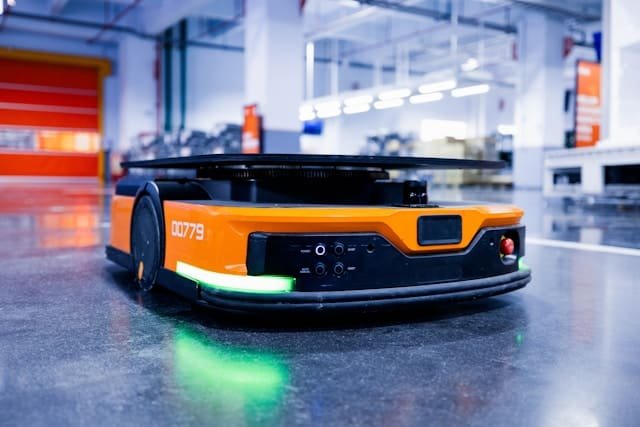
As supply chains adapt to increasing complexity, automation has moved from an optional investment to a core operational strategy. Among the most prominent technologies supporting this change are automated guided vehicles (AGVs) and autonomous mobile robots (AMRs). These systems are increasingly used to improve internal logistics, resolve labor issues, and support responsive, data-driven operations.
AGV and AMR: what is the difference?
Although AGVs and AMRs transport materials within a facility, they differ in navigation, adaptability, and system architecture.
AGVs operate on fixed routes, often guided by magnetic strips, wires or ground markers. They are better suited to predictable, repetitive transportation tasks in static environments, while AMRs use sensors, cameras and SLAM (simultaneous localization and mapping) to navigate dynamically. They can adapt routes on the fly, avoid obstacles and work efficiently in more flexible or changing warehouse configurations.
Key Benefits of Mobile Robotics in Warehousing
Mobile robotic systems deliver tangible value in operational, security and data visibility areas:
- Reduced manual labor
AGVs and AMRs automate repetitive and physically intensive tasks, reducing the risk of injury and facilitating the reliance on manual labor. - Constant flow
The robots operate continuously, without interruptions or shift changes, making material flows more predictable and easier to plan. - Optimized use of space
Especially with AMRs, warehouses can be designed with narrower aisles and denser storage systems thanks to their navigation flexibility. - Improved data integration
Many AMRs integrate with WMS and ERP platforms to provide data on performance, utilization and maintenance, enabling smarter resource planning.
Real-world industrial applications
These technologies are already providing measurable value in various industries:
Ecommerce Execution
- AMRs make it easier to prepare goods for the person, reducing walk time and improving picking rates.
- AGVs move harvested goods in bulk to shipping areas or replenish high-moving inventory areas.
Automotive manufacturing
- AGVs deliver parts to production lines just in time, supporting lean assembly processes.
- AMRs transport kits or subassemblies to workstations that vary depending on vehicle model or workflow.
Pharmaceutical production
- AMRs operate in cleanroom environments, reducing human contact and the risk of contamination.
- AGVs and AMRs enable safe, temperature-controlled handling of sensitive materials.
Third-Party Logistics (3PL)
- AMRs provide flexibility during seasonal peaks, managing preparation, sorting or replenishment tasks.
- AGVs are used for repetitive movements along stable paths, for example from arrival docks to storage.
Implementation Considerations
Introducing AGVs or AMRs into an operation requires careful alignment with facility layout, security protocols and IT infrastructure.
- Facility Mapping: AMRs require digital maps and may require updates as warehouse layouts evolve.
- Fleet coordination: A fleet management platform is often needed to manage robot traffic alongside human workers and forklifts.
- Cybersecurity: Since these systems connect to business software, secure communications and access control are essential.
Ecosystem and Integration Trends
The mobile robotics market is growing, with vendors offering closer integration with leading WMS and ERP providers. This makes it easier for businesses to integrate robotics into their existing digital infrastructure and scale deployments more efficiently.
Looking to the future: strategic role of robotics
AGVs and AMRs are increasingly becoming part of larger warehouse modernization efforts. Their ability to improve operational efficiency, support data visibility, and enable agile response to changing demands makes them useful beyond their role in automating work.
Organizations that align robotics with upstream systems, such as forecasting and inventory planning, are better positioned to navigate disruptions and optimize execution strategies.
AGVs and AMRs are practical and proven technologies for improving warehouse operations. Their modularity, affordability, and compatibility with digital systems make them accessible to a wider range of businesses, from large enterprises to mid-sized distribution centers. As warehouses continue to evolve, mobile robotics will play a central role in building more efficient, safer and more adaptive supply chains.