

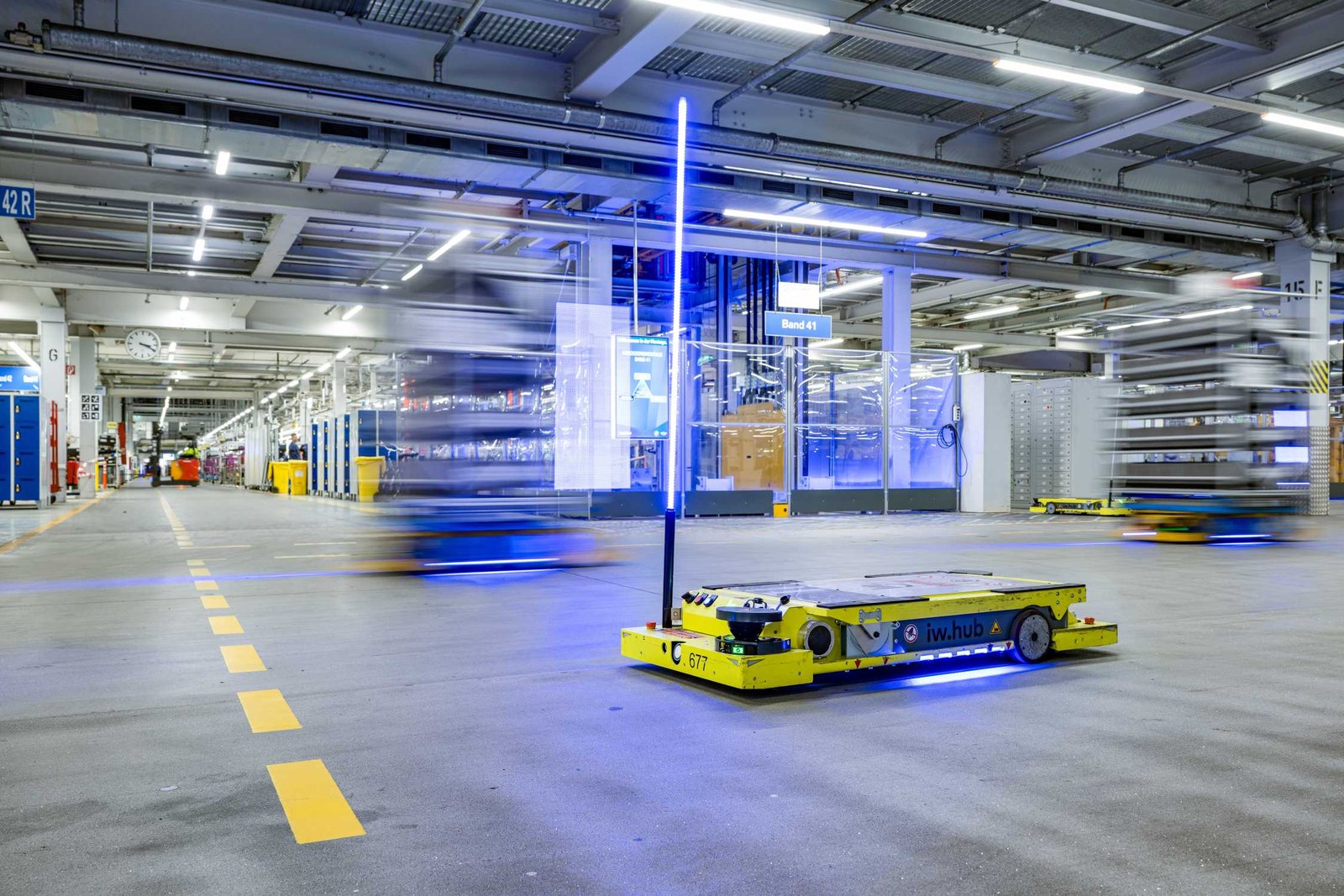
+++ Sophisticated factory logistics with 50 trailer trains and 140 intelligent transport robots make around 10,000 trips daily, delivering parts to production +++ Intelligent connectivity via a cloud-based traffic control system guarantees optimal guidance and on-time supply of parts to be assembled line according to delivery priority +++
Regensburg. Digital, automated and intelligently connected via the cloud: the BMW Group Plant Regensburg is advancing the digitalization and automation of its logistics – a further step on the road to the digital factory of the future, the BMW iFACTORY. Every 57 seconds, a new vehicle rolls off the assembly line. Each one is unique, built to the customer’s individual preferences from thousands of distinct components. Every working day, up to 1,400 BMW X1 and BMW X2 vehicles are shipped to customers around the world, including conventional combustion engine vehicles, plug-in hybrids and fully electric models.
The logistics behind this process are extremely complex: the components and spare parts required for production must always be in the right place in the factory’s vehicle assembly, at the right time – delivered “just in time” and within the right order, “just in time”. sequence” – to create individually personalized vehicles for customers. At the BMW Group site in Regensburg, this essential logistics task for efficient production is primarily carried out by driverless, automated or autonomous transport systems, intelligently connected via a cloud-based traffic control system called BMW Automated Transport Services (ATS). ). In some cases, loading and unloading of transport vehicles is also fully automated.
Depending on the transport task, different types of driverless vehicles are used. For example, automated trailer trains transport small parts from the warehouse to the assembly line, while larger components weighing up to a ton are handled by intelligent transportation robots (STR). These flat transport robots, developed by the BMW Group in collaboration with the Fraunhofer Institute for Material Flows and Logistics (IML) around ten years ago, now operate autonomously thanks to AI modules dedicated. Relying on sensors and software, the devices recognize their surroundings, allowing them to independently navigate around obstacles when oncoming traffic permits.
Transport devices are managed via the central cloud-based BMW traffic control system, ATS. When it’s time to restock, an employee on the assembly line rotates the change frame with the empty parts containers and uses it to operate what’s called a reclaim toggle. The control system then receives the signal that new parts must be delivered. In this way, the control system enables smooth and precise delivery of materials, as well as maintaining an intelligent traffic flow in the assembly hall. It also provides optimal route guidance, based on delivery priorities, and ensures that transport devices are parked sensibly and their batteries are sufficiently charged.
The BMW Group plant in Regensburg currently enables an intelligent connection between almost 50 automated trailer trains and more than 140 intelligent transport robots via the ATS control system. The fleet includes both automated and autonomous devices from different manufacturers, processing approximately 10,000 parts deliveries each business day.
“What makes this system so unique are the numerous sequenced parts specifically tailored to each customer’s vehicle. They must all be delivered in the order they were installed on the assembly line. Even a brief system failure in the delivery of sequenced parts would result in a production stoppage – and that is of course something we want to avoid,” says Thomas Dietz, Head of Process Improvement and Production Management. quality for physical logistics. “A lot of detailed work, both on hardware and software, was required to reach the current state. »
The existing fleet is continually expanded to incorporate additional transport routes and vehicles. It is also planned to gradually integrate other types of autonomous vehicles into the control system, such as autonomous forklifts or automated forklifts. “Our vision of intelligently connected logistics, relying on a variety of different autonomous transport systems that seamlessly interact with each other – from the smallest to the largest – is gradually taking shape,” explains Dietz.
The driverless logistics fleet is already supplemented by an autonomous transport vehicle recently put into operation in the press workshop in Regensburg, with a payload capacity of 55 tonnes.
If you have any questions, please contact:
Christian Dürrschmidt, Communication Regensburg,
Mobile phone: +49 151 6060 5194, Email: Christian.Duerrschmidt@bmw.de
Saskia Graser, communications manager for Regensburg and Wackersdorf,
Mobile: +49 151 6060 2014, Email: Saskia.Graser@bmw.de
Media site: www.press.bmwgroup.com
Email: presse@bmw.de
The BMW Group
The BMW Group has considered itself the benchmark for production technology and operational excellence in automobile manufacturing for decades, including at its locations in Regensburg and Wackersdorf.
The BMW Group automobile plant in Regensburg has been in operation since 1986 and is one of more than 30 BMW Group production sites worldwide. In total, up to 1,400 vehicles of the BMW X1 and BMW X2 models roll off the production lines at the Regensburg plant every working day – destined for customers all over the world. Different types of drivetrains are manufactured flexibly on a single production line – from vehicles with internal combustion engines to plug-in hybrids and fully electric models.
The high-voltage batteries for the electric models built in Regensburg are also produced locally, in the direct vicinity of the automobile factory. They are assembled in the electrical component production plant, opened in 2021 at the Leibnizstrasse site.
The BMW Innovation Park Wackersdorf is also part of the Regensburg location. The 55-acre campus built in the 1980s was originally intended to serve as a nuclear reprocessing facility. The BMW group has established its cockpit production there, as well as its supply of spare parts for foreign factories. Besides BMW, which is the largest employer, several other companies are also based at the Wackersdorf Innovation Park. In total, around 2,500 employees work there. The BMW Group’s core workforce at the locations in Regensburg and Wackersdorf in eastern Bavaria numbers around 9,250 employees, including more than 300 apprentices.
www.bmwgroup-werke.com/regensburg/de.html