

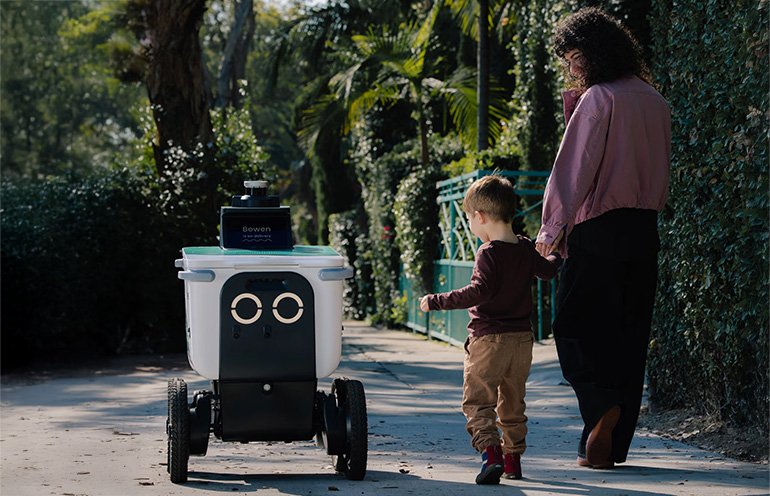
The CEO of Serve Robotics, which makes delivery robots, says AI and robots should be designed to delight people. Source: Serving Robotics
In the 1890s, bicycles were considered dangerous machines that could cause illnesses, including appendicitis and so-called “bike face.” Today, many people make similar claims about AI.
After three years of enthusiasm, the novelty has worn off and we are starting to see articles suggesting that AI is making people stupider, that it is ruining society, or that it is causing mass delusion.
As the founder of three artificial intelligence startups over the past 13 years, I am unabashedly optimistic about the “Cambrian explosion” of AI inventions. I believe that AI and robotics – the ultimate physical manifestation of AI – have the potential to make enormous positive differences in our lives in ways that we can barely imagine today. I also recognize that many people are increasingly nervous about it.
This is an encouraging sign: it means people recognize the power of AI. Technology leaders have a responsibility to respond to this awareness productively, not by arguing, but by creating products so useful, beneficial, and even charming that people cherish the opportunity to interact with them.
We are more than capable of addressing the risks in order to realize the benefits of AI, which will far outweigh its drawbacks. Here are four steps to building AI products people love.
1. Start with what people need
First, the classic design principle: start by focusing on what the user needs, not what the technology can do. It’s too easy to find a solution in search of a problem.
At a previous startup, we were testing a competitor’s AI product that analyzed household electricity consumption to detect costly problems. A week after installing it, a colleague received an alert: his pool pump was broken. The problem ? He didn’t have a swimming pool!
Our product was different. When we onboarded new customers, we simply asked them to choose the appliances they owned from a list. One of my engineers at the time protested: “It’s cheating!” As if using a checklist, instead of millions of AI parameters, is somehow unworthy of an AI-powered startup.
Sometimes as engineers we get caught up in the thrill of solving a difficult problem or using a shiny new technology. Focusing on user needs often leads to simple changes that significantly reduce complexity for everyone.
2. Understand the benefits of AI
With any new technology, understanding how to use it well starts with knowing its limitations: how and when will this technology fail, and what do we do when it fails?
For AI, we can often measure failure along two dimensions:
- False positives: A system alerts you to a pool where one does not exist or stops one autonomous vehicle for an imaginary obstacle.
- False negatives: A system may fail to detect the unnecessary energy consumption of a real swimming pool, or a self-driving car may fail to stop in front of a real obstacle.
“Precision” is a measure of false positives and “recall” measures false negatives.
Here’s the key idea: AI can be optimized for either precision (fewer false positives) or recall (fewer false negatives). But optimizing for both is extremely expensive and time-consuming.
There are a few apps, like robotaxiswhere optimizing both is so important, for security reasons, that it is worth investing tens of billions of dollars in research and development. For the rest of us, the key to creating useful AI products lies in making smarter design decisions. And to do that, we first need to decide: should we optimize for precision or recall?
We built our home power product to recover whenever something wastes energy. In other words, it was good at recall. But we knew that stupid mistakes like identifying a non-existent device (poor accuracy) would destroy customer trust.
Instead of trying to increase accuracy at great expense, we simply asked the customer what devices they owned. Problem solved.

3. Empower people to help AI
Think about how robots can complement human effort and free people from mundane, dangerous, or difficult tasks. Too often, the debate around AI and robotics focuses on whether they will replace humans. This neglects the possibility of humans and AI working together. Humans can help AI with the inevitable trade-off between precision and recall.
With a well-designed product, each side complements the other. We can build AI to detect what humans struggle to notice, like unnecessary electricity consumption patterns, and achieve great results by focusing on precision or recall.
Meanwhile, humans can be responsible for the other dimension, such as knowing what devices they own, which is difficult for AI. By freeing people from difficult, tedious, or time-consuming tasks that they don’t want to do, such as analyzing data for anomalies or scanning text for typos, AI can allow them to engage in more rewarding and enjoyable work.
If your product does all of this, congratulations: you’ve gone further than many products ever have.
4. Exceed expectations
However, a crucial final step is necessary to truly win people’s hearts: you must go beyond the basics and add something astonishingly wonderful.
It’s hard to predict what it will be, but you’ll know it when you find it. For example, with smart speakers, the main function is to play music. The unexpected aspect is that they can tell jokes and play games, making them endlessly entertaining for children.
For the friendly delivery robots that my company, Serve Robotics, makes, adding flashing “eyes” and individualized names, people saw them as cute creatures rolling down the sidewalk. It has nothing to do with delivering burritos, but the names and eyes humanize them.
Children go out of their way to talk to the robots and adults cross the street to take photos or even give them hugs. This is especially important because the people who most often interact with our bots are not our customers at all. They are just regular passers-by.
Like the bud vase in a VW bug, it’s the charming detail that takes a product from simply good to delicious.
Delight will make the difference for AI and robotics
AI offers limitless possibilities to rethink and reshape the way we do things in almost every field. Over the next few years, there will be disruptions and unintended consequences, as with any technological revolution. But there will also be incredible advances that will improve our lives in many ways.
While we can’t predict every advancement, we can shape how they unfold by ensuring that AI development serves human flourishing rather than just technological progress.
It may sound like an optional “extra,” but today’s AI-powered products need to feel good, just like bicycles in the 1890s needed pom-poms on the handlebars: they’re the key to getting people to like them, leading to widespread adoption, success, and better lives for us all.
About the author
 Ali Kashani co-founded Serving robotics in January 2021 and has since served as CEO and member of its board of directors. Before that, he was vice president of Postmates Inc., an on-demand food delivery platform.
Prior to Postmates, Dr. Kashani was co-founder and chief technology officer at Neurio Technology Inc., a smart home technology company acquired by Generac Power Systems Inc. He is an inventor with 15 granted or pending patents.
Kashani received his Bachelor of Science in Computer Engineering and PhD in Robotics from the University of British Columbia and was awarded the Alexander Graham Bell Canada Graduate Scholarship from the Natural Sciences and Engineering Research Council of Canada. He was invited to The Robot Report Podcast in March.