

California is the world’s fourth-largest economy, the birthplace of technology, the leading tech talent pool, and home to the nation’s most valuable technology companies, most successful pre-seed startups, and 33 of the 50 largest private AI companies in the world. California is in a unique position to benefit from this talent, and today Governor Newsom is expanding his engagement with some of the brightest minds in global technology policy to advance California’s work.
Engaging California’s best and brightest talent to advance responsible AI
The Governor today announced the launch of the California Innovation Council, which leverages the collective knowledge of the nation’s top technology policy experts to help California develop and strengthen its technology policy. The council will address issues ranging from empowering workers to combating tech fraud to protecting children online. Participants include former U.S. Senator Laphonza Butler, the Stanford Institute for Human-Centered AI, the UC Berkeley Office of the President, the Mozilla Foundation, the Brookings Institute, the California Chamber of Commerce, and more. A full list is below.
“For too long, ‘move fast and break things’ meant breaking trust, breaking communities, and breaking democracy itself. California is charting a different path: moving deliberately and building things that actually work for people.” said Nabiha Syed, executive director of the Mozilla Foundation. “Our mission has always been to prove that you can imagine and innovate without exploitation. The Mozilla Foundation is honored to be part of this Council that embodies these principles exactly at the scale and time when it is needed most.”
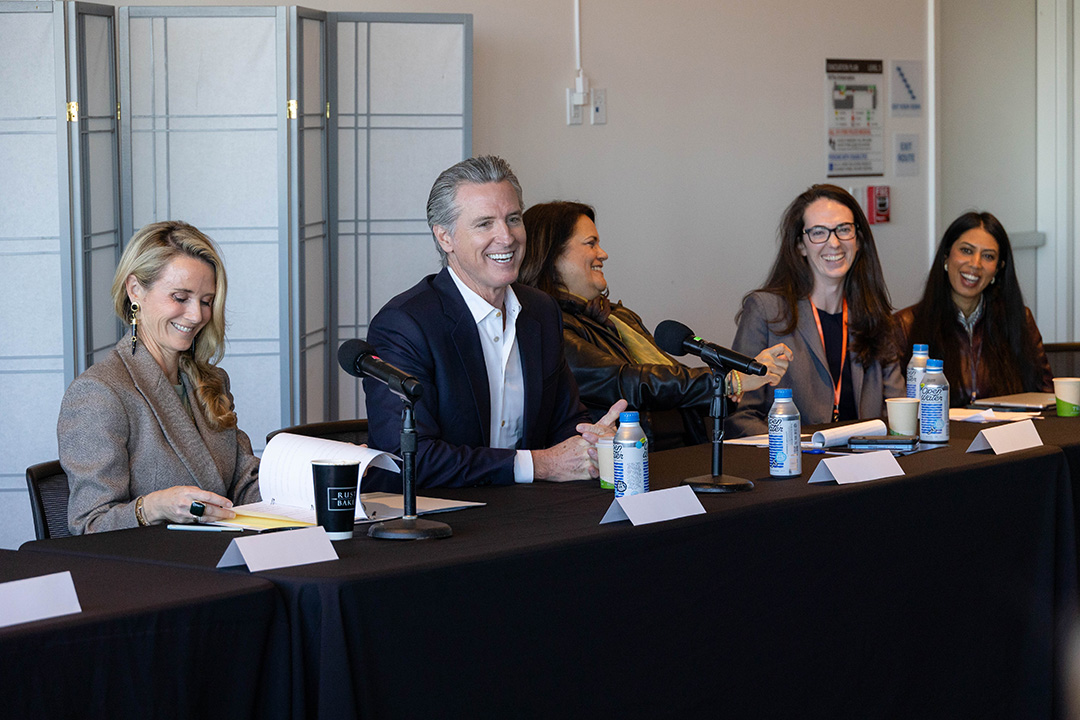
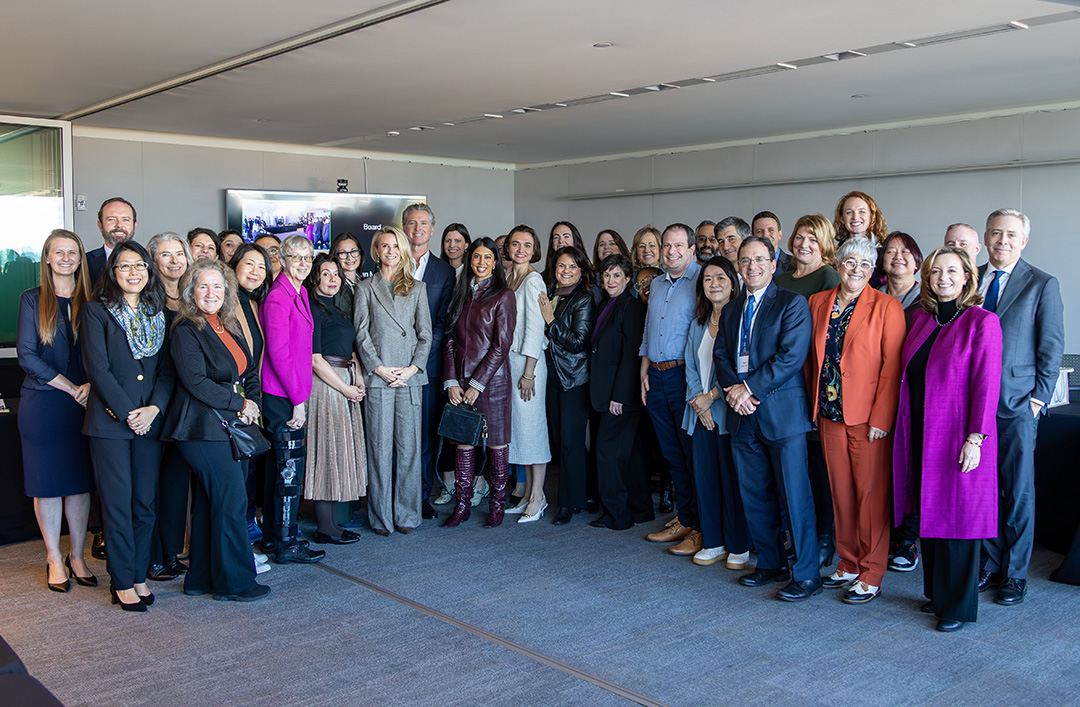
Governor Newsom and First Partner Jennifer Siebel Newsom convened the Council for an inaugural meeting hosted by the Mozilla Foundation at the Commonwealth Club of San Francisco. There, the groups were divided into four working groups:
-
Protecting Children’s Safety Online and Combating Image-Based Abuse (led by inaugural partner Jennifer Siebel Newsom of the State Board of Education and the California Department of Technology)
-
Fighting tech fraud (led by the Business, Consumer Services and Housing Agency)
-
Modernizing Government Service Delivery (led by the Government Operations Agency, including the California Department of Technology and the Office of Data and Innovation)
-
Technology, Economic Development and Workforce (led by the Governor’s Office of Business and Economic Development and the Labor and Workforce Development Agency)
New partnerships to modernize government services
The Governor is also launching a new Emerging Technologies Accelerator today, creating formal partnerships between the state and the Stanford Institute for Human-Centered AI, UC Berkeley, the Mozilla Foundation, the Tech Talent Project, US Digital Response and Nava Labs. The organizations will work with the state, through GovOps, the California Department of Technology and the Office of Data and Innovation, to design, develop, deploy and evaluate products that modernize government service delivery.
Introducing Poppy. AI to facilitate the work of civil servants
Governor Newsom recognized the role of AI in advancing and improving government services – and in solving problems to improve the lives of Californians. In 2023, Governor Newsom issued an executive order directing agencies to begin responsible adoption of generative artificial intelligence (GenAI), explore beneficial uses of GenAI, and streamline procurement to help the state rapidly test new GenAI solutions.
To help meet the governor’s directive, the California Department of Technology launched a new AI tool, Poppy. Poppy is built on the large GenAI language models and is specifically designed for use by state government, with more than 20 state departments already involved in its development and testing.
Poppy provides additional security through the state network. Poppy, which uses 11 different AI models, provides additional security to protect state data on the state network, leverages the state’s public data to reduce risk, and leverages state servers to reduce costs. It includes predefined, easy-to-use queries tailored to the common needs of businesses across the state, facilitating more reliable and trustworthy results. It does not use the personally identifiable information of Californians.
“We want to empower every state employee to leverage AI to support their work. This tool is built around our statewide business processes, aligned with our values, and designed to make government work more effective,” said Liana Bailey-Crimmins, state information director and CDT director. “Poppy can accelerate the adoption of GenAI across California and allow our teams to focus on what matters most: delivering real results for the people we serve.”
New training and scholarships in AI
Also in response to the governor’s executive order, the California Department of Human Resources, Office of Data and Innovation, and Department of Technology have developed more than 20 AI training courses for state employees, including responsible AI adoption training, a five-course AI “certificate,” and AI boot camps. The state is also collaborating with UC Davis, Sacramento State and Cisco to provide training on GenAI adoption, ethics and governance. To further strengthen the state’s AI capacity and build a pipeline of leaders in responsible public sector adoption of AI, the California Department of Technology has launched new emerging technology fellowship programs with the Center for Research on Information Technology in the Interest of Society and the Banatao Institute (CITRIS) at the University of California, as well as the Family Center for Ethics in Society at Stanford.
Cradle of modern technology
California works closely to foster technology leadership and create an environment where industry and talent thrive. This is why California is home to the most technology companies in the country. California is the global leader in technology and balances its work to advance AI with common-sense laws aimed at protecting the public, while embracing technology to make our lives easier and government more effective, efficient and transparent. California currently has laws that help:
Governor’s Council for Innovation
Protecting children’s safety online and tackling image-based abuse
Led by the Office of the First Partner (OFP) with support from the California Department of Technology (CDT) and the State Board of Education (SBE).)
- Cailin Crockett, Senior Consultant, Global NCII Clearing Center
- Adam Dodge, Founder, EndTAB
- Katya Hancock, CEO, Young Futures
- Sunny Xun Liu, research director, Stanford Social Media Lab
- Larissa May, Founder and Executive Director, #HalfTheStory
- Candice Odgers, director of research and faculty development, School of Social Ecology, UC Irvine
- Sharon Olken, board member of the National Council of Education
- Jenny Radesky, Co-Medical Director, American Academy of Pediatrics, Center of Excellence for Social Media and Youth Mental Health
- Derek Slater, co-founder, Proteus Strategies
Modernizing government service delivery
Led by GovOps, including CDT and the Office of Data and Innovation (ODI)
- Jennifer Anastasoff, founder and executive director, Tech Talent Project
- Krista Canellakis, program director, US Digital Response
- Geneviève Gaudet, design director, Nava Labs
- Dan Ho, Professor and Reg Lab Director, Stanford University
- Tara McGuinness, Founder and Executive Director, New Practice Lab, New America
- Deirdre Mulligan, professor in the School of Information at UC Berkeley and director of the Berkeley Center for Law & Technology
- Nabiha Syed, Executive Director, Mozilla Foundation
Technology, economic development and the workforce
Co-led by the Governor’s Office of Business and Economic Development and the Workforce and Labor Development Agency
- Laphonza Butler, former United States senator
- Ronak Daylami, Vice President for Advocacy, Privacy, Cybersecurity and Emerging Technologies, California Chamber of Commerce
- Molly Kinder, senior scholar, Brookings
- Julianne McCall, CEO, California Council on Science and Technology (CCST)
- Katherine Newman, Provost, UC Office of the President
- David Onek, CEO, Silicon Valley Social Venture Fund (SV2)
- Angie Wei, former Secretary of Legislative Affairs, Governor Gavin Newsom
Fight against technological fraud
Led by the Business, Consumer Services and Housing Agency (BCSH), including the Department for Financial Protection and Innovation (DFPI)
- Kate Griffin, Director, Inclusive Financial System, Financial Security Program, Aspen Institute
- Carole House, Senior Researcher, Atlantic Council
- Johnette Jauron, Cybercrime Section Chief, California Department of Justice
- Ted Mermin, Director, California Low-Income Consumer Coalition (CLICC)
- Leigh Phillips, President and CEO, Saver Life
- Kathy Stokes, Director of Fraud Prevention, Fraud Watch Network, AARP
- Erin West, Founder and President, Operation Shamrock