

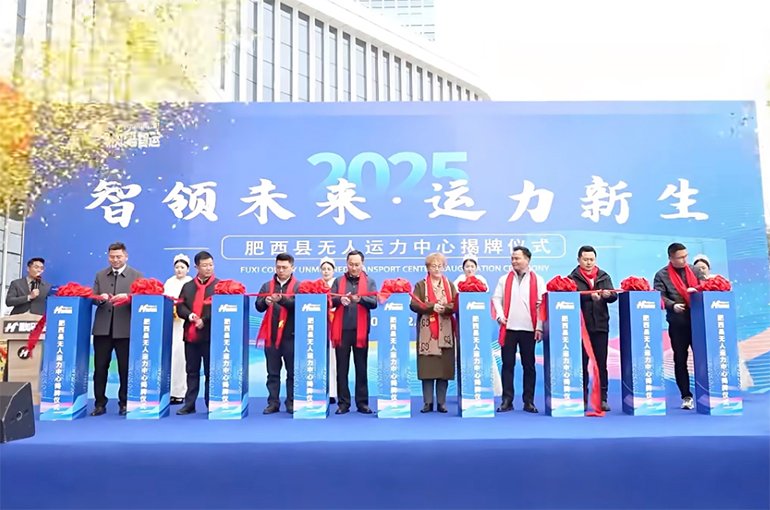
(Yicai) Dec. 15 — China’s first unmanned transportation center has officially started operations in Hefei, capital of eastern Anhui Province, aiming to help users reduce logistics costs and achieve profitability through the large-scale adoption of unmanned logistics vehicles.
The center relies on Level 4 autonomous logistics vehicles and customized scenarios and can realize automated operations across the entire chain from route planning to unmanned delivery, Li Jian, president of Heizhima Smart Transport, the center’s technology and operation service provider, told Yicai.
As the country’s first transportation center focused on the large-scale commercial application of unmanned urban delivery vehicles, the Hefei center integrates various intelligent service capabilities, including unmanned logistics solutions, high-precision map management, cloud-based real-time dispatch, remote monitoring, intelligent data analysis, and vehicle operation and maintenance.
Unlike previous unmanned transportation capabilities, which were limited to relatively closed spaces, the Hefei center will cover the entire city and meet the needs of end users, providing services in various commercial delivery scenarios, such as express parcel delivery, university services and park logistics, Li said.
Operating the center will increase the scale of unmanned delivery services, and the scale effect will enable demand to benefit from the use of unmanned delivery services, Li noted. “The purpose of the center is to promote the cost-effectiveness of unmanned logistics.”
The Hefei center positions itself as a “transportation service provider,” allowing companies with delivery needs in the city to benefit from on-demand unmanned transportation services rather than purchasing and maintaining expensive unmanned vehicles themselves, Li said.
The “transportation capacity as a service” model will lower the threshold for companies to use cutting-edge technologies, Li noted. For customers in industries such as e-commerce, retail and manufacturing, using the center’s unmanned services will likely reduce their overall logistics costs by around 60 percent.
Hefei has basically carried out large-scale testing and demonstration applications of functional unmanned vehicles, an informed source told Yicai. However, even though there is market demand for unmanned vehicles across the city, many enforcement challenges remain, they added.
To become the top player, Hefei needs to continuously improve the technology and operation management model of driverless vehicles in real-world application scenarios, another industry insider said.
The sales volume of low-speed autonomous driving vehicles in China is expected to exceed 47,000 units, with a revenue of CNY 18.5 billion ($2.62 billion) by this year, according to Low-Speed Autonomous Driving Industry Research Institute New Strategy. Their sales volume will likely reach 95,000 units, with a revenue of over CNY 41 billion, by 2030.
Editors: Tang Shihua, Futura Costaglione