

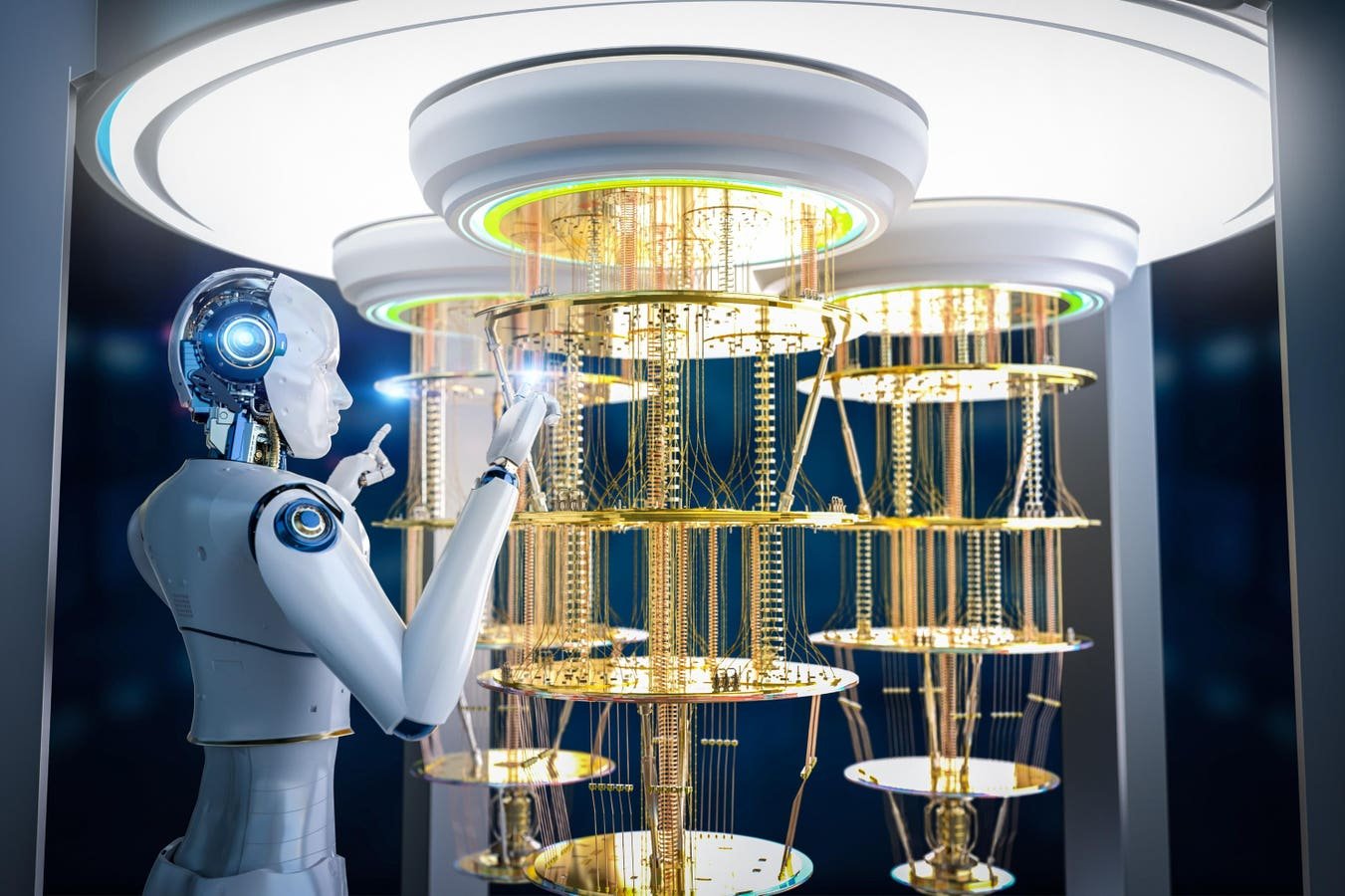

Quantum machine learning technology with 3D rendering, quantum machine and humanoid robot controlled cognitive algorithms
getty
We are currently experiencing a significant technological and industrial revolution. Artificial intelligence and quantum computing are no longer just ideas only talked about in research papers or labs. They are changing how businesses manage real-time risk, as well as cybersecurity, national security and economic competitiveness.
These converging forces present challenges, as the growth of cybersecurity, the looming impact of quantum decryption, and the cultural issues businesses face when adopting disruptive technologies require new thinking and adaptation. The fact is that technological change is advancing faster than our institutions, our policies, and the readiness of our workforce.
Cybersecurity was never meant to be part of the original design of the digital world, from its inception to the rise of AI and quantum technology.
In recent years, the scale and velocity of risk have evolved significantly. The barrier to enemy entry has been lowered thanks to artificial intelligence, while at the same time the attack surface has been expanded. Quantum computing, on the other hand, poses the risk of undermining the cryptographic foundations responsible for ensuring the security of everything from government communications to financial transactions.
A technique sometimes called “harvest now, decrypt later,” it is already impacting how nation states collect data today in preparation for future decryption skills. This issue, both geopolitical and technological, has long-term implications for economic sovereignty, defense systems and intellectual property.
The prospects and risks of quantum computing
Futuristic central processing unit. Powerful Quantum processor on PCB motherboard with data transfers.
getty
Quantum computing represents a major change in the history of computing. Once adequately powered systems are operational, commonly used encryption standards, such as RSA, will be susceptible to vulnerabilities. “Q Day,” as it is commonly known, could arrive sooner than expected.
Quantum, on the other hand, should not be considered a threat in itself. The use of quantum technologies will also enable significant advances in sensing, optimization, materials science and secure communications, as I discussed in Skytop Media. Quantum-enhanced sensors and space-based systems, for example, have the potential to significantly improve navigation, supply chain surveillance, and national security.
Organizations are beginning to include quantum readiness in their long-term planning, and quantum-resilient infrastructure should become a compliance priority. Understanding that quantum is not an isolated phenomenon but rather a constant diffusion of capabilities is a difficulty for those in positions of responsibility. Photonics, quantum algorithms, and hybrid classical-quantum systems are all examples of technologies already being implemented today. If an organization waits until quantum computing is “fully mature” before beginning preparations, it will find itself at a strategic disadvantage.
Artificial intelligence is the pinnacle of dual-use technology
Computer chip labeled “AI” on a circuit board. The scene is lit by a cool blue glow, highlighting various circuit pathways and components surrounding the chip. It visually represents the concept of artificial intelligence technology embedded in hardware, suggesting advanced computing power and digital innovation.
getty
Currently, artificial intelligence is the most powerful dual-use technology. AI systems are evolving towards more autonomous and goal-oriented systems capable of formulating strategies and implementing actions. The rapid adoption of AI has led to increased risks of data exposure, requiring smarter controls and more robust defense mechanisms. This is expected to become both an attacking and defensive boundary.
Adversaries are already using artificial intelligence to automate phishing attacks, create deep fakes, and identify weaknesses at machine speed. At the same time, defenders are implementing artificial intelligence to improve threat intelligence, automate patching, and make incident response more efficient.
Artificial intelligence serves as a force multiplier for both adversaries and defenders in the cyber landscape. What will differentiate resilience from disaster will be governance, strategy and human oversight. These factors will determine resilience. Rather than playing the role of human judgment, artificial intelligence should continue to function as a tool.
Agentic artificial intelligence, which can operate autonomously without requiring constant input, raises some very important questions. Companies are adopting these systems faster than they can understand the consequences. Without clear guidelines, understanding and accountability, risks increase quickly.
Space business and security
A blue digital globe showing Europe, Africa and Asia. The globe is surrounded by swirling communication lines and the background of the image features lines of text with IT industry keywords.
getty
The lack of analysis and control of space infrastructure is highlighted as a growing potential cybersecurity danger to monitor between now and 2030. Space infrastructure is becoming an increasingly important target.
One of the major future threats to cybersecurity that should be monitored between now and 2030 is the lack of analysis and management of space infrastructure. This is a growing target for cybercriminals.
It is increasingly important to protect this infrastructure against physical and cyber threats, although some numbers are limited in the data currently available. The growing reliance on space assets for communications, intelligence and national security means that securing this infrastructure is becoming increasingly important.
New risk equation for CISOs
risk word isolated on internet digital background
getty
There has been a significant change in the responsibilities of the information security manager. Previously considered a technical support duty, the Chief Information Security Officer (CISO) is today considered a senior executive responsible for safeguarding the company’s value, reputation and operational continuity.
A significant number of chief information security officers (CISOs) have no budgetary authority, despite being under relentless pressure from regulators, boards of directors, and adversaries. Burnout is a widespread phenomenon. More technology is not the solution; Rather, the solution lies in better risk management, more transparent governance and stronger alignment between security, business strategy and leadership within the organization.
These days, risk can be summed up simply: threat multiplied by vulnerability multiplied by consequence. Artificial intelligence (AI) and quantum computing significantly augment all three of these factors.
Ultimately, acceptance of technology is determined by culture, whether it fails or succeeds. The temptation to “buy AI” or “invest in quantum” without having a coherent strategy is one of the biggest obstacles I see, and it is present in both the private and public sectors.
Having the opportunity to teach as an assistant professor at Georgetown University, I witnessed the need to combine technical knowledge with strategic thinking and communication skills in tomorrow’s workforce. There is a growing demand among organizations for people who can translate complex technologies into insights that can be implemented by leaders.
To succeed, education, continuous learning and transparency are all necessary. This applies not only to CEOs and engineers, but also to those who determine policy. One of the recurring challenges I have highlighted over the years is the fact that regulation often lags behind the reality of technological progress. Innovation outpaces accountability when no informed governance is implemented.
Preparing for the decade that follows
Highly detailed digitally generated background animation, perfectly usable for a wide range of topics related to network security, the Internet of Things, or technology in general. Space, galaxy or spaceship etc. Seamless loop.
getty
This particular industrial revolution is more condensed, more global and more interconnected than any other revolution that has appeared in the past. There is a convergence of artificial intelligence, quantum computing, fifth-generation wireless networks and the Internet of Things that is redefining privacy, security and economic power.
It is not fear, but a feeling of urgency that is to be remembered here. Now is the time for individuals, organizations and governments to invest in better understanding these technologies. Implementing quantum-resistant cryptography, AI governance frameworks, and workforce upskilling are no longer just desirable; rather, they are essential.
We are not heading towards a future characterized by these technologies; on the contrary, we have already arrived at that moment. We need to determine whether or not we are prepared to deal with it in a prudent manner.