

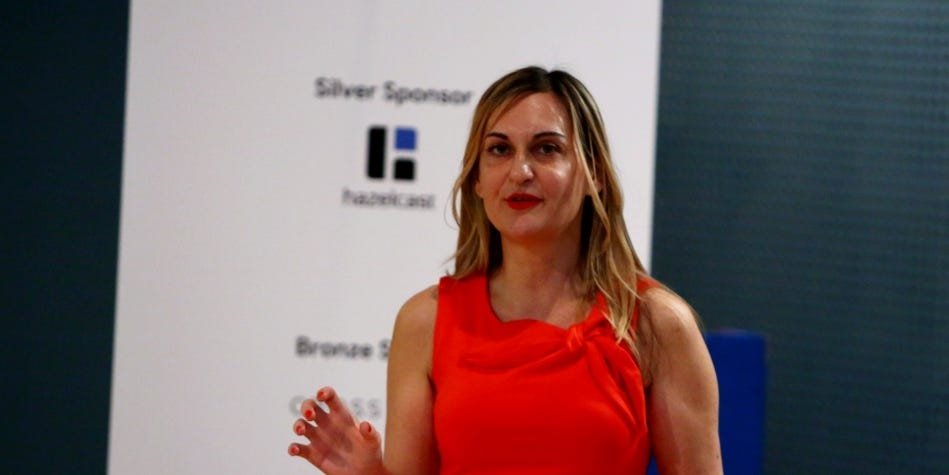
This essay as told is based on a conversation with Yesim Saydan, a branding and communications expert in her early 50s, based in the Netherlands. The following has been edited for length and clarity.
When I’m stuck on a business decision or need to come up with a creative idea or strategy, brainstorming usually starts with my Steve Jobs Custom GPT.
My solo consulting business helps senior executives and established entrepreneurs increase their authority and influence through social media and branding strategies. But expanding this work on my own was a challenge.
Before AI, if I wanted to increase the number of clients I could support, my main option was hire freelancers for special projects or tasks. I spent a lot of unnecessary time training freelancers on my specific framework, and I often felt like they didn’t care as much as I did.
When OpenAI launched custom GPTs, everything changed. I used the feature to create over 17 custom GPTs to build my team. Next, I thought about my ideal mentors and created personalized GPTs.
I had to create more than 4 custom GPTs to get good results
One of my first jobs was at Citibank as a Wall Street project manager, following my move from Türkiye to the United States for my MBA. This is how I began my 14-year corporate career, during which I worked in New York, Paris and the Netherlands.
I started my business about ten years ago because I wanted more flexibility in my work schedule. At the time, social media was just starting to take off and I saw a clear opportunity.
I had played with AI tools before, but OpenAI’s custom GPTs were a game changer. Initially, I envisioned creating my ideal agent team of four. I quickly realized that AI produced poor results when overloaded with too many tasks.
Instead, I created a custom GPT for each important task I wanted the AI to perform. This is how I ended up with over 17 custom GPTs making up what seems to me to be my perfect team.
I trained my AI team to allow me to focus on the broader strategy
I can create a custom GPT in five or 10 minutes, but what really makes it powerful is the training process. I create standard operating procedure documents for each task and client, serving as training materials for my agents that outline my methodology and frameworks.
I have client-specific AI agents trained on each primary client’s tone, goals, and past conversations, so I’m never starting from scratch with a task. Training is ongoing. Every time I make a request or upload a document, the agent improves, just like a real employee would.
When I need to communicate or create content in a client’s tone, the draft I get is so personalized that it feels like I spent hours perfecting it, when in fact my AI team took care of it.
I’ve trained a market researcher, sales call analyst, proposal writer, video scriptwriter, and even a custom GPT to evaluate LinkedIn Profiles using six pillars to determine whether LinkedIn’s current presence builds authority, attracts its ideal customer, and establishes trust, clarity, and uniqueness. This allows me to focus on an overall strategy.
I taught my personalized GPT to think like Steve Jobs and guide me
After creating my ideal employees, I asked myself which mentors I would like to have alive or dead. Steve Jobs is known for his creativity and innovation, and there are already many videos online about him; he is the perfect mentor to create a custom GPT for.
In the instructions, I started with things like: “you are Steve Jobs, you have decades of experience in fields X, Y, Z, your most important skill is creativity, innovation, thinking outside the box.”
There are two types of video transcriptions that I trained him on. I’ve uploaded transcripts of videos where he explains his strategies and what he looks for in products. The second approach was training by examples. I found videos showing how he launched products like the iPhone or iPad, so the AI learned from both his thought process and his execution of these launches.
To get to the current level, I spent about 40 hours researching and creating training resources, including PDFs and other documents that GPT can use as references. I continue to add more whenever I find relevant material, and I now have custom GPTs for Dan Kennedy and Elon Musk Also.
I need to avoid asking certain questions to get the most appropriate answers
The frustrating part with AI model training is that I can give it a lot of the information needed to have Steve Jobs’ superpowers, but then the AI could take it and produce a lot of different things.
When I ask, I avoid asking questions like, “What do you think about this idea?” » because the AI generally wants to agree with me and please me. Instead, I ask, “On a scale of one to ten, how good is this idea?”
That’s not going to say the idea is bad, but now it might tell me it’s a five. Then I’ll ask, “Okay, what would make a 10?” »
This is usually when he starts to rely on the experience of Steve Jobs with whom I trained him. We can go back and forth until I get the most out of it helpful and honest feedback possible.
Depending on the task, I typically go through three to five refinement cycles to achieve more strategic results.
Learn more about our Tiny Teams series
AI scares me, but there’s no turning back now
When a product like NotebookLM was introduced, I started thinking, “Oh my God, this is going to make the entire human race obsolete.” » I find AI products fascinating at first, but they can really scare me.
I truly believe that we don’t know what the world will look like even a year from now. Sometimes I literally freeze think about the impactswhat if everyone ends up homeless, but I generally try to remember that I’m not God or a higher power, and I don’t know what’s going to happen. It calms me down.
I also realized that AI, on its own, is powerful, but what really makes it magical is when we combine our expertise and skills with it. Using personalized agents as an extension of our brain, rather than a replacement, is what really produces a great result.
There is no return possible.
Do you have a story to share about working primarily with AI agents? If this is the case, please contact the journalist at aapplegate@businessinsider.com.