


Dublin, January 27, 2026 (GLOBE NEWSWIRE) — The “Logistics Automation Market – Global Industry Size, Share, Trends, Opportunities and Forecast, 2021-2031” was added to ResearchAndMarkets.com offer.
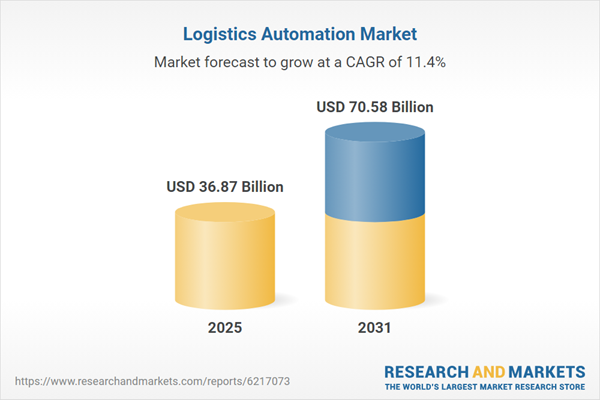
The global logistics automation market is expected to grow substantially from $36.87 billion in 2025 to $70.58 billion by 2031, with a compound annual growth rate of 11.43%.
This sector focuses on the strategic combination of robotic machines, autonomous vehicles and control software designed to streamline supply chain functions including warehousing, inventory management and transportation. The market is mainly driven by structural necessities rather than passing trends; These include the booming e-commerce sector’s requirement for rapid order fulfillment, a severe shortage of skilled manual labor, and the critical operational need for precision within complex distribution networks to close fundamental efficiency gaps in global commerce.
Despite these powerful drivers, the market faces significant obstacles, including the high capital expenditure required for initial deployment and the technical complexity involved in merging automated systems with existing infrastructure. Data from the International Federation of Robotics indicates that in the year to 2025, global sales of professional service robots for transportation and logistics reached 102,900 units, an increase of 14%. This statistic highlights a sustained commitment to investing in automation solutions, even as organizations face the financial and operational challenges associated with modernizing their logistics operations.
Market factors:
Pressing issues related to acute global labor shortages and rising labor costs are major structural catalysts accelerating the adoption of logistics automation. As the gap between labor demand and the supply of skilled workers grows, organizations are increasingly forced to replace manual workflows with automated alternatives to ensure business continuity and protect profit margins.
This deficit is now considered no longer as a cyclical trend but as a persistent operational risk; According to a January 2024 study by Descartes Systems Group, 76% of supply chain and logistics managers reported facing significant labor shortages. As a result, the implementation of robotics and automated transportation systems has moved from a strategic advantage to a necessity for survival, allowing companies to separate their production capacity from labor market volatility.
At the same time, the integration of artificial intelligence and machine learning transforms static machines into intelligent and adaptive ecosystems capable of self-optimization. This technological convergence enables features that existing systems cannot support, such as predictive maintenance, dynamic route planning and real-time decision making, thereby maximizing return on hardware investment.
An April 2024 Rockwell Automation report indicates that 83% of manufacturers globally plan to integrate generative AI into their operations within the year to drive business outcomes. This technological momentum is reflected in capital allocation strategies, with MHI reporting in 2024 that 55% of supply chain executives are increasing their investments in technology and innovation to meet these changing efficiency demands.
Market Challenges:
The substantial initial capital expenditure required for implementation, combined with the technical difficulties of integrating automated systems into existing infrastructure, poses a formidable barrier to the broader expansion of the logistics automation market. This financial barrier effectively divides the industry, limiting the adoption of advanced robotics and control software to large, well-capitalized companies while excluding smaller players unable to absorb sunk costs. As a result, much of the addressable market remains dependent on manual processes, as the return on investment for upgrading older facilities often seems too distant or uncertain to justify an immediate cash flight.
The magnitude of this investment threshold is confirmed by recent industry data reflecting the high cost of entry. According to the Material Handling Institute, in 2025, 19% of supply chain leaders intended to allocate more than $10 million on technology and innovation, while 60% planned to spend more than $1 million.
These figures highlight that automation is increasingly a capital-intensive commitment, where the high price of entry directly limits market penetration among small and medium-sized businesses. This financial exclusivity, compounded by operational risks from disrupting existing workflows during integration, forces many organizations to postpone modernization, thereby blocking overall market growth.
Market Trends:
The rise of autonomous mobile robots (AMRs) is rapidly replacing traditional automated guided vehicles (AGVs) as the standard solution for internal logistics transportation. Unlike traditional AGVs, which rely on fixed infrastructure such as magnetic strips or cables, AMRs use advanced navigation algorithms and onboard sensors to dynamically map environments and avoid obstacles in real time.
This technological advancement allows facilities to flexibly increase throughput without the need for costly facility upgrades, making them ideal for the fluctuating volumes inherent in modern e-commerce. According to Logistics Management’s April 2024 Intralogistics Robotics Survey, 71% of respondents plan to expand their robot fleet over the next two years, signaling a decisive industry pivot toward these adaptable mobile solutions.
Simultaneously, the market is witnessing a strategic shift towards workforce augmentation through collaborative robots (cobots) and wearable technology, going beyond simple labor substitution. Rather than replacing human operators, these technologies are designed to support employees, reducing physical strain and improving decision-making to create an automated “human-centered” environment.
This approach mitigates the operational risks of full automation while maximizing the productivity of the existing labor pool. As noted in Rockwell Automation’s April 2024 “State of Smart Manufacturing” report, 94% of manufacturers plan to maintain or increase their workforce after adopting smart manufacturing technology, confirming that the dominant implementation model prioritizes human-machine collaboration over pure replacement.
Key Players Profiled in Logistics Automation Market:
- 6 River Systems LLC
- BEUMER Group
- E&K Automation Limited
- ABB AG
- Global dematics
- Falcon Autotech Private Limited
- SBS Toshiba Logistics
- TGW Logistics Group
- Zebra Technologies
- Smart Honeywell
Scope of the report:
Logistics Automation Market, By Component:
- Software
- Hardware-integrated systems
- Services
Logistics Automation Market, By Function:
- Warehouse and storage management
- Transportation management
Logistics Automation Market, By Vertical:
- Manufacturing
- Health and pharmaceuticals
- Fast Moving Consumer Goods (FMCG)
- Retail and e-commerce
- 3PL
- Aeronautics and Defense
- Oil
- Gas
- Energy
- Chemicals
- Others (paper printing
- Textiles Clothing)
Logistics Automation Market, By Region:
- North America
- Europe
- Asia-Pacific
- South America
- Middle East and Africa
Key attributes:
| Report attribute | Details |
| Number of pages | 180 |
| Forecast period | 2025 – 2031 |
| Estimated market value (USD) in 2025 | $36.87 billion |
| Projected Market Value (USD) by 2031 | $70.58 billion |
| Compound annual growth rate | 11.4% |
| Regions covered | Global |
For more information on this report, visit https://www.researchandmarkets.com/r/3dgcr1
About ResearchAndMarkets.com
ResearchAndMarkets.com is the world’s leading source of market research reports and international market data. We provide you with the latest data on international and regional markets, key industries, largest companies, new products and latest trends.