

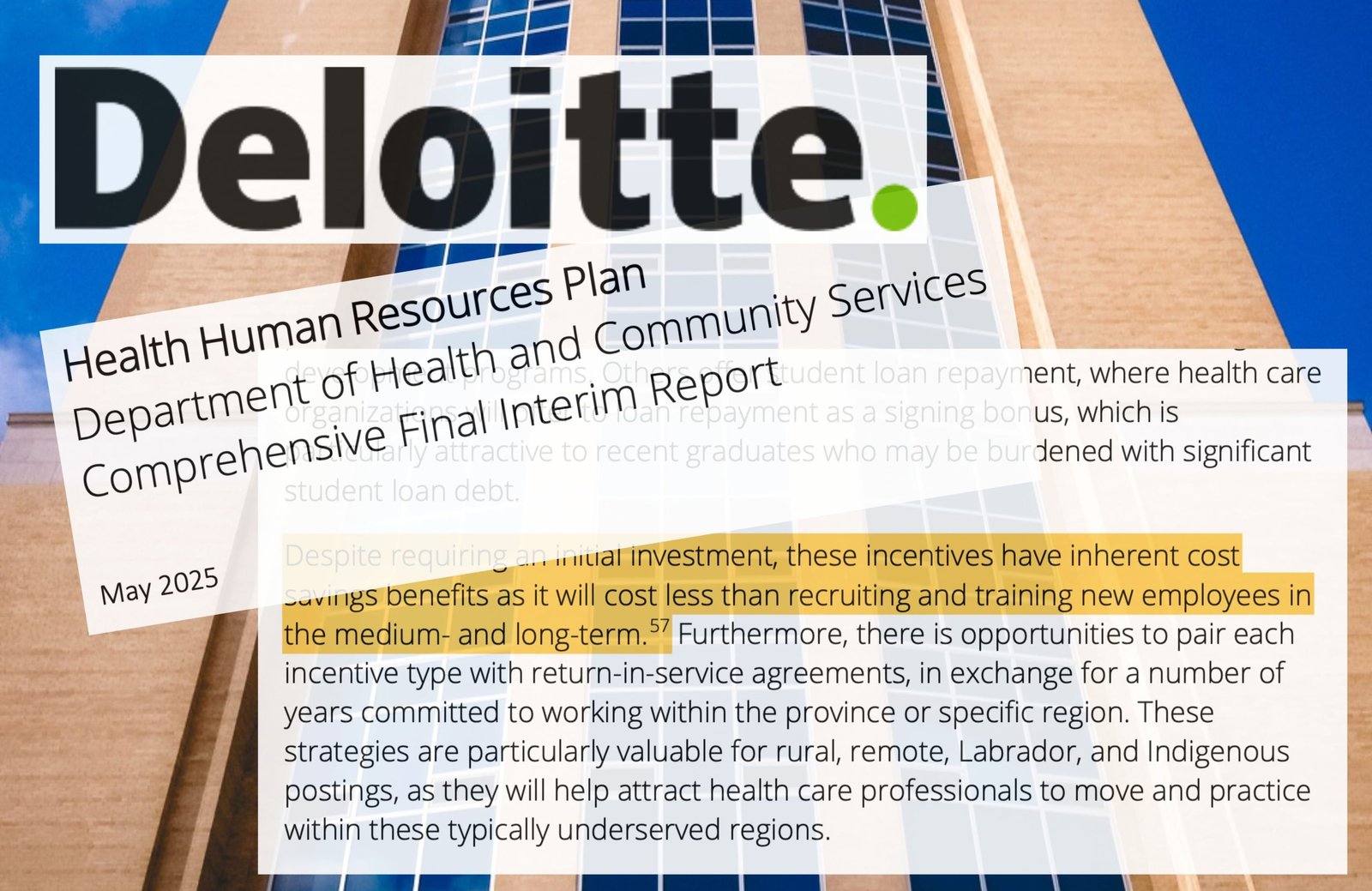
Following a scandal involving fabricated sources found in the province’s education deal, The Independent has confirmed that another major government-commissioned policy report contains fake quotes like those generated by artificial intelligence, calling into question the credibility of policy documents involving the use of AI.
Written by global consulting firm Deloitte and released by the Department of Health and Community Services in May, the Newfoundland and Labrador Health Human Resources Plan contains at least four citations that do not exist or appear not to exist.
The report cost the province nearly $1.6 million, according to documents obtained through a freedom of information request and published on blogger Matt Barter’s website.
The Health Human Resources Plan was commissioned by the previous Liberal government as part of its efforts to develop an effective human resources strategy for the province’s health sector, which is plagued by a shortage of nursing and medical staff.
Research materials cited in the 526-page document are used to support claims related to recruitment strategies, monetary incentives for recruitment and retention, virtual care and the impacts of the COVID-19 pandemic on healthcare workers.

In one case, the report cites a team of researchers and their work to support the claim that monetary and recruitment incentives “have inherent cost savings benefits because they will cost less than recruiting and training new employees in the medium to long term.”
Martha MacLeod, professor emerita at the University of Northern British Columbia’s School of Nursing and one of the co-authors of the paper cited in that claim – “The cost-effectiveness of a rural retention program for registered nurses in Canada” – told The Independent that the quote was “false” and “potentially AI-generated.”
“Our team has certainly done research on rural and remote nursing,” she said in an email. “But we never did a cost-effectiveness analysis, and we never had the financial data to do it.”
In another case, a team of researchers is cited to support the claim that “local recruiting is generally the most cost-effective strategy because it eliminates the need for costly relocation programs, reduces the risk of turnover, and can reduce recruiting and training costs.”
One of the authors of that paper — which the report says is titled “The cost-effectiveness of local health-care worker recruitment and retention strategies in Canada” — told The Independent that while she and some of the researchers cited in the quote have worked on the economics of recruitment and retention strategies, the paper itself “doesn’t exist.” Gail Tomblin Murphy, an assistant professor at Dalhousie University’s School of Nursing and former vice-president of research, innovation and discovery with the Nova Scotia health authority, said she has only worked with three of the other six authors named in the citation.

“It seems like if you come up with things like this, maybe they’re using AI a lot to generate work,” Tomblin Murphy said. “And I really think there are a lot of challenges with that. We have to be very careful to make sure that the evidence that informs the reports (is) the best evidence, that it’s validated evidence. And that ultimately, those reports – not just because they cost governments and the public – (are) accurate, evidence-based and useful for moving things forward.”
A third quote is used to support the uncontroversial claim that licensed respiratory therapists “working in acute care settings have reported increased workload and stress levels due to the pandemic.” The Deloitte report says a group of researchers “discovered” this to be the case in an article titled “The impact of COVID-19 on respiratory therapist workload and stress levels in Canada,” published in the Canadian Journal of Respiratory Therapy.

The report includes a hyperlink to an article on the Canadian Journal of Respiratory Therapy website that does not address the workload and stress levels of registered respiratory therapists due to the pandemic. The Independent was unable to confirm the existence of the article because it does not appear in academic search engines or on the Canadian Journal of Respiratory Therapy website.
This is not a first for Deloitte
Last month, Deloitte made international headlines after its Australian firm produced a report for the Australian government that contained “apparent AI-generated errors, including a fabricated citation of a federal court judgment and references to nonexistent academic research papers,” according to the Associated Press.
The company reportedly agreed to partially reimburse the government $290,000, but Deloitte did not respond to AP’s questions about AI’s potential involvement. The company told the AP that “the issue was resolved directly with the customer.”
The report was removed from the Australian government website, then later reappeared, this time with an appended disclosure that a generative AI system called Azure OpenAI was used in part of the report; the company did not specifically link the errors to the AI program.
According to media reports, the company said the use of AI had no impact on the “substantive content, conclusions or recommendations” of the report.

Deloitte itself encourages the use of AI technologies, both within its company and with its clients. A statement from Deloitte Canada CEO Anthony Viel on the company’s website says Deloitte “helps and inspires Canadian organizations to unlock possibilities, equipping them with the industry knowledge, infrastructure and cloud services needed so they can develop, train and deploy generative AI models safely, ethically and efficiently, which serve us all in the age of digital transformation.”
In NL’s health human resources plan, Deloitte recommends the use of generative AI “to support healthcare providers in clinical decision-making and inform the development of personalized treatment plans.” The report also suggests that AI can “help analyze hospital data (e.g., electronic health records, medical claims data, etc.) and analyze patterns and trends to inform resource allocation.”
In a report published on its website earlier this year, Deloitte Canada states that “growing trust (in generative AI) highlights a critical responsibility for Canadian businesses: ensuring that trust is not taken for granted but actively nurtured through transparency and collaboration.”
“It is essential that all parties are involved and that governance is integrated into the design, development and implementation of AI solutions,” the report said, adding “it is crucial to establish guardrails for the responsible deployment of generative AI solutions while prioritizing upskilling to ensure that people understand the technology and know how to use it effectively.”
Deloitte did not respond to questions from The Independent at the time of publication.
Wakeham, Quiet PC so far
Following the Education Accord scandal, then-Prime Minister-designate Tony Wakeham told the Newfoundland and Labrador Teachers’ Association that it was “embarrassing” that the report contained errors, as reported by CBC/Radio-Canada, and that the PC’s “first step will be to examine the Education Accord in detail and speak directly with the authors of the content (to) determine what is factual and what is not.” is not.”
The Independent recently asked the Prime Minister whether his government would review its artificial intelligence policies, but a spokesperson for Wakeham’s office said he was “not prioritizing” it.

In light of a second major government-commissioned report that contained errors likely generated by AI, The Independent asked Wakeham and the province’s Department of Health and Community Services what the government would do in response to the situation, how it would verify the veracity of claims made in the report, whether it would seek reimbursement from Deloitte and whether it would consider a policy around the use of AI in third-party reporting.
The government had more than two days to respond, but had not done so by the time of publication.
NDP Leader Jim Dinn says he is “disgusted” by this revelation, especially given the recent scale of the Education Accord scandal. “You’re playing with people’s lives,” he said Friday. “We already have enough information in the media that undermines confidence in the health care system as it is, and people are desperate. So this does nothing to instill confidence that they are trying to solve the problem.”
Dinn said that regardless of the extent to which AI was used in both reports, “it undermines confidence in the reports and in the decisions” going forward.
In June, Deloitte was chosen by the provincial government to conduct a review of basic nursing resource staffing in the province, which is expected in the spring.
Since November 22, the Health Human Resources Plan remained on the Government of Newfoundland and Labrador website without any disclosure of AI use.