

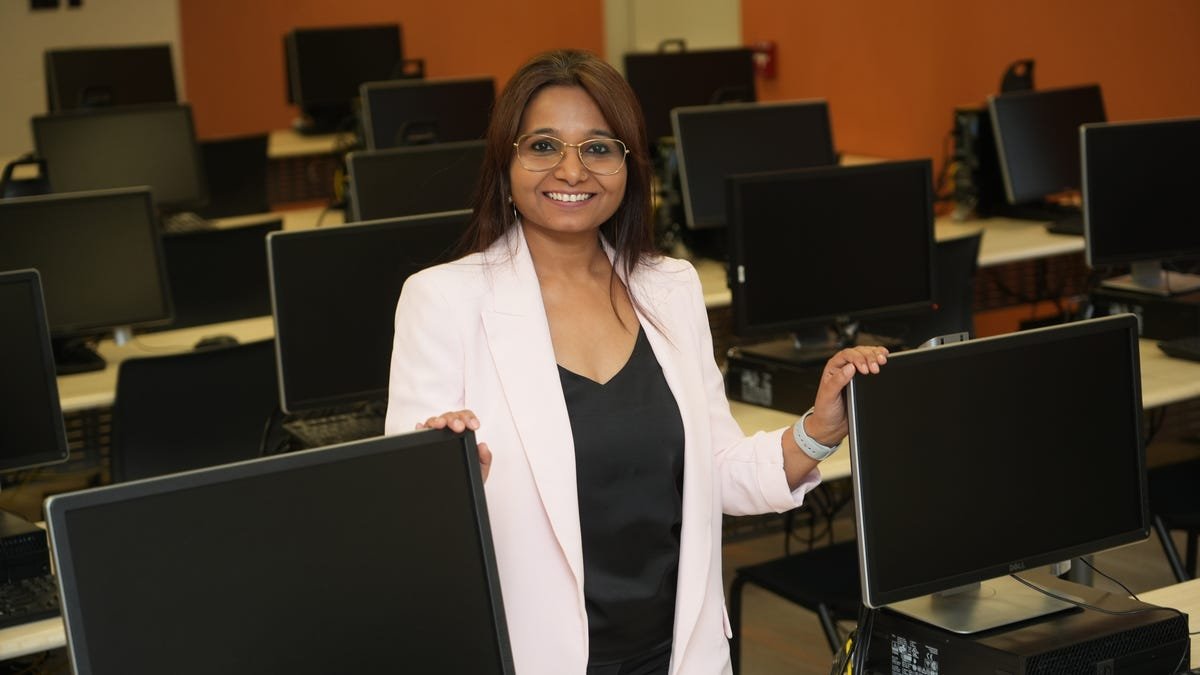
Deepshikha Bhati is a full-time faculty member and lecturer in the Department of Computer Science at Kent State University at Stark.
His interest in computer science began with a curiosity about how systems work and how technology can solve real-world problems.
“During graduate school, I worked with computer vision and facial recognition, which attracted me to artificial intelligence,” she said. “Over time, I became deeply interested in Explainable AI (XAI), as I saw a critical need for AI systems that were not only accurate but also understandable to people. Today, my research aims to make AI transparent, accountable and useful in the education, healthcare and creative sectors, connecting technical innovation with human-centered design.
Bhati, 34, from India, graduated from Vivekanand High School in Anand Vihar Delhi, India. She completed her bachelor’s and master’s degrees from Dr APJ Abdul Kalam Technical University in Lucknow, India. Deepshikha is pursuing a doctorate in computer science at Kent State.
“My career reflects a steady progression of teaching, research and innovation at Kent State University,” she said. “I began my journey in 2017 as a teaching assistant in the Department of Computer Science, then as a graduate assistant from 2018 to 2021 and then as a part-time instructor from 2021 to 2022, while completing my doctoral studies in computer science.
“Since fall 2022, I have been teaching full-time on the Stark campus, where I am currently a lecturer. Along the way, I have been fortunate to receive opportunities such as the John and Fonda Elliot Design Innovation Faculty Fellowship and the Teaching Scholars Program Fellowship, which allow me to combine my passion for artificial intelligence with innovative teaching practices and interdisciplinary projects.”
Where do you think AI will best serve the public over the next five years?
I believe AI will have the greatest impact in three areas: education, healthcare and manufacturing. In education, AI can provide personalized feedback and adaptive learning at scale, helping students develop confidence and critical thinking rather than just chasing grades.
In healthcare, this will streamline documentation, facilitate early diagnosis and improve patient care, always with clinicians in the know. In the IT and business sectors, AI will act as a force multiplier for productivity. Companies are already using AI co-pilots for coding, workflow automation, and cybersecurity monitoring.
Over the next few years, we will see AI integrated into every level of business operations, from customer support that feels more human to predictive analytics that enable better decision-making. This will make services faster, safer and more accessible to the public. It is important that the focus remains on human-centered AI, ensuring the technology is transparent and trustworthy.
What do you think is the next big thing for AI?
The next big step will be multimodal AI, systems that can seamlessly process and connect different types of information like text, images, audio and video.
This will enable more natural and powerful interaction with human AI. I also see a strong move towards responsible and explainable AI, where interpretability and ethics will be built into AI systems from the start.
What is most rewarding for you about teaching?
For me, seeing students gain confidence in themselves.
Many of my students are first-generation college students who are balancing school, work, and family. Seeing them not only master technical skills, but also discover their own potential is incredibly rewarding.
I also enjoy mentoring students through research projects, which provide them with opportunities they would not otherwise have on a regional campus.
When you’re not working or studying, what do you like to do in your free time?
I love traveling and exploring new places whenever I can. I also enjoy painting and gardening, which help me relax and feel creative. Cooking is something I enjoy and it gives me a nice break from work.
Often, I find that my best ideas come when I step away from my desk and spend time doing these relaxing activities.
Besides tech-related reading, what are your favorite types of books or magazines?
I don’t have much time to read outside of work, but when I do, I enjoy reading religious books such as Bhagwat Geeta and other spiritual texts.
I’m also very interested in learning about different religions and cultures, sometimes through books, but often by watching videos on YouTube. It helps me understand different perspectives and values, which I find very meaningful.
Editor’s Note: Five Questions With… is a Sunday news story that features a member of the Stark County community. If you would like to recommend someone to participate, email newsroom@cantonrep.com.