

Most 15-year-olds worry about things like an upcoming math test or whether their crush likes them back.
But a growing number of teens are using artificial intelligence to launch innovative tech companies, with a focus on raising venture capital and launching products — not choosing who they’ll take to prom.
Although teenage tech founders are nothing new — Mark Zuckerberg was 19 when he started Facebook and Bill Gates was 19 when he founded Microsoft — they are increasingly younger and more prevalent thanks to the AI boom.
“What was really just a one-off event that happens all of a sudden is becoming very common,” Kevin Hartz, a San Francisco-based tech insider who mentors teen founders through the Z Fellows startup program, told the Post.
“It seems very American, like this kind of entrepreneurial spirit is still alive and extremely well in the United States,” added Hartz, who is also the founder of ticketing platform Eventbrite.
Silicon Valley is adapting to this change. Last fall, Y Combinator — the popular startup accelerator and venture capital firm — launched an early decision program encouraging founders to apply to its accelerator program while they’re still in college. Z Fellows has no age requirements and openly supports founders dropping out of high school or college to start tech companies.
Not so long ago, parents might have been more skeptical. But today, starting a business at a young age is increasingly seen as a viable career path.
“They can do almost anything, and they are really a driving force behind this AI economy today,” Hartz said. “It’s truly extraordinary.”
Take a look at some of the AI kids.
Pranjali Awasthi, 19 years old
At just 19 years old, Awasthi has already founded two AI startups. She launched her first company, Delv AI, an AI-powered research platform that summarizes and analyzes documents, when she was a 14-year-old high school student in Florida. “I’m kind of desensitized to, ‘Oh my God, you’re so young,’” Awasthi told the Post.
After graduating from high school at age 16, she spent a semester at Georgia Tech before dropping out and moving to San Francisco.
“If you’re an ambitious agency person and there’s so much happening with AI, it makes sense,” she explained.
She is now starting her second company, Slashy, an AI messaging assistant for founders backed by Y Combinator.
She and her co-founders – Harsha Gaddipati, 21, and Dhruv Roongta, 20 – aren’t just starting a company together. They also live together.
“It helps us bond throughout this process,” she said.
Zach Yadegari, 18 years old
Less than a year ago, the Long Island native was rejected by 15 major universitiesincluding Harvard, Stanford, MIT, and Princeton — despite a 4.0 GPA, stellar test scores, and a startup that was bringing in tens of thousands of dollars every month.
Carefree. That startup — a calorie-counting and weight-tracking app called Cal AI that he co-founded with Henry Langmack, 18, Blake Anderson, 25, and Jake Castillo, 30 — has been downloaded more than 8 million times and is now on track to introduce $30 million per year.
Yadegari, who came up with the idea for the app after becoming frustrated with what was out there while trying to bulk up a few years ago, ended up enrolling at the University of Miami for the social experiment. He’s just like a normal student – except slate gray Lamborghini he bought with money he earned from Cal AI.
The young founder started coding at sevenand by age 16, he had created a gaming website and sold it for six figures. He says he never felt limited by his age.
“I think entrepreneurship is really cool because at the end of the day, age doesn’t really matter,” Yadegari told CNBC last year. “You’re either good or you’re not good at what you do, and then the market will decide the outcome.”
Siddharth Nandyala, 15 years old
In 2024, the Frisco, Texas-based teenager founded Circadian AI, a smartphone app designed to detect early signs of heart disease in seconds by holding the phone close to the patient’s chest, where it records the heartbeat and uses cloud-based machine learning to analyze sounds.
Nandyala hopes the app can be used as a pre-screening tool in resource-limited rural areas, helping healthcare professionals identify at-risk patients and refer them to specialists.
“It can be provided to trained professionals, nurses or healthcare providers in these resource-limited settings, where they could take these tools and use them to understand if a patient has a potential cardiovascular abnormality,” he explained.
Defying the stereotype of the college-dropout tech founder, Nandyala is in his second semester at the University of Texas at Dallas — as the youngest student ever enrolled there. Because of his age, he still lives at home rather than in dorms, but he says college has already been a pivotal experience.
“It taught me a lot in terms of setting priorities, both from a social and development perspective,” he said. It really shaped me as a person.
Sunkalp Chandra, 18 years old
As Sunkalp Chandra finishes his senior year at High Technology HS in Lincroft, New Jersey, some of his teachers are surprised to learn that he runs a technology company.
“Running an AI startup isn’t exactly a typical extracurricular activity,” he told the Post.
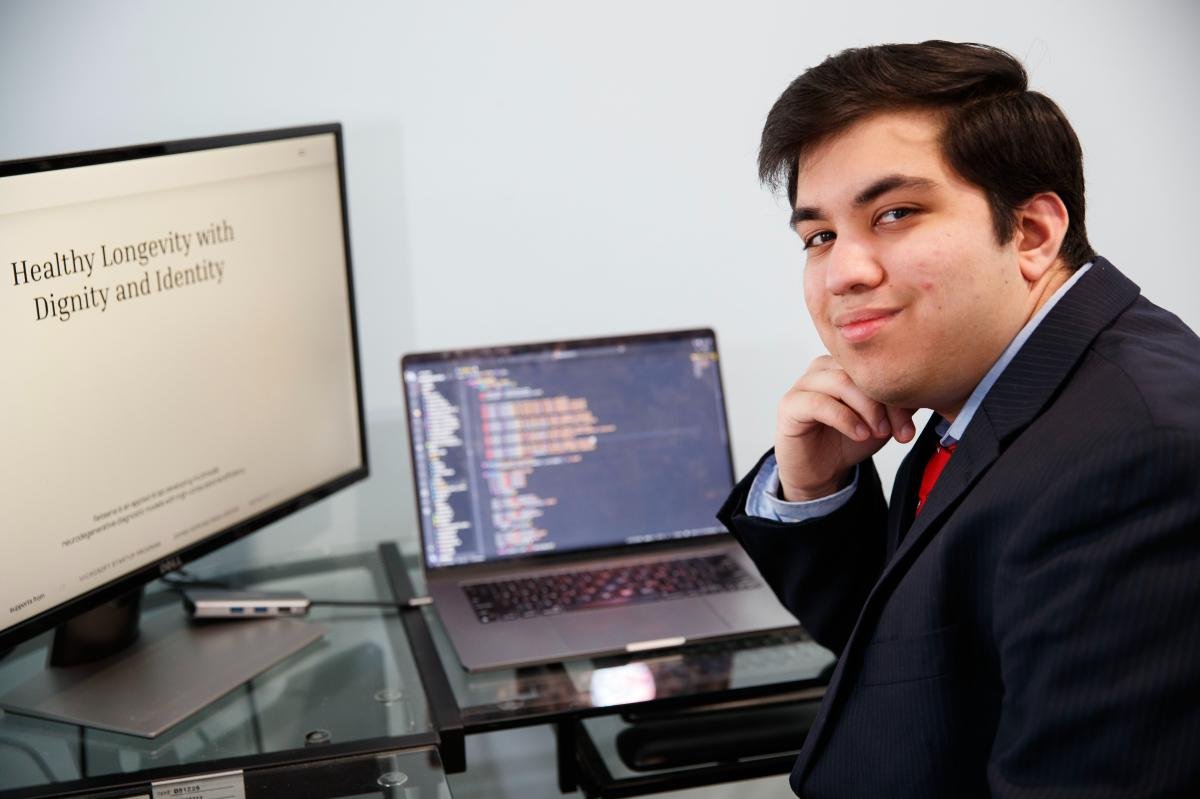
Chandra focuses on classes and homework during the day. Early mornings, evenings, and weekends, he works to create Reteena, an AI-based health technology startup that creates tools to make the diagnosis and treatment of Alzheimer’s disease more efficient and accessible.
Chandra and his co-founders are currently focused on their flagship product, Remembrance, which they launched last year. He describes it as an AI-powered reminiscence therapy tool that engages users in gentle conversations to trigger personal memories. The team plans to start raising venture capital once he’s in college.
Chandra met her co-founders, Alex Yang and Jainish Patel, through online Discord communities and they connected over their shared interests in technology and Alzheimer’s disease. They still have never met in person, and the team is scattered across the world: Yang is based in Seoul, South Korea, and Patel is based in Florida.
“We wanted to use modern AI to help people maintain their dignity, memory and identity as they age, especially in the face of cognitive decline,” Chandra told the Post.
Some in the healthcare industry are skeptical of a start-up founded by teenagers, but Chandra doesn’t take it personally.
“We are focused on demonstrating our preparation, our research,” he said. “Once people saw the rigor behind what we were building, the conversation shifted from doubt to more curiosity and support.”
Aayam Bansal, 18, and Ishaan Gangwani, 18
The San Francisco-based couple raised $1.5 million — including $500,000 recently from Y Combinator — for their startup Synthetic Sciences, an AI assistant for researchers that helps them with everything from reviewing studies to running experiments.
For Bansal, committing full time to synthetic sciences meant dropping out of college at the University of Illinois at Urbana-Champaign during his first semester.
“The problem was so real and what I was doing at Synthetic Sciences seemed like a rare window where working on it full time would be uniquely leveraged,” he said. “The university will always be there; this opportunity probably won’t. »
Even without school, running a startup as a teenager is a lot.
“In a single day, I can talk to investors, deal with legal or compliance issues, manage operations, ship products, debug code, talk to users, and think about marketing – and none of that can really be given up. The constant context switching is exhausting,” he said. “At this age, you learn everything in real time, which is intense, but it also requires you to level up very quickly. »