

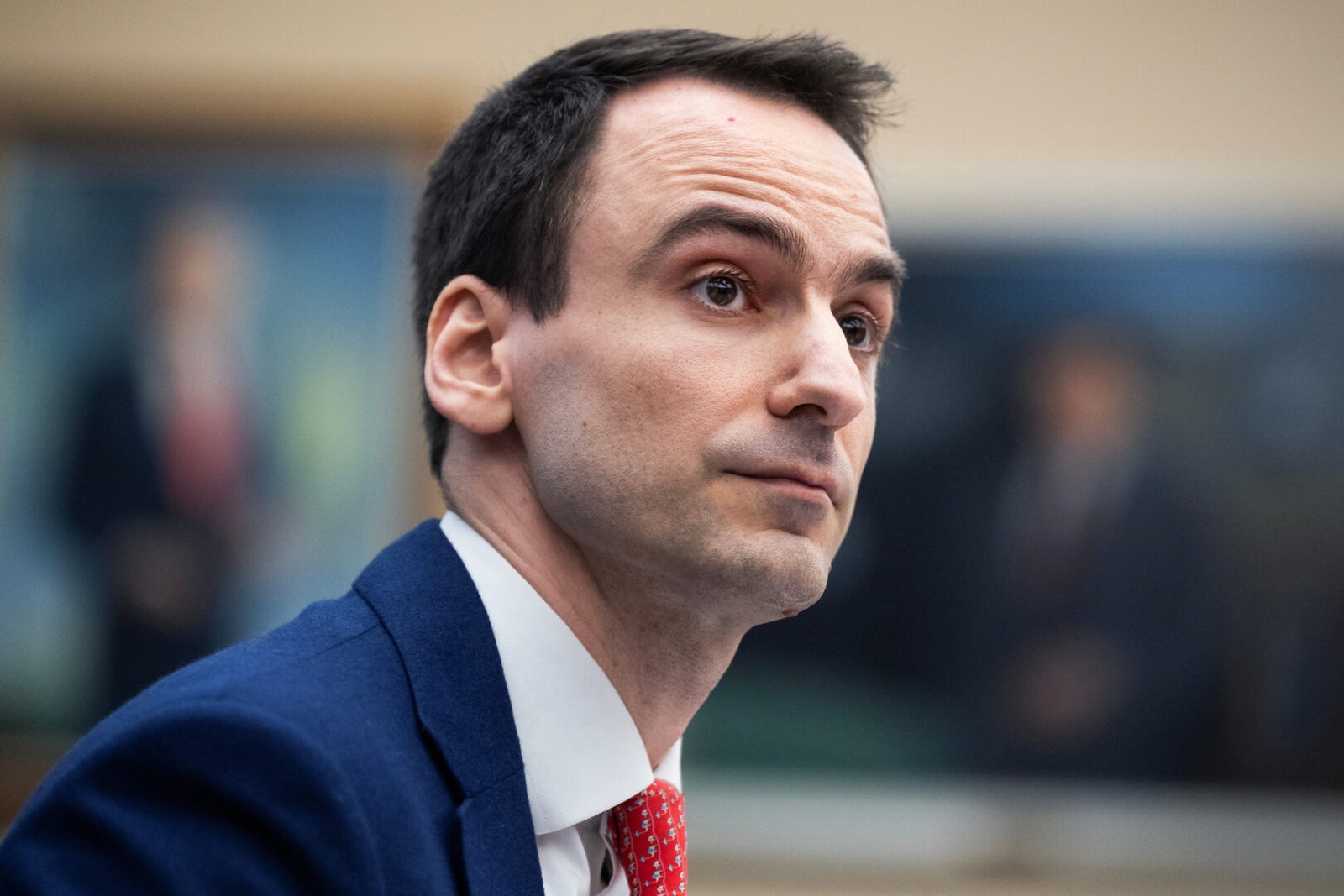
A White House artificial intelligence strategy official on Wednesday gave House lawmakers few details about what Congress can expect from the administration’s planned legislative recommendations for a national standard that would seek to preempt state laws.
In December, President Donald Trump signed an executive order directing federal agencies to sue states if their AI laws are “onerous” and to limit states’ access to certain federal funds, including through a broadband deployment program, based on those laws. The order came after attempts by pro-AI lawmakers to legislate national preemption of state AI laws failed in the face of bipartisan opposition in favor of defending state authority.
The executive order also directed White House Science and Technology Advisor Michael Kratsios, along with Special Advisor for AI and Cryptography David Sacks, to develop legislative recommendations for a national AI standard that would preempt AI laws.
In his first appearance on Capitol Hill since that order, Kratsios avoided details of his testimony before the House Research Committee on Science, Space and Technology, while facing lawmakers’ concerns about the balance of AI responsibilities between states, Congress and the Trump administration.
Kratsios said that in carrying out the administration’s AI action plan released early last year, he saw “opportunities for collaboration” with the committee and Congress.
“If America’s innovators want to continue leading the world, they will need regulatory clarity and certainty, for which the legislative and executive branches must work together,” Kratsios said.
Subcommittee Chairman Jay Obernolte, R-Calif., offered general support for Congress’ adoption of what he called “an appropriate federal framework” that “maintains the United States’ position as a leading force in the development and deployment of AI globally.”
But he also highlighted the role of states in regulating AI. His home state of California has passed laws that require AI developers to provide information about any catastrophic risks related to their models as well as their training data.
“I think what everyone believes is there should be a federal path and there should be a state path,” he said.
“And that the federal government must first define what falls under Article 1 of the Constitution, interstate commerce, and where those preemptive guardrails are, where regulation is reserved solely for regulation at the federal level, and then outside of those guardrails, where states are free to go and become the laboratories of democracy that they are.”
Obernolte pressed Kratsios on potential “guardrails” and the administration’s vision for congressional action.
Kratsios spoke about the reasoning behind the December executive order that tasked him with developing legislative recommendations, including to prevent AI startups from having to comply with regulations in many different states. He highlighted the order’s exclusion of state laws on child safety, data center infrastructure and AI procurement.
He said he and Sacks “look forward, over the coming weeks and months, to working with Congress on a viable solution” to an AI standard, but he did not say what that standard would cover or when legislative recommendations would be ready.
Rep. Zoe Lofgren, Democrat of California, questioned the executive order’s attempts to shift power over AI from states and Congress to the executive branch, adding that she believes the executive order is unconstitutional.
“What we should not do is prevent states from taking necessary steps to protect their citizens while here in Congress we do nothing to pass laws ourselves,” Lofgren said.
Lofgren expressed support for the goals of the administration’s AI action plan, particularly “goals on innovation, infrastructure, international diplomacy, and security.” But she said the plan “only minimally addresses the risks of AI, and even where it does, including with respect to deepfakes, the administration has not taken meaningful steps to address these risks.”
Musk and deepfakes
Lofgren said he was concerned about the federal government’s relationship with Elon Musk’s X, formerly Twitter, in the wake of the platform allowing the Grok AI chatbot to generate sexualized images of real people, including children. The Senate passed by voice vote Tuesday a law that would allow victims sue X and other platforms for AI generation and distribution of non-consensual intimate images.
Kratsios said misuse of technology, including by any federal government employee, “requires accountability” rather than “blanket restrictions on the use and development of this technology.”
Lawmakers on both sides also questioned Kratsios about the administration’s plans for the National Institute of Standards and Technology and its Center for AI Standards and Innovation, known until last summer as the U.S. AI Security Institute.
Obernolte said he plans to introduce a bill called the Great American AI Act, which would codify the center.
He also praised the administration’s support for maintaining the National Artificial Intelligence Research Resource, or NAIRR, which he sponsored a bill to codify.
Kratsios celebrated the administration’s decision to replace the old security institute with CAISI and its decision that NIST revise its AI risk management framework to “eliminate references to misinformation, diversity, equity, inclusion, and climate change.”
“We want NIST to focus on advanced scientific metrology. Inserting political rhetoric into its work is something that devalues and corrupts the broader efforts that NIST is trying to make in many important scientific areas,” Kratsios said.
Rep. Haley Stevens, D-Mich., a ranking member of the panel, lamented the administration’s attempts to cut NIST’s budget and the potential impacts on programs aimed at encouraging the use of AI in manufacturing.
“The cuts hinder NIST’s AI-related efforts. They will weaken cybersecurity and privacy standards, which I have legislation on, and limit advanced manufacturing, physical infrastructure and resilience innovation,” Stevens said.
The president’s budget request for fiscal year 2026 proposed a $325 million cut, but the Commerce-Justice-Science compromise bill included in a package of three bills being considered by the Senate would reject that proposal.