

This audio is automatically generated. Please let us know if you have back.
Walmart is unifying its supply chain using artificial intelligence and automation, while aiming for cost efficiency, accuracy and speed across its entire network.
Over the past few years, the retailer has strategically invested in technology to accelerate global operations that can adapt to real-time challenges. These investments have led it to use agentic AI for decision-making, optimization and proactive problem solving.
“End to end, every segment of what we do is driven by some form of intelligence,” Indira Uppuluri, senior vice president of supply chain technology at Walmart, told Supply Chain Dive.
Even though Walmart has deployed a series of tools and platforms that form the technological backbone of its network, there is still more to do, Uppuluri said. The company is constantly experimenting with new technology models by testing them on a smaller scale and evaluating feedback before rolling them out across the company.
Walmart’s digital twin is an example of core technology that provides a baseline for performance, as well as a “sandbox” that tests different modeling approaches or strategies, Uppuluri said.
“This allows us to assess trade-offs between conflicting business objectives, quantify the likely impact of operational changes on store operations in the face of uncertainty and derive valuable insights,” she said.
Here are four examples of how Walmart is using AI to build adaptability and connectivity throughout its supply chain to support a better overall customer experience.
1. Forecast
A resilient network at Walmart starts with demand forecasting, Uppuluri told Supply Chain Dive.
The retail giant uses tools like a multi-horizon recurrent neural network – built entirely within Walmart – to predict demand for multiple points in the future. The neural network stores past predictions over different planning horizons, Uppuluri explained, with data from past demand patterns, planned future events as well as current global and local trends.
“As an example, by using this model to predict demand, we can plan inventory levels across our network more accurately and further in advance,” she said.
Robust forecasts can optimize inventory placement decisions by analyzing different factors that can impact demand, Uppuluri said. In turn, Walmart can ensure that excess inventory, or safety stock, does not sit around in warehouses.
The benefits of improving forecasting with AI extend to inventory imports, as predictability is key to managing shipment times and quality.
2. Inventory management
Agentic AI tools provide Walmart with a consistent, unified view of inventory across stores, distribution centers and other supply chain facilities. By layering multiple AI and automation technologies, Walmart’s systems can “automatically detect, diagnose and correct issues in real time without requiring constant manual intervention,” Uppuluri said.
“For example, if an unexpected increase in demand begins to deplete inventory faster than expected, AI-powered forecasting tools can adjust replenishment schedules and the flow of goods throughout the supply chain,” she added.
In turn, when challenges such as weather-related events hamper logistics pathways or distribution operations, the retailer’s supply chain can “adapt” to overcome the obstacles, Uppuluri said.
The retailer also uses computer vision and AI for quality control of incoming inventory, improving visibility to ensure merchandise quality, Uppuluri said. For example, the technology could identify a crushed tomato or an expired expiration date.
3. Warehouse Operations
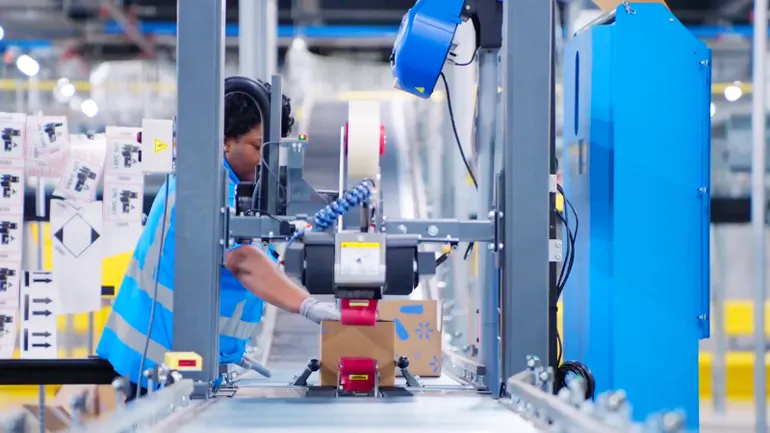
Beyond optimizing demand forecasting and inventory placement, Walmart also leverages generative AI, robotics, computer vision and automation in the warehouse to ensure productivity and safety, including erasing repetitive manual tasks, Uppuluri said.
Additionally, warehouse automation systems with smart cameras enable the company to ensure operations run smoothly, by a July blog post.
Still, disruptions and challenges are inevitable in warehouses as thousands of associates work alongside conveyors and other forms of automation, Uppuluri said.
To solve problems as they arise, Walmart uses generative AI to direct the right associates to handle disruptions. Uppuluri said the system gets data from multiple areas, including task management systems, associate role assignments, scheduling data and skill profiles.
“For example, AI-based systems in our distribution centers analyze and predict automation alerts,” she said. “They provide guidance on next steps to take to resolve issues and, in many cases, automate them. »
In practice, if the flow of goods is disrupted – for example due to a late arrival of a truck or a damaged pallet – the generative AI platform will suggest an associate to help manage the problem, Uppuluri explained.
The company also incorporates this approach into its training, creating a behind-the-scenes knowledge base so employees know what actions to take, she added.
4. Logistics management
Walmart targets speed and better fill rates for its trucks to optimize transportation and logistics operations, a key to improving customer satisfaction, according to Uppuluri.
She added that Walmart operates “adaptive search models in large neighborhoods” that help drivers identify the shortest and/or most cost-effective route to a customer.
AI also tells Walmart how to diversify port origins and identify optimal locations to send imports in the event of disruptions such as storms or traffic jams in the Panama Canal, according to Uppuluri. In turn, the company has numerous AI models running behind the scenes to de-risk its logistics operations.
This story was first published in our Operations Weekly newsletter. Register here.