

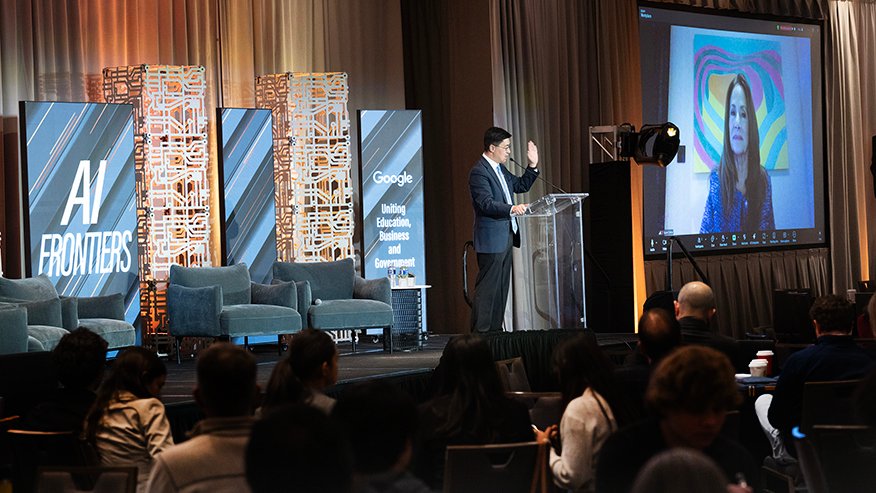
Mung Chiang and Karen Dahut talk about AI research and AI in education at the Google-Purdue AI Summit 2025
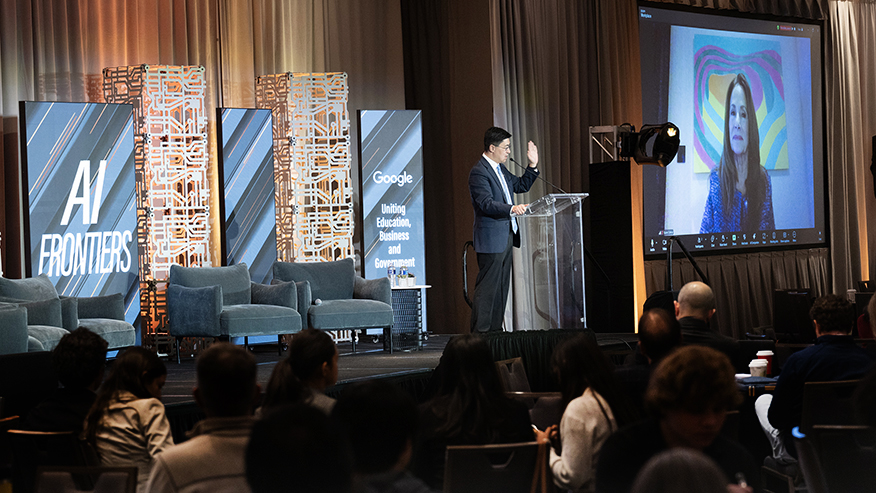
Purdue President Mung Chiang and Google Public Sector CEO Karen Dahut, who participated remotely in the AI summit, said the collaboration will accelerate groundbreaking AI research while preparing the next generation of students to tackle society’s most pressing challenges. (Photo by Purdue University/John Underwood)
WEST LAFAYETTE, Ind. — Building on previous collaborations, Purdue University and Google are charting a path toward deeper collaboration in artificial intelligence, one that would combine education and research to prepare the next generation of AI leaders while advancing the technology itself.
Leaders of both organizations discussed this joint commitment with stakeholders on Thursday, November 13 at AI Frontiers: Uniting Education, Business, and Government for Real-World Innovationwhich they co-organized to advance the dialogue on the role of AI in education and research.
“We aim to expand the partnership between Google and Purdue and put AI in the hands of every student, faculty and staff member, and at the heart of the curriculum,” said Karen Dahut, Google Public Sector CEO. “Purdue and Google already work together to analyze massive amounts of data that make roads safer, and we look forward to expanding our partnership in the future. We are deeply committed and excited to work alongside Chairman Chiang and his team.”
Purdue University President Mung Chiang highlighted how this public-private partnership would accelerate groundbreaking AI research while preparing the next generation of students to tackle society’s most pressing challenges.
“At the Google-Purdue AI Summit, today is a momentous day for Purdue’s AI strategy. Purdue University and Google aim to grow this exciting strategic AI partnership in the years to come, both in research through physical AI and in education through professional AI skills,” Chiang said. “In particular, Purdue and Google will work together to put the most advanced AI tools in the hands of every Purdue student, because every boilermaking graduate from one of the nation’s largest universities will be ready for an AI-driven workplace, regardless of their choice of career field.”
In response to the rapidly evolving role of AI across industries, Purdue announced at the summit plans to introduce a new AI proficiency degree requirement, with implementation expected to go into effect for new students in fall 2026. Pending approval from the Purdue Board of Trustees, this fundamental curriculum innovation will ensure that all Purdue students have practical skills in AI tools and applications for the future of work.
The daylong forum in Indianapolis brought together academic and industry leaders to examine how AI and emerging technologies are transforming critical sectors, including advanced manufacturing, health care, national security and agriculture. Discussions highlighted the critical role of collaborative efforts in advancing responsible innovation and workforce development.
Dimitrios Peroulis, senior vice president of partnerships and online at Purdue, said industry leaders depend on trusted partners who can help accelerate innovation while preparing the next generation of talent.
“Whether it’s smart medical devices, autonomous agricultural equipment or AI-enabled drones, this summit illustrates how AI is quickly becoming a critical part of healthcare, manufacturing, agriculture and defense,” Peroulis said. “Students who can bridge the digital and physical domains will be leaders in these fields. »
Speakers at the summit included Chris Hein, head of public sector engineering at Google; Srikanth Thirumalai, vice president of engineering at Waymo; and U.S. Senator Todd Young of Indiana, co-author of the Creating Meaningful Semiconductor Production Incentives for America Act, or the CHIPS and Science Act of 2022.
Hein is a field technology director at Google Public Sector, where he partners with government and education leaders to apply AI to advance their most critical missions. He is dedicated to ensuring technology is used ethically and effectively.
Thirumalai is vice president of embedded software at Waymo, an autonomous driving technology company. He leads the development of the software stack and machine learning models that power Waymo driver perception, prediction and planning.
Physical AI is an essential part of Purdue calculatesa comprehensive university initiative that focuses on four key pillars of Purdue’s broad technology and computing environment: computer science departments, physical AI, quantum science, and semiconductor innovation.
Demonstrating Purdue’s national leadership in revolutionary technology, the university created Purdue Institute for Physical Artificial Intelligence. IPAI is the nation’s premier research institute dedicated to advancing AI in the physical world.
The Purdue Institute for Physical Artificial Intelligence, the Purdue Office of Industry Partnerships, Purdue Online and the Purdue Office of Research are supporting Purdue and Google in this event.
About Purdue University
Purdue University is a public research university leading in large-scale excellence. Ranked among the top 10 public universities in the United States, Purdue discovers, disseminates and deploys knowledge with unparalleled quality and scale. More than 106,000 students study at Purdue across multiple campuses, locations and modalities, including more than 57,000 on our main campuses in West Lafayette and Indianapolis. Committed to affordability and accessibility, Purdue’s main campus has frozen tuition 14 years in a row. See how Purdue never stops in its persistent pursuit of the next giant leap, including its integrated, comprehensive urban expansion of Indianapolis; the Mitch Daniels School of Business; Purdue calculates; and the One Health initiative — to https://www.purdue.edu/president/strategic-initiatives.