

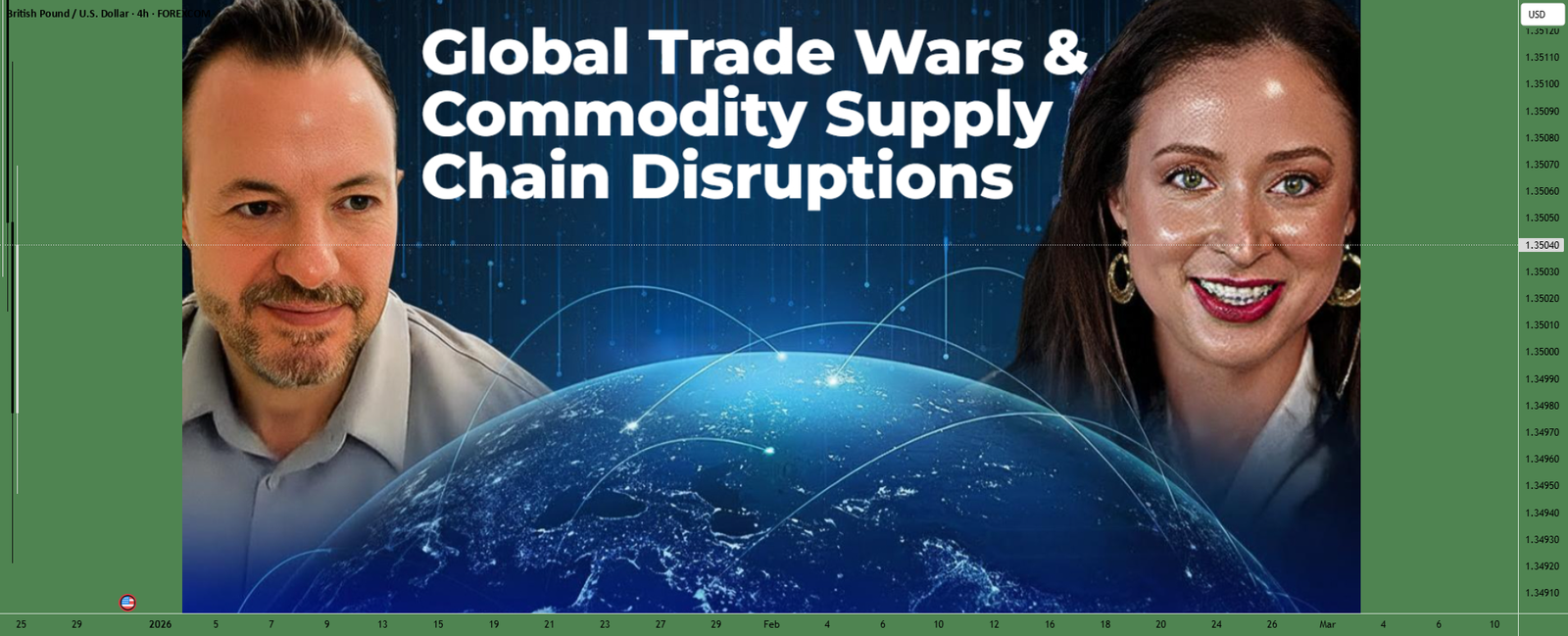
A trade war occurs when countries impose tariffs, quotas, sanctions, or non-tariff barriers against each other to protect their domestic industries or gain geopolitical leverage. Unlike traditional trade conflicts narrowly focused on economic advantage, modern trade wars are deeply tied to national security, technological leadership, and political influence. Trade tensions between the United States and China, sanctions against Russia, semiconductor export controls, and strategic restrictions on rare earth elements are prime examples.
These trade conflicts disrupt the free flow of goods, increase costs for businesses and consumers, and alter long-established supply chains. Although some countries may temporarily benefit from protectionist measures, the global economy as a whole often faces slower growth, higher inflation and increased uncertainty.
Raw materials at the center of the global conflict
Commodities – such as crude oil, natural gas, metals, agricultural products and essential minerals – are particularly vulnerable to trade wars. Unlike finished goods, commodities are location specific and highly dependent on geography, climate and natural resources. This makes substitution difficult in the short term.
For example:
Energy commodities like oil and gas are affected by sanctions, shipping restrictions and geopolitical bottlenecks.
Industrial metals such as copper, aluminum, steel and lithium are affected by tariffs, export bans and resource nationalism.
Agricultural products face disruptions from trade embargoes, retaliatory tariffs and climate-related supply shocks.
When trade barriers increase, commodity prices often become more volatile, reflecting supply constraints and demand uncertainty.
Fragility of the supply chain and the end of “just in time”
For decades, global supply chains have been optimized for profitability rather than resilience. Companies relied on just-in-time inventory systems, sourcing raw materials from the cheapest producers, often concentrated in a few regions. The trade wars have highlighted the fragility of this model.
Tariffs and sanctions force businesses to:
Rerouting supply chains to alternative countries
Establish redundant supply agreements
Holding higher inventories, which increases costs
Investing in national or “friendly” production centers
This shift from efficiency to resilience fundamentally changes demand patterns for raw materials. For example, diversification beyond a single supplier can increase overall raw material consumption and logistics costs, thereby contributing to structurally higher prices.
Energy markets and geopolitical realignment
Energy commodities are among the most geopolitically sensitive assets. Sanctions against major producers can reshape global energy flows overnight. When energy exporting countries are restricted from accessing certain markets, they often redirect supplies at reduced prices, while importing countries scramble to find alternatives.
This leads to:
Regional price disparities
Increased shipping distances and transportation costs
Increased use of strategic reserves
Accelerated investment in renewable energy and energy security initiatives
Trade wars in energy markets also accelerate the militarization of resources, where access to oil, gas or electricity becomes a tool of political pressure rather than a simple economic exchange.
Critical minerals and strategic raw materials
The global transition to electric vehicles, renewable energy and advanced technologies has increased the importance of essential minerals such as lithium, cobalt, nickel, rare earth elements and graphite. Control of these resources has become a strategic priority for many countries.
Trade restrictions and export controls in this space may:
Delaying clean energy transitions
Increasing costs of batteries and electronics
Encourage domestic investment in mining and processing
Intensifying competition for resource-rich regions
Countries are increasingly stockpiling strategic products and offering subsidies to secure supply chains, reinforcing a more fragmented global trading system.
Inflation, volatility and economic fallout
Disruptions in the raw material supply chain directly fuel inflation. When raw material costs increase due to tariffs, shipping delays or shortages, manufacturers pass these costs downstream. This results in higher prices for food, fuel, housing and consumer goods.
Central banks are faced with difficult trade-offs:
Tightening monetary policy to combat inflation can slow economic growth
Adapting to supply-driven inflation risks depreciating currencies and creating asset bubbles
For emerging markets, the impact can be particularly severe. Many are net importers of energy and industrial products, making them vulnerable to price spikes caused by global trade tensions.
Changing business alliances and regionalization
One of the most lasting impacts of global trade wars is the reconfiguration of trade alliances. Instead of a single integrated global market, the world is moving toward regional blocs and “friend-shoring,” where countries prefer to trade with politically aligned partners.
This trend leads to:
Regional commodity price benchmarks
Reduced effectiveness but increased political stability
Higher capital spending on localized infrastructure
Long-term changes in global trade flows
Although regionalization can improve resilience, it often comes at the cost of higher prices and slower productivity growth.
Implications for Businesses and Investors
For businesses, dealing with trade wars requires active risk management. Companies must monitor geopolitical developments, diversify their suppliers, hedge their commodity exposure and invest in supply chain transparency. Commodity-intensive industries such as manufacturing, construction, energy and agriculture are particularly exposed.
For investors, commodity markets are becoming both a risk and an opportunity. Trade-related disruptions can create:
Sharp increases in commodity prices subject to constraints
Long-term investment themes around resource security
Increased correlation between geopolitics and asset prices
However, volatility also increases the importance of timing, diversification and macroeconomic analysis.
The road ahead: structural change, not a temporary shock
Global trade wars and raw material supply chain disruptions are not short-term anomalies; they represent a structural change in the functioning of the global economy. Strategic competition, climate policies, demographic pressures and technological transformation will continue to reshape business structures.
Rather than a return to frictionless globalization, the future points to a more complex, fragmented and politically influenced trading system. Raw materials will remain at the heart of this transformation, acting both as economic inputs and strategic assets.
Conclusion
Global trade wars and disruptions to raw material supply chains have fundamentally changed the dynamics of global markets. By raising costs, amplifying volatility, and reshaping supply chains, they challenge long-held assumptions about efficiency and globalization. While these disruptions pose risks to growth and stability, they also encourage innovation, resilience and strategic thinking.
Understanding the interplay between geopolitics, trade policy and commodities is now essential for policymakers, businesses and investors. In an era where economics and geopolitics are inseparable, commodities are no longer just raw materials: they are instruments of power, security and global influence.