


Listen to this article
About 4 minutes
The audio version of this article is generated by AI-based technology. Pronunciation errors may occur. We work with our partners to continually review and improve results.
One of the world’s top artificial intelligence researchers working in New Brunswick is optimistic about what the future could bring with advances in technology, but he urges caution.
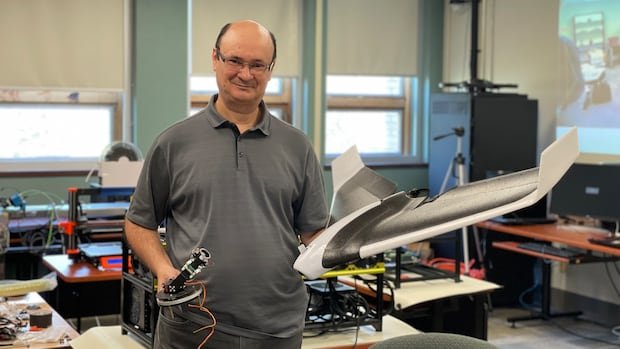
Moulay Akhloufi, AI researcher at the University of Moncton, was ranked by Stanford University among the top two percent of AI researchers in the world.
The list is compiled by looking at the number of research papers someone authored or co-authored, and how often those papers are cited by other scientists.
Akhloufi said the future of AI will be influenced by education about the technology and how it is used.
“Historically, we’ve seen every technology, its good uses and its bad uses,” he said.
Machine learning
Akhloufi works primarily in the field of machine learning, a subset of AI in which computers are trained to perform specific tasks.
This would be distinct from more general AI like large language models, such as ChatGPT, and other forms of generative AI.
Akhloufi works with machines and robots trained in machine learning that could be used by businesses.
“For example, we have a client in Saint John who wants to use this kind of robot to move, for example, packages for (elderly) people or to pick up trash for example using these robots,” explained Akhloufi.
Information morning – Moncton10:35 a.m.U of M professor ranked among top AI researchers in the world
Moulay Akhloufi is a professor in the Department of Computer Science at the University of Moncton.
Akhloufi said this could be beneficial in countries where there is a labor shortage and companies cannot hire enough people to do the job.
But he acknowledged it could also lead to job losses and said the key would be to provide training for people who find themselves replaced by an AI worker.
“We will always need humans, but not the same jobs,” says Akhloufi.
But speed will be key to training people for new jobs, and he doesn’t think the government is working fast enough to fix it.
“I think we will have to move more quickly to find ways to train people so they can scale,” Akhloufi said.
“Otherwise we will be in trouble at some point as a society.”
Existential threat
One area of concern to some AI researchers is the development of artificial general intelligence, also known as Super AI.
Super AI is a theoretical stage of AI when its intelligence exceeds human intelligence and, depending on who you ask, its arrival may come sooner rather than later.
And the risk this could pose to humanity is also a topic researchers are debating.
In 2022, the University of Oxford and the Machine Intelligence Research Institute, a California-based think tank that examines the existential threats posed by AI, surveyed 738 AI researchers. The survey showed that 48 percent of respondents give a 10 percent chance that “the long-term effect of advanced AI on humanity will be ‘extremely bad (e.g., extinction of humanity)’.”
Akhloufi wouldn’t put a numerical value on the possible existential threat posed by Super AI, but he said there is a “real concern.”
He said the technology is not yet at the level of Super AI, but it is important to think about the possibility, especially with some of the malicious uses coming from existing AI, like deepfakes – images and videos doctored using AI.
“If we don’t put safeguards in place, we’ll be in big trouble and we’ll probably be in big trouble,” Akhloufi said.
“I’m sure that, like, bad people will use these tools for bad things. So that’s where we’ll have to be careful.”
But Akhloufi said AI could do a lot of good, particularly in the medical field, where the technology could speed up disease detection and drug development.
He said: “I try to be optimistic because what we are doing is really positive and has an impact on our society. »