

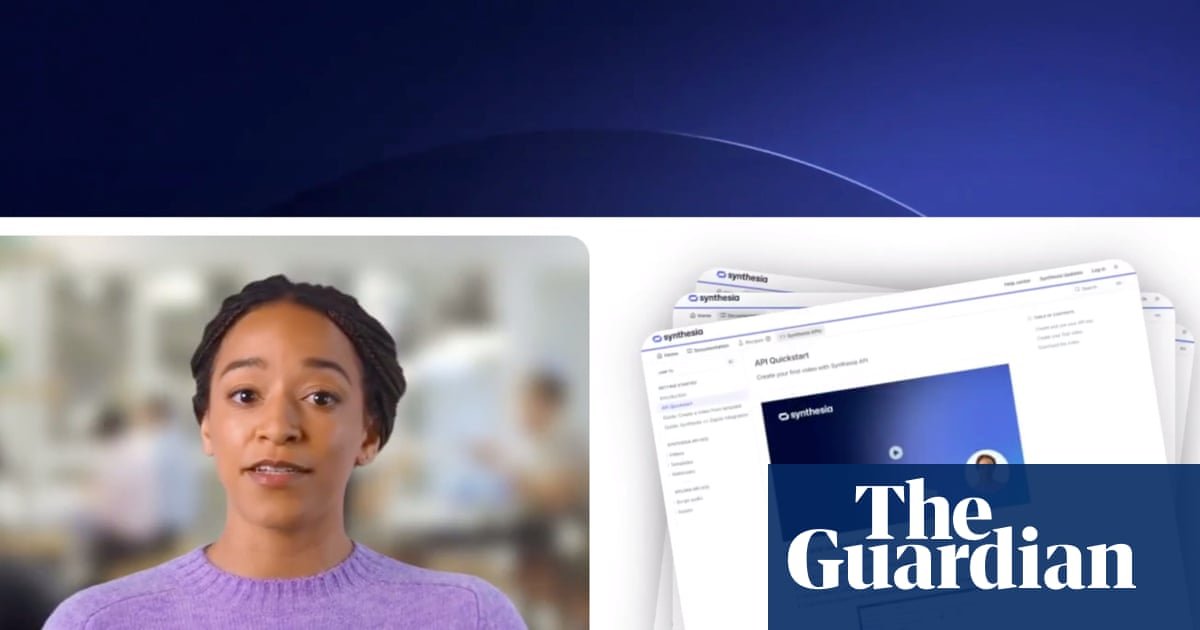
A British AI startup that makes realistic video avatars has almost doubled its valuation to $4bn (£3bn), providing a boost to the UK tech sector.
Synthesia was valued at $2.1 billion last year and moved into new offices in central London, marking the moment with a ceremony attended by Sadiq Khan, the city’s mayor, and Peter Kyle, then the technology secretary.
On Monday, it announced that its latest fundraising round, led by existing investor Google Ventures, had raised $200 million and valued the British company at $4 billion. Google Ventures is the venture capital arm of the search company.
Synthesia uses human actors to generate digital avatars of people and also offers employers the ability to create replicas of their staff. These avatars are then deployed by organizations in corporate videos in a range of scenarios such as workplace health and safety, cybersecurity tips and how to communicate better at work.
The company counts 70% of FTSE 100 companies among its clients, including NatWest, Lloyds Bank and British Gas. It is also used by non-corporate bodies, including the NHS, the European Commission and the United Nations.
The startup is also developing new avatars that will train employees and provide them with new skills, through scenarios such as role plays and personalized explanations.
Synthesia co-founder Steffen Tjerrild said the increase in valuation reflected the commitment of the company’s longtime backers rather than hype around the AI sector. “Existing investors have seen the progress, seen the numbers, seen them grow year over year,” he said. “It also shows that it’s less about external investors trying to hype, but also validation by existing investors.”
Last year, James Anderson, a prominent British technology investor, said he had seen big increases in the valuations of AI startups such as OpenAI and Anthropic “disconcerting”. Tjerrild said Synthesia was focused on executing its business plan, which he added was supported by supportive long-term investors.
“This round is driven by insiders, or primarily existing investors who deeply understand the business, who have seen the execution and improvement of the business over many years,” he said.
Synthesia generated revenue of $58.3 million in 2024 but posted a pre-tax loss of $59.2 million, according to its latest published accounts, which the company says reflect its investments in headcount, technology and new offices. Synthesia said it was on track to achieve $200 million in revenue this year.
The $4 billion valuation puts the company on par with British broadcaster ITV, which is worth £3.1 billion. Tjerrild’s stake in Synthesia now stands at $160 million, the same value as that of its CEO and co-founder, Victor Riparbelli.
Synthesia was founded in 2017 by the two Danish nationals as well as computer scientists Matthias Niessner and Lourdes Agapito.
Last year, the Mayor of London said Synthesia was doing “incredibly well” when it opened its new offices. However, in a speech this month Khan said AI would “pave the way for a new era of mass unemployment” if used recklessly, as intelligent, autonomous systems would prove cheap replacements for humans.
Tjerrild said he believes AI will allow companies to hire more staff. “We are an AI-driven company, we have 600 employees and we hired 40% more people last year,” he said. “As a business owner myself, if my employees become more productive, it means I can invest and hire more people.