

Spend any time online these days and artificial intelligence (AI) will offer to answer your Internet search queries, summarize long documents, improve the tone of your emails, and other seemingly endless tasks, but the research around this technology and its uses is still emerging.

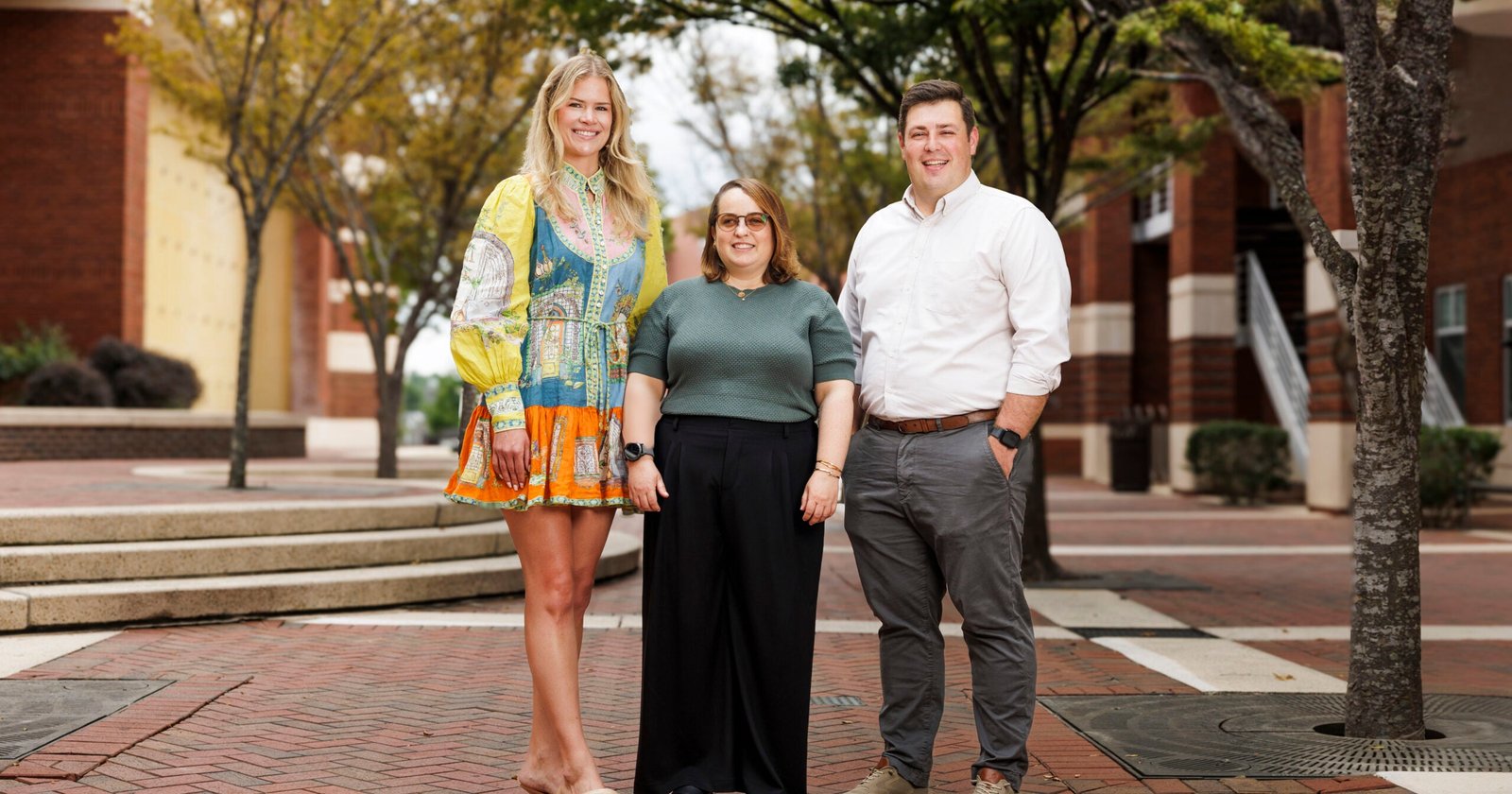
From left, School of Communication faculty members Erika Johnson, Rachel Son and Drew Ashby-King study the use of artificial intelligence in entertainment and how people respond to it. (Photos by Steven Mantilla)
Now three East Carolina universities School of Communication faculty members plan to study the use of AI in entertainment and how it affects people’s understanding and perception of the technology.
Drew Ashby-King, Erika Johnson and Rachel Son will study this aspect of AI with $10,000 in funding. Faculty of Fine Arts and Communication Research and Creative Activity Prize. These annual awards support the innovative research and creative projects of the college’s faculty members.
The project focuses on a social experimentation and competition TV show, in which participants live in separate apartments and interact solely through a social media app and the profiles they create, presenting themselves as they wish. This can lead players to present themselves differently from reality, known as “catfishing”.
This reaches a new level during one season of the show, when a new participant is an AI chatbot. The public knows that the AI has entered the chat; other participants do not.
Ashby-King, Johnson and Son want to study how viewers react to this knowledge and how their views of AI are affected – or not – by seeing AI used in this way. Son has spent years studying various aspects of AI and entertainment and, to his knowledge, this is the first program to adopt this use of AI, in which the chatbot would have grown to adapt to the program and react in real time.
“I focus a lot on the entertainment experience and how it affects your well-being,” Son said. “That’s where it all started, trying to understand how this changes your entertainment experience.
“But it goes beyond that to understanding how exposure to AI in this way has an effect on the way we understand AI or our perceptions of AI. Are we less worried, or do we feel like we have a better sense of AI knowledge?”
At the same time, the trio wants to know how this experience affects users’ well-being.
“Entertainment is often used for things like recovery or relaxation,” Son said. “How does using AI embedded in our entertainment affect that? How does that change your entertainment experience?”
Son’s previous research found that audiences were “done” when they discovered a play used AI and didn’t want to engage with it, demonstrating negative perceptions of the technology. These pieces were written stories, and Son is eager to see how audiences will respond to the use of AI in the audiovisual format of a television program.
Ashby-King said he imagines most of the people surveyed during the study haven’t thought about this type of use of AI; when they send a message online, they don’t think about whether a human or a chatbot will receive and respond to that communication.
“I think most of us always operate under the assumption that there are people on the other side, but the reality is that’s not the case,” he said. “We’re seeing AI-generated videos particularly on social media. I think there are some interesting implications for what we can say about larger impacts, based on the results.”
The three brainstormed many possible implications and discoveries, some that extend beyond this project and could spark additional research. Examples are how a person with psychopathy or narcicism reacts to AI, and different categories of morality, such as whether the public would view a human catfish as more moral than the chatbot.
Additionally, Ashby-King said an interesting literacy outcome could be potential actions ECU and other institutions could consider based on increased knowledge of AI through exposure to it in entertainment. He said institutions could add an AI module to security and other training that students must complete when they begin their studies.
“Do we start expanding this exposure from the beginning, adapting it to the university context? » he said. “And should we try to find interventions to increase that AI knowledge because that will be beneficial to the whole college experience?” »