

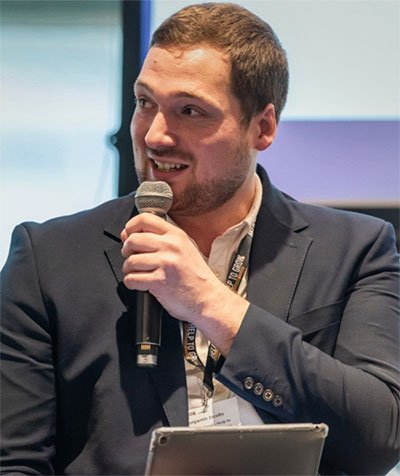
Following the recent publication from the Association of Business Mentors (ABM), AI and the future of business mentoringWe spoke with ABM Business Mentor Ben Jacobs about how AI is reshaping decision-making in small businesses and the role business mentors can play in facilitating the adoption of AI technologies. The report provides a practical, evidence-based view of where help is most urgently needed, ensuring the UK’s AI ambition translates into business outcomes that keep people center stage.
 Q: Why is the role of business mentoring being “reframed” by artificial intelligence (AI)?
AI is reframing corporate mentoring in three very practical ways. Above all, it is about transforming the companies we support. For many SMEs, AI has moved from a simple “accessory” to a strategic issue in terms of productivity, quality of service, customer experience and competitiveness.
In our own work at ABM, we’ve seen AI-focused mentoring conversations more than double in the second half of 2025 – a clear signal that business leaders are trying to determine where AI truly creates value, and where it is just noise. However, we also know that business leaders don’t always know where to explore and evaluate the opportunities, questions and doubts that often arise when considering AI.
Second, it transforms the tools and practice of mentoring itself. Mentors are starting to use AI to become better mentors – not to replace the relationship, but to strengthen it. This may involve using AI to reduce administration, to support reflective practice after sessions, to check thinking, surface additional leads, and help mentors prepare more effectively. Used well, it improves both quality and consistency and protects well-being by removing some of the burden of the role. It also means mentors can bring more value to more companies and work effectively with a broader portfolio of mentees.
Third, it transforms what is expected of business support organizations like ours. It’s no longer enough to simply say “AI matters.” We have a responsibility to implement this knowledge in a safe, ethical and genuinely useful way. In practice, this means creating and curating AI tools that can be used in mentoring sessions to structure thinking, explore options, and test decisions. Between sessions, these tools can help maintain momentum, capture actions, support thinking, and provide guidance that helps business leaders without losing the human connection. That’s why we’ve developed AI-powered tools for use in mentor training, mentor matching, and hands-on session support.
Q: How do professional business mentors support the UK’s national AI adoption mandate?
A: We help leaders translate AI from headlines and “noise” into a clear business plan: identify high-value use cases, prioritize efforts, test hypotheses, and build the confidence to act. Just as important, mentors help businesses act responsibly: protecting customer trust, managing data well, and thinking about human impact so that adoption builds well-being rather than burning out teams.
The biggest win is that AI can become a platform for innovation, new services, new ways to create value and more personalized customer experiences. But the benefits only last when adoption is responsible. This means integrating sensible safeguards around data, privacy, accuracy and bias so that trust is protected. In short: if the UK wants widespread and responsible adoption of AI, it needs people who can guide its adoption on the ground. Professional business mentors are already there.
The AI opportunity and strategic direction
Q: What is the main evidence that AI is a rapidly growing area of concern for SMEs?
A: The ABM found that the volume of AI-focused mentoring doubled in 2025, reflecting a sharp increase in the number of SMEs seeking help with AI as a business challenge or opportunity. Additionally, according to the ONS, in July 2025, 14% of businesses planned to adopt some form of AI within three months – the highest level since tracking began. Together, all of this paints a picture of a business ecosystem ready and eager to adopt new technologies, but which lacks the know-how to do so effectively, without external support.
Q: What specific risks does the white paper highlight that structured mentoring can help SMEs manage?
A: The biggest risk we see is unstructured adoption or informal experiments without a strategy or guardrails. In a cohort of business leaders we spoke with, more than 60% said they don’t have an AI strategy, even though many were already testing tools on a daily basis. Structured mentoring helps transform “shadow AI” into safe progress. It is important to clarify the company’s goals, the place of AI in business, and the importance of protecting customer trust, privacy, data privacy, and compliance.
It also helps leaders avoid two common pitfalls: overconfidence (assuming that outcomes are always good, or that risks are someone else’s problem) and inaction (waiting for perfect certainty while competitors learn by doing). Additionally, it helps teams manage the human side, like how roles change, how decisions are made, and how to keep work meaningful rather than mechanized.
Ethics, governance and impact on the workforce
Q: What questions are now dominating conversations about mentoring around AI?
A: At the start of a conversation, leaders are often too quick to ask “what tool?” “, a good business mentor will start with a different question by asking “what does your company do”, “where is the market going?” » and then “How can we get there faster with AI?” »
Conversations quickly move to business model and strategy (where value will be created), operating model issues (how work actually gets done), and workforce impact (skills, roles, job design, and anxiety).
We also see trust and ethics constantly emerging, including fairness and bias, transparency with customers and staff, and what “good” looks like when AI is involved in decisions.
Governance is another big theme. Who is responsible for AI-assisted outcomes, what simple safeguards are proportionate for an SME and how to manage privacy, confidentiality and ownership of AI-generated work. In practice, this is a cultural shift from fear or hype to informed experimentation.
Q: What support and training do you provide to business mentors on AI?
We have developed a course designed to help experienced practitioners gain the confidence to help businesses develop an AI strategy and implement their AI investments safely and responsibly. It provides mentors with hands-on experience and practical AI tools, as well as structured learning on data security, privacy, ethical use and change management. Since the end of September 2025, 200 mentors have registered for our “AI for Business Mentors course”,
Q: What is the impact of small training interventions for mentors on the broader business community?
A: Even small, targeted training interventions can have a ripple effect within the business community. An individual mentor can work with more than 20 companies per year. When a mentor improves their skills, for example by learning to define the opportunities, risks and ethics of AI in simple language, this expertise trickles down into dozens of SMB boardrooms, management teams and conversations with founders. Each better-equipped mentor helps multiple businesses make smarter decisions, design smarter experiences, and avoid common pitfalls. It is a powerful multiplier of AI capabilities, innovation and responsible adoption across the ecosystem.