

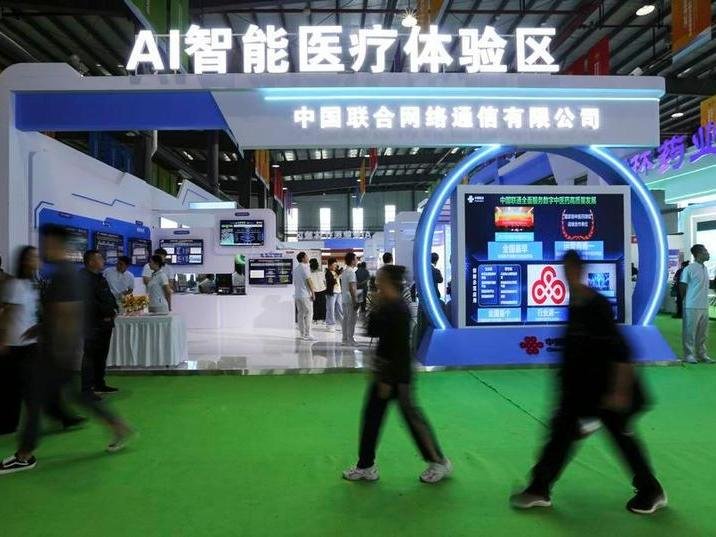
China’s artificial intelligence healthcare sector is poised for a year of stronger business prospects, as AI accelerates the reshaping of the healthcare market with its applications in diversified scenarios that span clinical applications, patient services, medical research and operations management, according to a market study.
Analysys, a Beijing-based data analytics company, noted in a recent research paper that the industrialization of China’s healthcare market through AI is accelerating. The company said the AI healthcare market value reached approximately 106 billion yuan ($15.21 billion) in 2024, with this growth driven by transformative advancements in AI technologies and smart hardware.
According to its analysis, AI applications in high-value scenarios, such as tumor screening and chronic disease management, are expected to become a growth driver for the industry over the next three years.
China Securities, a leading securities company, also highlighted promising market and investment prospects for AI-based healthcare in a series of recently released market analyses.
In a research note, China Securities particularly attributes the momentum of AI health sector development to policy support, citing a national goal announced in April 2025 by the government to develop more than 100 typical scenarios in which digital intelligence technologies will be applied in the pharmaceutical industry by 2027.
One notable example is a plan released last month by the Beijing Municipal Health Commission, which targets widespread adoption of AI in medical institutions by 2027, a move expected to be emulated by other regions, according to the China Securities study.
In a January research report, CITIC Securities, another securities firm, highlighted a fundamental shift in the commercialization of AI-based healthcare in China, which shows a more defined path this year as payment mechanisms for AI-based medical solutions strengthen and payers are more clearly identified.
Government policies are fueling market demand, the report said.
A guideline issued by the National Healthcare Security Administration last year integrated AI-assisted diagnostics into the national disease pricing framework, allowing public health insurance to directly reimburse AI-assisted medical solutions. According to the report, this move has unlocked substantial commercial potential for AI pathology.
The report notes that many regions in China, including the municipalities of Beijing and Shanghai as well as the provinces of Zhejiang and Guangdong, are accelerating the application of AI healthcare, with government-supported pilot bases already established.
In addition, CITIC Securities highlighted five potential investment frontiers, including AI drug development, AI solutions for basic healthcare, medical data circulation and transactions, AI-assisted pathology diagnosis, and the expansion of AI healthcare models in consumer markets.
Investments by large companies in healthcare AI models, such as PANDA, an AI platform developed by Alibaba’s Damo Academy, and Ant Afu, a user-facing AI healthcare management application, are strengthening the capability of these models and driving deeper AI commercialization of healthcare.
Xinhua – China Daily