

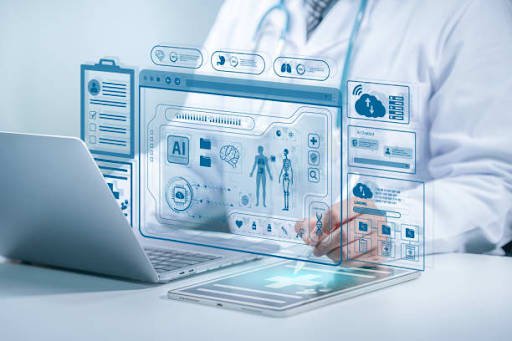
The role of artificial intelligence (AI) is changing almost every industry; the impact on the medical industry is particularly impressive. Nowadays, AI in healthcare helps researchers, hospitals and doctors achieve better results and save money by helping patients. Since the early days of disease diagnosis, AI has become a fundamental driver of innovation in contemporary medicine, as well as the ability to plan treatments. With the continued development of healthcare systems, machine learning, deep learning and data analytics are helping to transform the way patients receive care. Simultaneously, AI in medicine enables people to make lifestyle changes, i.e. maintain their healthy weight, with the help of personalized advice and health information. This article discusses the benefits and applications of the accelerated emergence of AI in healthcare and its implications for the world.
Benefits of AI in Healthcare
1. Faster and more accurate diagnosis
Analyzing medical data with a high level of precision, touted by AI as one of the most glorified benefits of AI in the field of health care. AI-based algorithms are able to analyze X-rays, CT scans, MRIs and lab reports in less time than a human and detect patterns too small for a human to see. This results in early detection of cancer, heart disease and neurological disorders. AI in medicine can also help doctors in their decision-making, which reduces the rate of medical errors, allows them to make better decisions and treat their patients in a timely manner, thereby increasing the survival rate of patients. Such innovations not only ensure that healthcare is more efficient; they also promote trust between patients and medical staff.
2. Better personalization of treatment
Every patient is an individual and AI is an important tool for designing a unique treatment plan tailored to the person’s health needs. Machine learning algorithms analyze genetic data, lifestyle habits and medical history and determine how a patient will respond to medications or a particular treatment. For example, AI systems can suggest changes in diet and activity level to people trying to keep their weight within a healthy range, and develop highly tailored wellness plans. Individual care will mean patients receive the best care with the fewest side effects. As a result, hospitals will be better positioned to achieve better outcomes and minimize unwarranted procedures.
3. Increased hospital productivity
AI does not only work in the clinical sphere, but its operational benefits are no less transformative. AI-based applications are used in hospitals to optimize hospital schedules, patient traffic and bed occupancy. These systems automatically assign staff, reduce waiting time and avoid traffic jams. Algorithms are used to help patients book appointments, reduce administrative burden and navigate through chatbots and virtual assistants. The use of AI in healthcare helps hospitals save a lot of time and resources that can be used by medical teams to devote more time to patient-centered care. This helps make operations a little easier and health systems more reliable.
Important Applications of AI in Healthcare
1. Medical imaging and diagnostics
AI is now needed to interpret medical images very accurately. Deep learning systems identify abnormalities such as tumors, fractures and infections at a faster rate than other systems. AI tools are used to prioritize urgent cases by radiologists and accelerate the timeliness of emergency care. These systems serve as a second pair of eyes in most hospitals and not every detail is overlooked. Applications of AI in medicine have been very useful in increasing confidence in diagnoses and minimizing human errors.
2. AI in virtual health assistants and telemedicine.
AI-powered virtual assistants will transform the way providers and patients connect through telemedicine, providing patients with a way to document their current health concerns, schedule doctor appointments, and provide information about their emotional state when not seeing their doctor. These technologies can help anyone looking to maintain a healthy weight or blood pressure. Another way AI supports remote or synchronous consultations with doctors is by creating medical summaries for doctors, which is a much more efficient way to prepare for online visits. Due to the increasing development of telemedicine, AI has helped shape accessible and convenient healthcare for patients around the world.
3. Predictive Analytics for Disease Prevention
Predictive analytics is an AI-powered technology that predicts health problems and prevents them before they get worse. Through the analysis of trends in patient information, AI systems are able to detect the presence of diabetes, heart disease and mental illness in their early stages. This helps doctors act earlier and prescribe individual lifestyle changes. Predictive analytics can also monitor habits and estimate risks associated with obesity, so people interested in healthy weight management can use it. AI-powered preventive care reduces long-term care expenses and improves patients’ quality of life.
Practical impact of AI in healthcare
1. Make transformational clinical decisions
AI would help doctors make evidence-based suggestions to aid decision-making. One example is AI, which analyzes data from thousands of patients to recommend treatments that have proven effective in similar cases. This feature helps doctors reduce uncertainty and provide high-quality, standard care. THE AI in medicine has become a necessary element in fields such as oncology and cardiology to plan complex operations, predict treatments and select the most effective clinical routes.
2. Better patient engagement and self-care
Today, patients are more involved than ever in their healthcare processes. Sleep, heart rate, nutrition and physical activity are provided in real-time by AI-driven mobile apps and wearable gadgets. The tools are used to ensure individuals stay healthy, active, and avoid chronic disease. AI encourages patients to establish more positive routines and take control of their health with personalized recommendations. Such a shift in prevention, such as self-care, reduces the health care burden.
3. Invest in research and drug discovery
Medical research is accelerating thanks to AI, where large data sets are analyzed and acted upon in minutes rather than months. Identifying a new drug formulation, predicting disease mutations, and finding possible cures are scenarios where researchers are using AI and finding solutions faster. In the event of a global health crisis, AI can be used to study virus patterns and predict their spread so that response can be rapid. It is certain that through the application of AI in medical research, medical discoveries become more effective, and millions of people benefit from them.
Conclusion
AI is no longer a future phenomenon, but it is already defining the modern reality of healthcare. The role of AI in healthcare is unquestionable, as it has been used for early diagnosis, individualized care, improving hospital processes, and creating innovative research. However, with the development of this technology, AI in medicine will continue to provide new opportunities and help patients learn to live healthier, more informed lives. From assisting in clinical decision-making to helping people maintain a healthy weight, AI is setting a new benchmark for healthcare innovation around the world.