

Every year, Gartner publishes its list of technology trends. This year the list looks like this (organized into three categories):
Bucket #1: AI imperatives and risks
- Agentic AI
- AI governance platforms
- Disinformation Security
Bucket #2: New frontiers in computing
- Post-quantum cryptography
- Ambient invisible intelligence
- Energy efficient computing
- Hybrid IT
Bucket #3: Human-machine synergy
- Spatial computing
- Polyfunctional Robots
- Neurological improvement
Thematic trends
What’s nice about this list are the buckets or “themes” that Gartner likes to call them. It’s impossible not to bring them together to explain the broader trajectories of technologies that have the potential to impact all aspects of business. Organizing trends into themes therefore makes sense.
The AI theme is spot on – and my students would agree. In our courses on AI, machine learning, generative AI, and emerging business technologies at the Villanova School of Business, we also follow technology trends. We moved pretty quickly from large language models to pre-trained generative transformers, custom GPTs, proprietary LLMs, and Agentic AI, noting how “easy” it is to build agents with tools like Autogen , LangChain and CrewAI, among others. There is no doubt that agentic AI is a major and significant trend in 2025 and beyond.
AI governance is necessary, but not always so easy to define or apply. Gartner is right to list this technology trend. But as the article notes, “AI guidelines vary by region and industry, making it difficult to establish consistent practices.”
One of the major challenges of AI is its ability to create and spread disinformation. “Disinformation security” is not only an important trend, it is also a necessity.
The second theme – New Frontiers in Computing – fits almost perfectly with our Emerging Business Technologies course. Post-quantum cryptography – “data protection that resists the decryption risks of quantum computing (QC)” – anticipates advances in quantum computing that we think are inevitable but will sometimes be risky.
Our reaction to ambient invisible intelligence trends is “it’s time” and we’ve started talking about using technology to create natural, intuitive experiences.
Energy-efficient computing is an exploding requirement. While blockchain has been the wake-up call for energy needs, AI is the tsunami. Gartner is right to emphasize this requirement, regardless of how it is met.
The hybrid IT trend is evident.
The third theme – human-machine synergy – is another theme that almost should have been addressed. The first trend is spatial computing, which is resurrecting augmented and virtual reality (AR/VR) to solve some of the problems we expected it to have five years ago. The enabling technology is now ready to leverage AR/VR in areas identified by Gartner, such as “gaming, education, and e-commerce…healthcare, retail, and manufacturing.”
Although Gartner identifies the cost and burden of head-mounted displays, we believe these displays will shrink significantly over the next few years. The recent release of smart glasses from vendors like Meta and Viture Pro XR Glasses suggests how this will evolve.
Gartner identifies “multifunctional robots” as an important trend and we agree. The marriage between robotics and AI is only just beginning and will soon give rise to children capable of performing multiple tasks.
Over the years the Defense Advanced Research Projects Agency has invested in brain-computer interfaces. In fact, several decades ago, DARPA funded some of the earliest research in biocybernetics.. Companies like Neural link have already demonstrated significant potential in this area. Gartner rightly places neurological enhancement on the list of technology trends.
Thematic opportunities
Gartner’s themes and trends closely match the trends we see in academia. Our courses on AI, machine learning, generative AI, and emerging business technologies intersect with many Gartner trends.
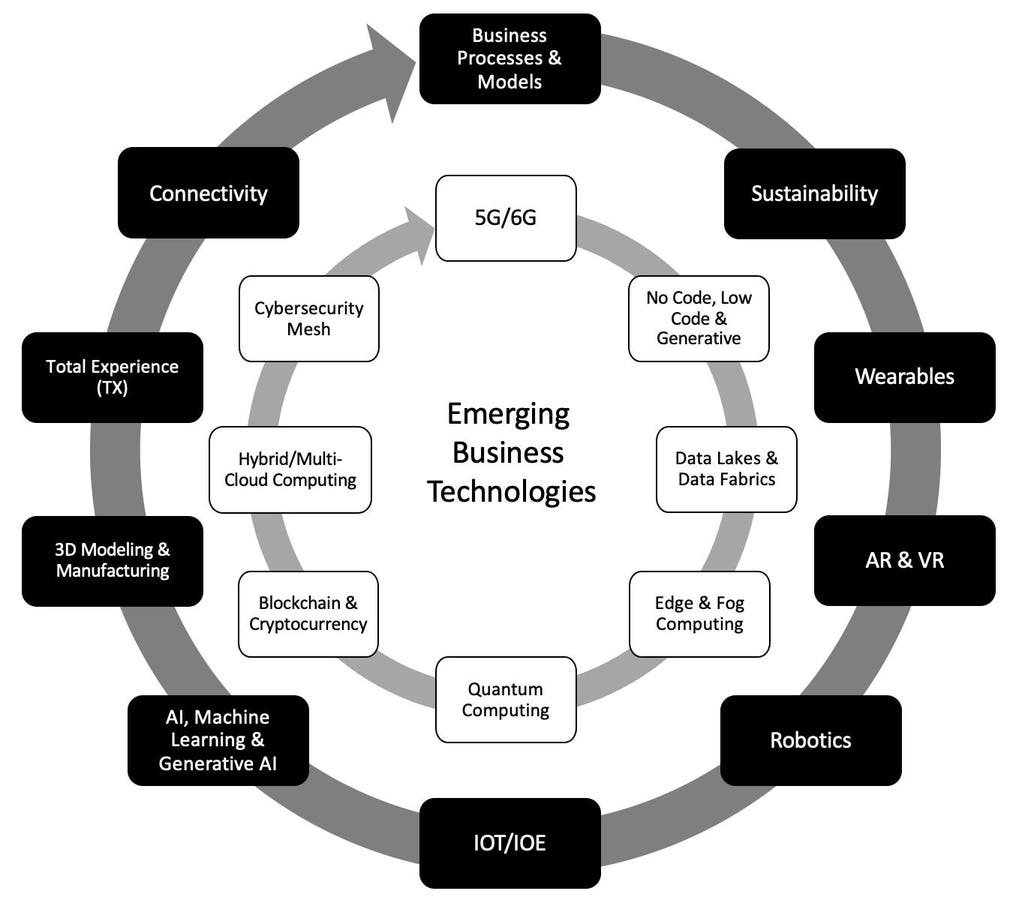
We should follow Gartner’s lead and organize them into baskets or themes. The figure below, from our Emerging Business Technology course, is organized around infrastructure (the inner circle) and applications (the outer ring) technologies. The upcoming AI, Machine Learning and Generative AI course will focus heavily on Agentic AI and the Emerging Business Technologies course will focus heavily on Sustainability, Human-Machine Synergy and Robotics.
Business Technology Trends
The technology trends sector
Gartner isn’t the only company focusing on technology trends. Forrester, Deloitte, IBM, IDC, PWC, and McKinsey all track and predict technology trends. The challenge, of course, lies in the volatility of these trends. For example, the courses we teach at university are redesigned every semester. Five years ago, generative AI was unrecognizable as an application platform. Today, it is redefining industries. Where will it be in five years? I’d like to see Gartner list the trends – and the industries most affected – in 10 years. Or at least in five years. It’s much easier to do them year after year. Same for my classes. I’m not sure I could teach a course on emerging business technologies that focuses on how technologies will change five years from now.
On top of all this, trend forecasters must identify where technologies will land in vertical industries as well as the processes and sub-processes that define them. They should also probabilistically identify which processes and subprocesses will be automated, improved, or eliminated as AI, machine learning, and generative AI evolve. This would allow strategists and tacticians to exploit the technology competitively. One thing is certain. No one can ignore technology trends this year, next year, or any year.