

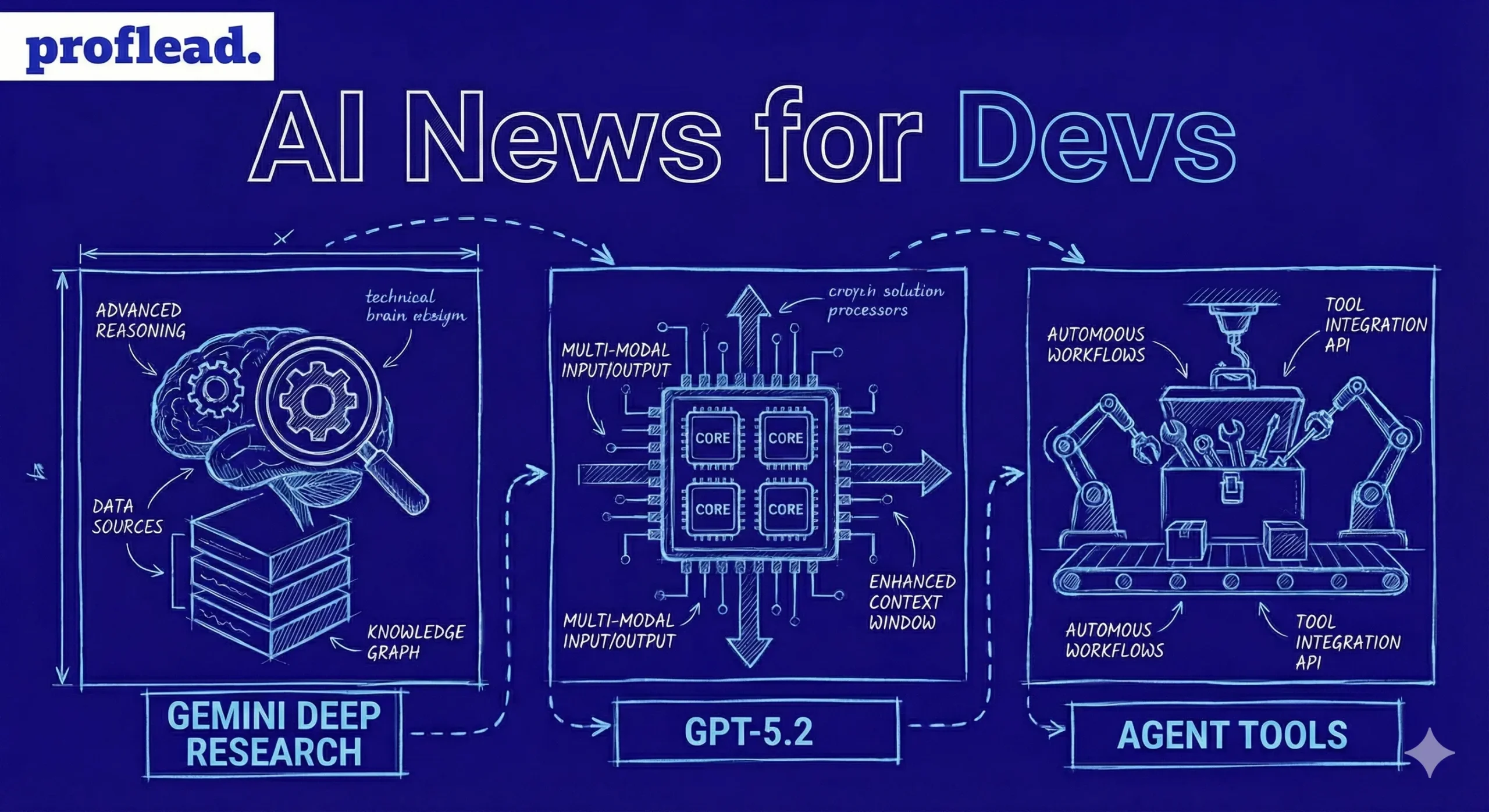
Between December 8 and 13, 2025, many important AI updates were released to developers. I’ve rounded up the most important updates you should know about. These updates include new AI models, better tools for creating AI agents, design tools, and development platforms.
1. Google Gemini Deep Search and Interactions API
Google has released Gemini Deep Research, a new AI agent powered by Gemini 3 Pro. He can read and understand large amounts of information, then create clear reports with sources and citations.
Developers can use this agent through the new Interactions API. This API is a single REST interface that helps manage conversations, memory, and tool usage when creating AI agents.
Learn more: https://blog.google
2. OpenAI GPT-5.2 release
OpenAI has launched GPT-5.2, calling it the most powerful model yet. It’s better to:
-
Write and understand code
-
Manage long conversations and documents
-
Working with images and other input
-
Use tools correctly
There are three versions:
-
Instant – fast and light
-
Brainstorming – great for coding and planning
-
Pro: highest precision for complex tasks
I haven’t tested it yet, but I definitely will.
Learn more: https://openai.com
3. Microsoft Ignite Ads
At Microsoft Ignite, Microsoft introduced Foundry, a platform for building and running AI agents at scale.
Key elements include:
-
Foundry IQ for finding and using knowledge
-
Foundry Control Plan for Security and Compliance
-
Agent Framework (combines Semantic Kernel and AutoGen)
-
Hosted agents to run agents in production
-
Model routing, including support for Claude from Anthropic
This platform helps teams more easily create, manage and control AI agents.
Learn more: https://techcommunity.microsoft.com
4. Agentic AI Foundation (AAIF)
OpenAI, Anthropic and Block created the Agentic AI Foundation (AAIF). Its goal is to support open standards and neutral governance for AI agents.
Companies like Google and Microsoft bring important technologies, such as:
-
Model Context Protocol (MCP)
-
AGENTS.mda standard for describing agent behavior
This allows different tools and platforms to work together. If you want to know more about AGENTS.md please watch my explanation video:
Learn more: https://openai.com
5. Google Disco and GenTabs
Google Labs introduced Disco, an experimental AI tool. One feature, GenTabs, can turn your open browser tabs and chat history into simple web apps.
Using natural language, GenTabs can create:
-
Dashboards
-
Small tools
-
Interactive pages
No coding is required and it is powered by Gemini 3.
Learn more: https://blog.google
6. Google Stitch with Gemini 3
Google has updated Stitch, a design tool now powered by Gemini 3. It helps generate high-quality user interfaces. A new Prototypes feature lets developers connect screens into interactive flows without writing code. This is useful for quickly testing ideas.
If you want to see a video on PointPlease let me know.
7. Mistral Devstral 2 and Vibe CLI
Mistral has released Devstral 2, an open source coding model with:
It works great on coding tests. Mistral also released Vibe CLI, a command-line tool that understands your project and lets you explore and modify the code in natural language.
Learn more: https://mistral.ai
8. Managing Google CLI sessions
Google updated the Gemini CLI to automatically save:
-
Prompts
-
Answers
-
Tool calls
-
Use of tokens
These are stored in project-based sessions. Developers can navigate and resume sessions using a session browser. This makes long or repeated workflows much easier.
This feature is enabled by default in version 0.20.0. Also be sure to watch my video on 10 Gemini CLI Pro Tips Every Coder Should Know!
9. Microsoft Lightning Search Agent
Microsoft Research introduced Agent Lightning, an open source framework for training AI agents using reinforcement learning.
It separates:
-
Agent execution
-
Agent training
This means developers can add reinforcement learning without rewriting their code. The system tracks agent actions and assigns rewards for each AI call.
Learn more: https://microsoft.com
Conclusion
December 2025 showed how quickly AI tools for developers are improving. New models, open standards, and agent frameworks make it easier to create smarter AI systems with better reasoning, smoother interfaces, and greater control.
See you next week! 😉