

 Listen to this article
Teaching businesses how to apply Generative AI their work this year became a full-time job for area entrepreneurs looking to help lead the Midstate in its AI revolution.
For Andrew Kochanowski and Adam Marsh, finding a niche in the growing AI field meant understanding the technology and how quickly it is evolving, but it also meant putting a local, accessible face on AI in an age when technology can seem dehumanizing.
Marsh, president and owner of Spring Grove-based Ledge Inc., a quality management consultant for manufacturers, has given nearly 70 talks on AI since he began learning about the technology last year — work that now includes combining traditional engineering services with AI tools that streamline routine tasks.
“We’re not trying to take away from them the things they’re good at,” Marsh said. “We’re trying to make them better at the things they’re not good at. And that’s a lot of paperwork.”
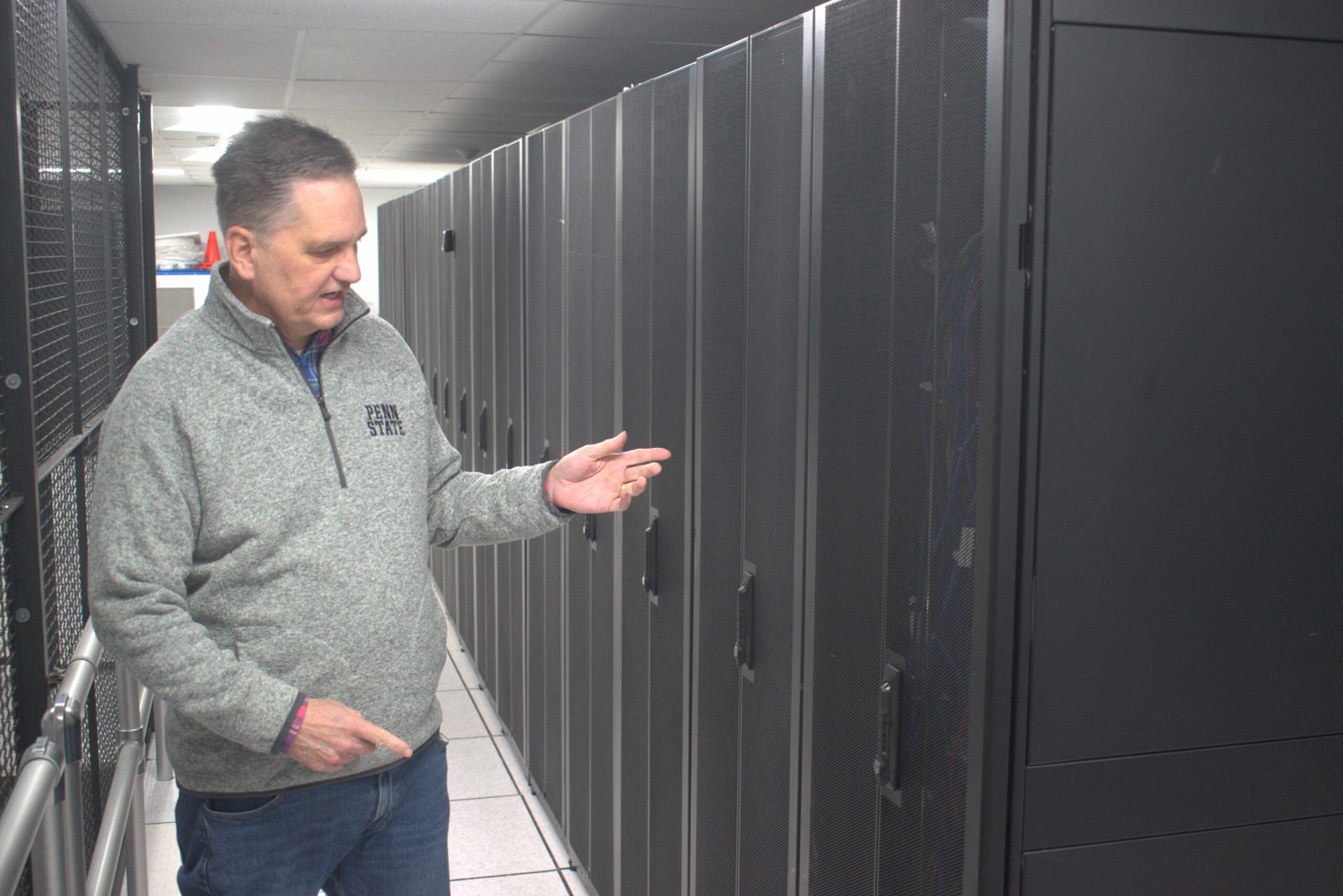
Kochanowski, founder and CEO of Harrisburg-based data center Alerify, launched operations in 2024 and began viewing AI as a unique opportunity to differentiate his business this year.
Alerify customers typically use the center to store company data privately and with redundancies that may be too expensive to have on-premises. With the expansive growth of generative AI in 2025, Kochanowski sees an opportunity for the data center to bolster its computing power and become a place for businesses in the region to access private AI servers.
“As a data center, we’re pretty bland. It’s colocation, it’s a private cloud server, or it is a disaster recovery. It’s kind of the three lanes of swimming,” he said. “However, as I started to learn more about AI, it became an important differentiator and it attracted a lot of attention from customers.”
Their increase in demand reflects a broader shift in the Midstate. Companies want to use AI to automate routine work and explore new tools, but many lack the training, infrastructure and secure systems to do so responsibly, creating a growing demand for local experts who can help close this gap.
Education first
Both Marsh and Kochanowski gave talks on how businesses can leverage generative AI: Marsh from the perspective of the many applications available to manufacturers in the region and Kochanowski from his understanding of infrastructure.
Both agree that today, they spend almost 75% of their time on education.

When he first spoke with a customer, Marsh said he often wanted to solve big problems on day one, but he found that starting small tasks builds confidence in what the software can do.
“Most people are at the exploration stage,” he said. “If the goal is to crawl, walk and then run, they’re just getting started. So let’s make them an AI policy, plug them into the software and start learning.”
A local connection to the software also helps bridge the wide gap between the companies creating the software and the end user. Marsh compared today’s generative AI tools to the early days of the internet, adding that a common misconception was that AI tools should act like glorified search engines.
“It’s an interesting world where the AI people are really, really high up here, and the manufacturers are here, and we’re trying to put them somewhere in the middle,” he said. “When we deploy AI in an enterprise, it’s different than any other software that anyone has purchased. Before, they bought software, they bought software to solve one solution. Now, they buy a tool that can solve many solutions across the entire enterprise, and they may not even know what solution or problem they’re trying to solve immediately.”
Make it local
Marsh and Kochanowski saw the benefits of working together to provide area businesses with local resources to improve their work with AI.
Together, the two offer businesses a way to use AI without sending sensitive data to large public cloud platforms.
Marsh can provide businesses with Ledge’s proprietary software, which uses generative AI software from a number of popular options, such as ChatGPT, Claude, and Gemini.
A business can then use Alerify’s data center to privatize its information and have the AI generate answers only using the protected knowledge base from Alerify’s private servers.
Kochanowski said that while a large company can host all of this from its own servers, mid-sized and smaller companies may find this cost prohibitive.
“(Generative AI) requires a tremendous amount of power, and that’s where graphics processing units (GPUs) can handle that volume of searches and queries and tie all of those questions together,” Kochanowski said. “For a company to invest in their own GPUs, that’s an astronomical expense. So if we provide that resource, they can come in, use it on a metered basis and only pay for what they use.”
Today, Marsh and Kochanowski’s main competitors are big national names, whether it’s the commercial offerings of today’s generative AI platforms or big data storage options like Amazon Web Service.
“Amazon is not going to answer the phone to answer your question. They’re worried about General Motors, Harley Davidson, Georgia Pacific,” Kochanowski said. “But for us, it’s about jumping over everything and solving the problem immediately because we understand that these are our neighbors, our associates and our colleagues in this area.”
The cost of standing still
What Marsh and Kochanowski are seeing locally reflects national trends: a majority of companies are experimenting with AI but not yet committing to the technology.
According to a 2025 study by Chicago-based consulting firm McKinsey & Co., nearly two-thirds of a group of 1,993 participants across 105 countries say their organizations have not yet begun to make AI enterprise-wide, but a similar 62% say their companies are experimenting with it.
Both say one of the biggest risks for businesses is not misuse of AI, but its use without leaders knowing where and how it is being applied.
“If a plant manager, CEO or executive president thinks their employees aren’t already using AI, they’re dead wrong,” Kochanowski said, adding that today’s college graduates are entering the workforce knowing how to use and access AI.
“If I can give my employees the right tools to keep this private and not include the big public cloud, the business will be better off and employees will be more efficient,” he said.
For Marsh, the answer is to anticipate this use and require the company to appoint an AI champion and develop an AI policy.
“From there, I like to show them use cases because it gets their brains working,” Marsh said. “And once they see them, they say, ‘Well, can it do this? Can it do that?’ And from there, it snowballed. We love having this session where we can sit down with them and explore the possibilities.