

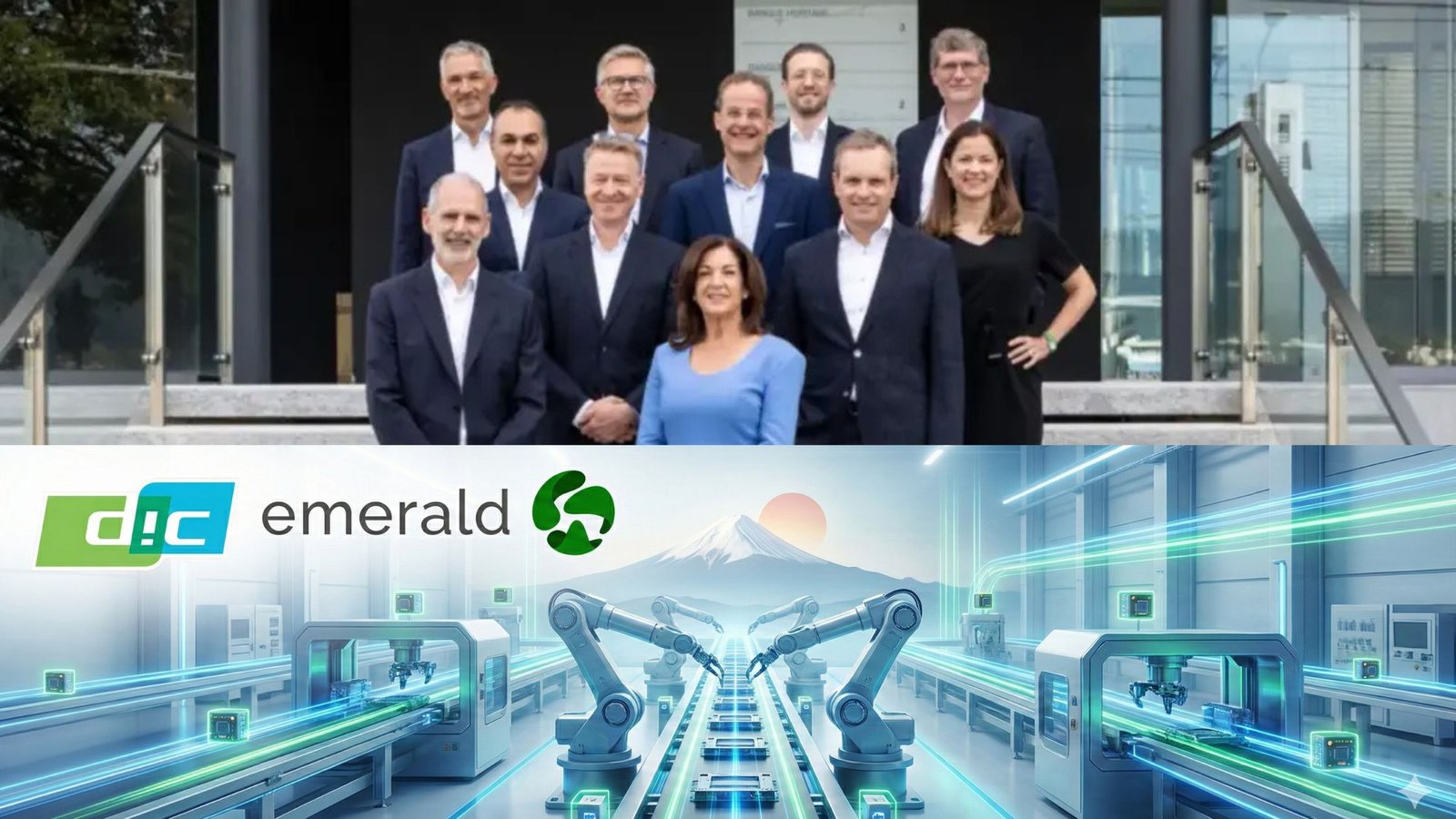
Japan’s DIC Corporation is partnering with Emerald Technology Ventures to create a portfolio of cross-border startups in sensing, robotics and automation, signaling a deeper industrial push toward AI-driven hardware.
Japanese chemical group DIC company joined forces with Emerald Technology Companies to launch a $62 million investment platform focused on what the companies describe as “physical AI.” The initiative aims to support startups developing technologies that integrate artificial intelligence into real-world systems such as robotics, sensors and automation.
Under the terms of the agreement, Emerald will act as a strategic partner to DIC, managing startup sourcing, due diligence, investment execution and post-investment support in Europe and North America. The platform represents a structured move by DIC to expand its exposure to emerging industrial technologies beyond its core materials business.
What is “Physical AI”?
While much of the current AI debate focuses on software models operating in digital environments, such as generative AI tools and data analysis platforms, physical AI refers to intelligent systems that interact directly with the real world.
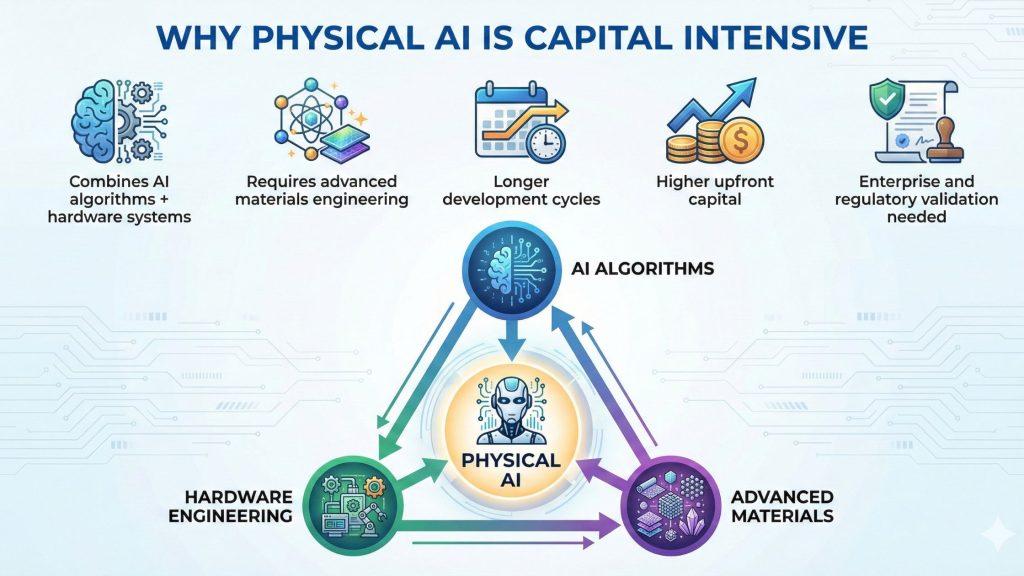
Physical AI combines artificial intelligence with hardware components that can sense, process, and respond to physical conditions. Instead of generating text or analyzing only numerical data, these systems translate AI decision-making into real-world actions.
Concretely, this includes technologies such as:
- Intelligent detection and on-board intelligencewhere sensors collect environmental or operational data in real time and AI algorithms process it for predictive or automated responses.
- Wearable technologiesthat integrate AI-based feedback into devices that monitor movement, health or performance.
- Robotics and soft roboticswhere machines are equipped with adaptive learning capabilities to operate safely and efficiently alongside humans.
- Industrial Automation Platformswhich combine AI, robotics and connected systems to optimize production lines, logistics operations or energy management.
What differentiates physical AI from software AI is the complexity of the integration. These systems lie at the intersection of three critical layers:
- AI algorithms and data models
- Hardware engineering and systems design
- Advanced materials and sensor technologies
Because they operate in real-world environments, physical AI applications must meet higher standards of sustainability, security, and regulatory compliance. Development cycles are typically longer, capital requirements are higher, and commercial deployment often depends on pilot testing and enterprise adoption rather than rapid consumer adoption.
For investors and businesses, this means that physical AI represents a more industrial and execution-demanding segment of the AI landscape – one in which technological advances must be coupled with manufacturing capabilities, supply chain integration and long-term strategic partnerships.
In short, physical AI extends artificial intelligence beyond screens and cloud systems to machines, devices and infrastructure, embedding intelligence into the physical fabric of industries.
Why DIC is expanding its venture capital strategy
DIC operates in more than 60 countries and reports consolidated annual revenues exceeding 1 trillion yen. Traditionally known for its pigments, resins and advanced materials used in packaging, electronics and automotive applications, the company is now seeking new growth vectors aligned with industrial transformation.
The investment platform is part of DIC’s “Direct to Society (D2S)” framework, which guides its approach to identifying long-term societal challenges and translating innovation into commercial ventures. Physical AI is positioned as a central pillar of this strategy, particularly where sensors, flexible components and intelligent materials converge.
Takashi Ikeda, Representative Director, President and CEO of DIC Group, said:
“The field of physical AI has the potential to reshape the relationship between people and technology, making it more natural and intuitive. Our partnership with Emerald represents a major step toward gaining world-class expertise and networks in this area.”
Zurich as a strategic base
To strengthen its global venture capital operations, DIC plans to establish a startup investment management subsidiary in Zurich in spring 2026. Switzerland has become a European deep-tech hub, supported by strong research institutes and industrial ecosystems in the areas of AI, robotics and advanced materials.
Emerald, headquartered in Zurich with offices across Europe, North America and Asia, will support DIC’s local presence and facilitate cross-border investment activities. The move reflects a broader trend of companies moving venture capital activities closer to innovation hubs rather than operating solely from their national headquarters.
A broader shift in corporate venture capital
The partnership highlights a broader shift by industrial companies towards structured venture capital investing. Rather than relying solely on in-house R&D or acquisitions, established manufacturers are increasingly collaborating with venture capital firms to gain early visibility into emerging technologies.
For Emerald, founded in 2000 and focused on investing in industrial and clean technology, the partnership adds another corporate mandate in the themes of hardware-driven innovation.
Gina Domanig, Managing Partner and CEO of Emerald, said:
“With physical AI, the real opportunity lies in technologies that work alongside people, enhancing human capabilities rather than replacing them. »
His remarks highlight the focus on human-centered AI systems – a positioning that contrasts with narratives focused solely on automation-driven movement.
Over the next five years, the platform is expected to build a diverse portfolio of more than a dozen companies operating at the intersection of AI, hardware and materials science. Emerald will manage deal flow and post-investment engagement, while DIC will bring industry expertise and strategic collaboration opportunities.
However, investments in physical AI come with inherent complexity. Hardware development cycles are longer, capital requirements are higher, and commercial adoption often depends on regulatory approvals and company validation. The success of the partnership will depend not only on contract sourcing, but also on the ability to convert pilot deployments into scalable industrial contracts.
Industrial AI moves from concept to capital allocation
At $62 million, the platform is small compared to the multibillion-dollar AI funds raised by global asset managers. Its importance, however, lies less in scale than in positioning. This partnership marks a shift in the way industrial companies approach artificial intelligence – not as a standalone software opportunity, but as an integrated capability within physical systems.
Over the past two years, much of the AI discourse has focused on generative models and cloud-based applications. Yet for industrial groups, the business opportunity increasingly lies in the application of AI to machines, materials and manufacturing environments. Intelligent robotics, sensor-driven systems and adaptive automation platforms are expected to reshape production lines, supply chains and mobility infrastructure over the next decade.
For companies like DIC, whose historical strength lies in materials science and industrial manufacturing, venture capital investment provides a structured way to access early-stage innovation without relying solely on internal R&D. By partnering with an experienced venture capital firm such as Emerald, DIC benefits from exposure to emerging technologies in Europe and North America while maintaining strategic flexibility. This reduces the risk of being technologically overwhelmed as AI capabilities are integrated into hardware and materials.
The move also represents a broader corporate trend. Large industrial players are increasingly using venture capital platforms to gain early insight into cutting-edge technologies – particularly in the areas of robotics, automation and advanced sensing – where integration with materials and manufacturing processes can create defensible competitive advantages. Rather than waiting for technologies to mature, companies are seeking early access through minority stakes and structured collaboration.
That said, hardware-centric AI investments are inherently complex. Development cycles are longer than those of software startups, capital intensity is higher, and scaling often depends on industry partnerships rather than rapid consumer adoption. Cross-border portfolio management adds another level of execution risk. Returns will depend on the startups’ ability to convert pilot projects into reproducible industrial contracts.
In this context, the DIC-Emerald platform can be seen as an early positioning strategy in a segment that could define the next phase of AI deployment. If generative AI has captured the digital imagination, physical AI represents the operational layer – embedding intelligence into equipment, materials and infrastructure.
Takeaways
- $62 million physical AI platform: DIC Corporation has established a $62 million investment vehicle focused on sensing, wearables, robotics and automation.
- Strategic venture capital partner: Emerald Technology Ventures will lead sourcing, due diligence, investment execution and post-investment support in Europe and North America.
- Focus on industrial AI: The platform targets “physical AI” – technologies that integrate AI into real hardware systems rather than purely software applications.
- Zurich expansion: DIC plans to establish a venture capital subsidiary in Zurich in 2026 to strengthen its presence in the European deep tech ecosystem.
- Materials meets AI: The initiative aligns with DIC’s capabilities in materials science and its “Direct to Society” framework for building long-term businesses.
- Execution is key: Hardware-intensive AI startups require longer cycles and greater capital; portfolio performance over the next five years will determine the impact.