

The future is coming quickly. Some might say it’s coming too quickly, while others might even say it’s already here.
For businesses operating in Idaho, like anywhere else, they must always look to the future.
Rapid changes in society that are merging with the business world are resulting in evolving issues and the need for problem solving when it comes to workforce developmentchanges in the way foreign trade is conducted, revisions to taxes and regulations, and the ever-evolving use of artificial intelligence (AI).
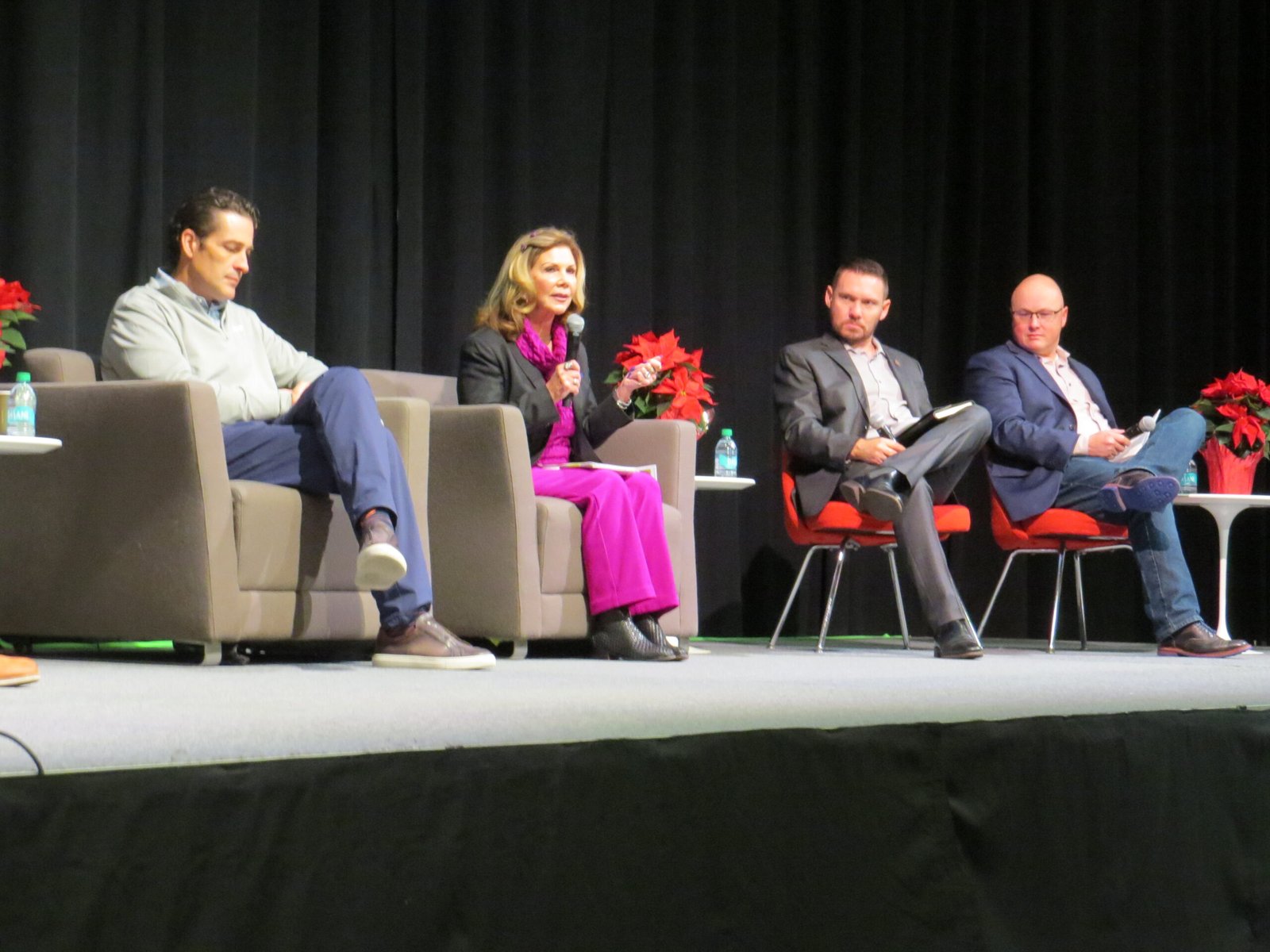
And while no one can accurately predict the future, everyone can talk about it, as a group of four local business leaders did at the recent Idaho Business Review Future Forum panel discussion Dec. 11 at the Boise Center.
In the face of so much economic uncertainty, locally, nationally and globally, panelist Jeremy Barber, vice president and partner of HC Company, and seasoned construction management professional with more than two decades of experience, offered some simple advice to those considering moving forward with a new project in the coming year.
“Start now. Anyone who always thinks they’re going to time the market and get in when it’s cheaper is wrong,” Barber said. “Between material costs and labor costs, everything is going to increase. »
When it comes to taking into account both the time and cost of completing a project, trade disputes with China, affected by tariffs, he pointed out, continue to impact the local construction and development industry.

“If the global economy is going to drive up the cost of a product, particularly steel, local costs will also go up,” he said. “For us, everything is influenced by the global market.”
Barber also noted that people often tend to forget or simply overlook the fact that even though a number of products are manufactured or assembled here in the United States, many of the components used in those products still come from overseas.
“Hopefully next year we’ll have a little more certainty, and while we may not be happy with what might happen with some of these rates, we can at least plan around these rates for the future,” Barber said.
For Coni Rathbone, recognized by Ozone Magazine as one of the nation’s top 25 Opportunity Zone lawyers, the Fed’s recent slight interest rate reduction could help provide some relief from lingering trade and tariff issues.
“This could help offset tariffs and price increases,” said Rathbone, whose resume includes a wealth of experience in real estate, securities and business transactions. “One of (President) Trump’s main goals with the BBB was to find incentives to bring manufacturing back to the United States. Hopefully, lower interest rates can help balance tariff issues.”
Accountant Josh Tyree, president of Sorren, a top 50 accounting firm with offices now in 12 states, explained how his group remains active within the industry. construction industryand that he sees projects being built “in a timely manner” at the local level.
“The amounts invested are enormous,” he said. “It’s a big impact for us.”
However, he also acknowledged that while international trade won’t have a “huge impact” on his industry, it is important for business leaders to keep pace with changes in tax laws.
“The one thing with all tax bills is they have to be balanced somehow,” Tyree said. “Whenever a tax law is written, there is always Part 2, which is how the IRS interprets it.”
Unlike the other panelists, it is changes in employment law rather than tax law that remain a priority for Rob Graham, director of HR strategy for Express Employment Professionals.

Developing a sustainable current and future workforce across a myriad of industries was a key topic of discussion for him during the session.
With a focus on workforce strategy and professional development, Graham said he has to “pivot a lot” within his industry as his company works to help local businesses retain enough staff in the future.
“The basic laws regarding checks are an area that we need to specifically educate our customers on,” Graham said. “Background check laws changed dramatically a few years ago and many people are not complying with them. »
Such changes, he noted, can cause employers to “hesitate” when it comes to hiring.
“If we can’t understand that from an educational standpoint and know where we need to be from a legal standpoint, businesses tend to run lean,” he said. “And there’s no shortage of people available.”
Likewise, he stressed the importance of companies hiring the “right people” to avoid unnecessary costs that can result from poor hiring decisions.
“Most new hires coming into a company (judge) within the first seven minutes how long they are likely to stay at a job,” Graham said. “The (new employee) will make that decision within that time frame whether it’s a long-term position or a stepping stone to something else.”
Capitalizing on what he describes as “transferable skills” is one way to contribute to the development of a workforce. “Some people may not have the exact skills, but they have the right attitude and cultural fit to be trained.

“Make sure you hire the right people at the right time,” he said. “That’s why I highly recommend looking into the training and development of your workforce.”
Additionally, he added, many companies, in what he called the “post-COVID” era, were considered “overstaffed” in various sectors.
“We were hanging on to people we normally wouldn’t,” Graham said. “Tolerating poor performance, bad behavior. A myriad of things. Today we see companies doing more with less and not replacing those workers.”
Tyree completely agreed with Graham’s assessment. “Companies are transporting more people than they probably need,” he said. “And with AI, it’s an easy excuse to let people go rather than hold on.”
AI, arguably the company’s most popular two-letter acronym, easily served as the centerpiece of the discussion, with each of the four panelists discussing the impact the technology currently has and will continue to have on their particular industry.

And with no less than 165 billion dollars invested in Opportunity Zones
Nationally, areas considered economically distressed communities used to drive long-term investment and job growth, but AI has certainly made its way into this specialized sector as well.
“This is an overlay of security laws and AI will help draft security information and documents,” Rathbone said. “The reporting requirements of new programs will benefit from AI. We will be able to better identify how many jobs are created and how much revenue is generated.”
And while AI can’t frame a structure or pour concrete, Barber explained how the technology can “enhance” the type of construction company he helps oversee.
“AI is much more powerful and intense, and it’s revolutionizing the way we operate,” he said.
Specifically on what he considers to be the “business development” side of the industry.
“We can use AI to draw a set of plans and ask it to identify and summarize the key points of the project in less than a page,” he said. “And it can even give us an analysis of whether we should move forward, even based on our construction company talents.”
The key, however, he said, is understanding how to properly incentivize a tool like ChatGPT to generate the best results. “It’s been an eye-opener for us to see how this can actually help us be more effective in what we do.” »
But when it comes to the staffing industry, Graham detailed some of what he sees as the “downsides” of over-reliance on AI.
“In the employee market, more and more workers are using AI as a crutch, like a Google search,” he said. “People don’t use their brains anymore. It can make them more beautiful than they are.”
Likewise, he also completely agrees with Barber’s assessment of knowing how to properly use AI to achieve the best results. “How you communicate with AI is really the most critical part of getting the right outcome. High performers who use AI as an enhancement allow them to be more productive.”
Highlighting a “values-driven” approach in his accounting firm, Tyree also highlighted the need to further use AI as an “opportunity” to improve production in the workplace.
“AI is coming, but it will take time to transform our industry,” he said. “He won’t know the person or the relationship. He won’t have a beer while we do tax planning. For us, the personal touch is what’s important.”
And in today’s multi-generational workforce, Graham believes it all comes back to the human element.
“Don’t reject so-called overqualified candidates,” he said. “When you put the right people in the right seats on the bus, your organization can accomplish much more in a shorter period of time. Supervisors and management need to understand how to utilize the strengths and weaknesses of their diverse workforce.”