

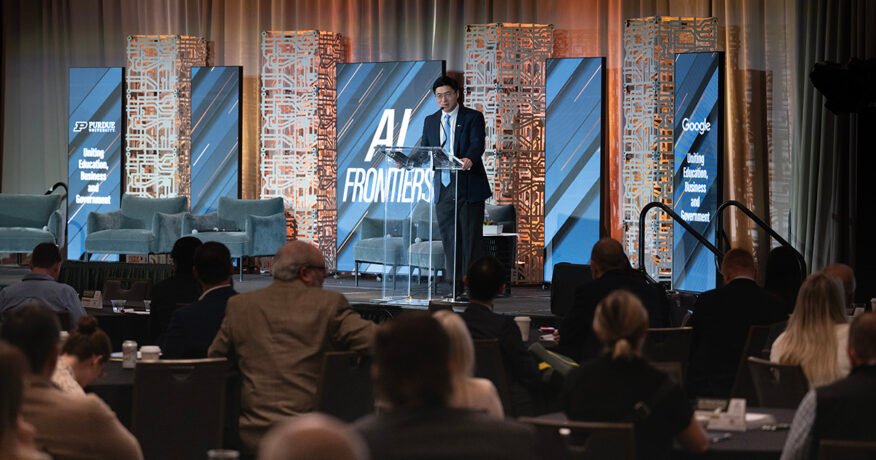

Purdue University President Mung Chiang speaks Nov. 13 at the AI Frontiers: Uniting Education, Business and Government for Real-World Innovation summit, where the new Datasets and Infrastructure for Physical AI Innovation initiative was announced. (Photo by Purdue University/John Underwood)
WEST LAFAYETTE, Ind. — A new initiative brings together disciplines across Purdue University to make valuable data sets more easily discoverable and accessible, enabling faster scientific breakthroughs using artificial intelligence and machine learning techniques.
The initiative, titled Datasets and Infrastructure for Physical AI Innovation, was announced on November 13 at the summit. AI Frontiers: Uniting Education, Business, and Government for Real-World Innovationhosted by Purdue and Google.
The initiative is a collaboration between the Purdue Institute for Physical Artificial Intelligence, nanoHUB, the Rosen Center for Advanced Computing, Purdue Libraries, and experts in various fields. Together, these teams develop and deploy data infrastructure to enable Purdue researchers, collaborators and partners to take physical AI to the next level.
This effort aims to support the entire data lifecycle: capturing data at the source, curating it for AI and machine learning, connecting it to high-performance computing resources for model training and inference, enabling real-world decision making for Purdue and its partners, and supporting feedback for new experiments and data collection efforts.
These datasets will range from geosciences and agriculture to life sciences and climate. View a selection of datasets developed as part of this initiative.
Raw data from laboratory equipment, field measurements, high-performance computer simulations, road and traffic imagery, and curated documents are indexed into AI-ready resources available directly on Purdue’s world-class cyberinfrastructure to develop AI models and evaluate their reliability. Real-time data is used to transform these AI models into intelligent digital twins for autonomous physical AI applications in transportation, supply chains and manufacturing.
With the increasing availability of autonomous and embodied infrastructures, AI researchers anticipate that these models will learn themselves and accelerate discoveries. The initiative is complemented by frameworks and processes to manage and manage access to licensed and controlled datasets on Purdue’s AI supercomputing facilities.
“Our researchers produce extraordinary data with the potential to transform science and society,” said Dan DeLaurentis, executive vice president for research. “This initiative ensures that these datasets are ready to drive artificial intelligence and machine learning, enabling faster, smarter and more reproducible discoveries. »
One example of the initiative’s impact is a smart digital twin for semiconductor manufacturing, developed in collaboration with Purdue’s Birck Nanotechnology Center. Experimental data from Birck’s processing tools are automatically captured and streamed to digital resources hosted on Purdue’s cyberinfrastructure. AI models are continually refined as new data comes in, improving their predictions and guiding optimal processing “recipes” for semiconductor devices. Indeed, the digital twin teaches itself: it improves efficiency, reduces waste and accelerates innovation in advanced manufacturing.
A second example focuses on digital agriculture. Using a smartphone app, farmers can collect data about their fields using remote imaging platforms such as drones, which is transmitted to Purdue servers. There, data is used to refine AI models to provide personalized, real-time feedback that helps farmers maximize yield and resource use. The system closes the loop between data collection, analysis and actionable insights, creating continuously improving digital twins that integrate data and models from individual plants to entire farms.
By making Purdue’s research data AI-ready, connected and reusable, the initiative supports the university’s commitment to excellence at scale. This ensures that Purdue’s broad research enterprise not only produces new knowledge, but also fuels a growing ecosystem of digital twins, intelligent systems and open data resources that amplify impact in everything from materials and manufacturing to agriculture and health.
“This effort aims to unlock the full potential of Purdue data,” said Alejandro Strachan, Reilly professor of materials engineering and researcher on intelligent twins and digital innovation. “By connecting data, high-performance computing and artificial intelligence, we are creating a foundation on which each new experiment makes our AI models smarter and our research more impactful at Purdue and beyond.” »
The effort also aligns with Purdue calculatesan initiative that encompasses the university’s research and programs in physical AI, computing, semiconductors and quantum science.
About Purdue University
Purdue University is a public research university leading in large-scale excellence. Ranked among the top 10 public universities in the United States, Purdue discovers, disseminates and deploys knowledge with unparalleled quality and scale. More than 107,000 students study at Purdue across multiple campuses, locations and modalities, including more than 58,000 on our main campuses in West Lafayette and Indianapolis. Committed to affordability and accessibility, Purdue’s main campus has frozen tuition 14 years in a row. Learn how Purdue never stops in its persistent pursuit of the next giant leap, including its integrated and comprehensive urban expansion of Indianapolis; the Mitch Daniels School of Business; Purdue calculates; and the One Health initiative — to https://www.purdue.edu/president/strategic-initiatives.