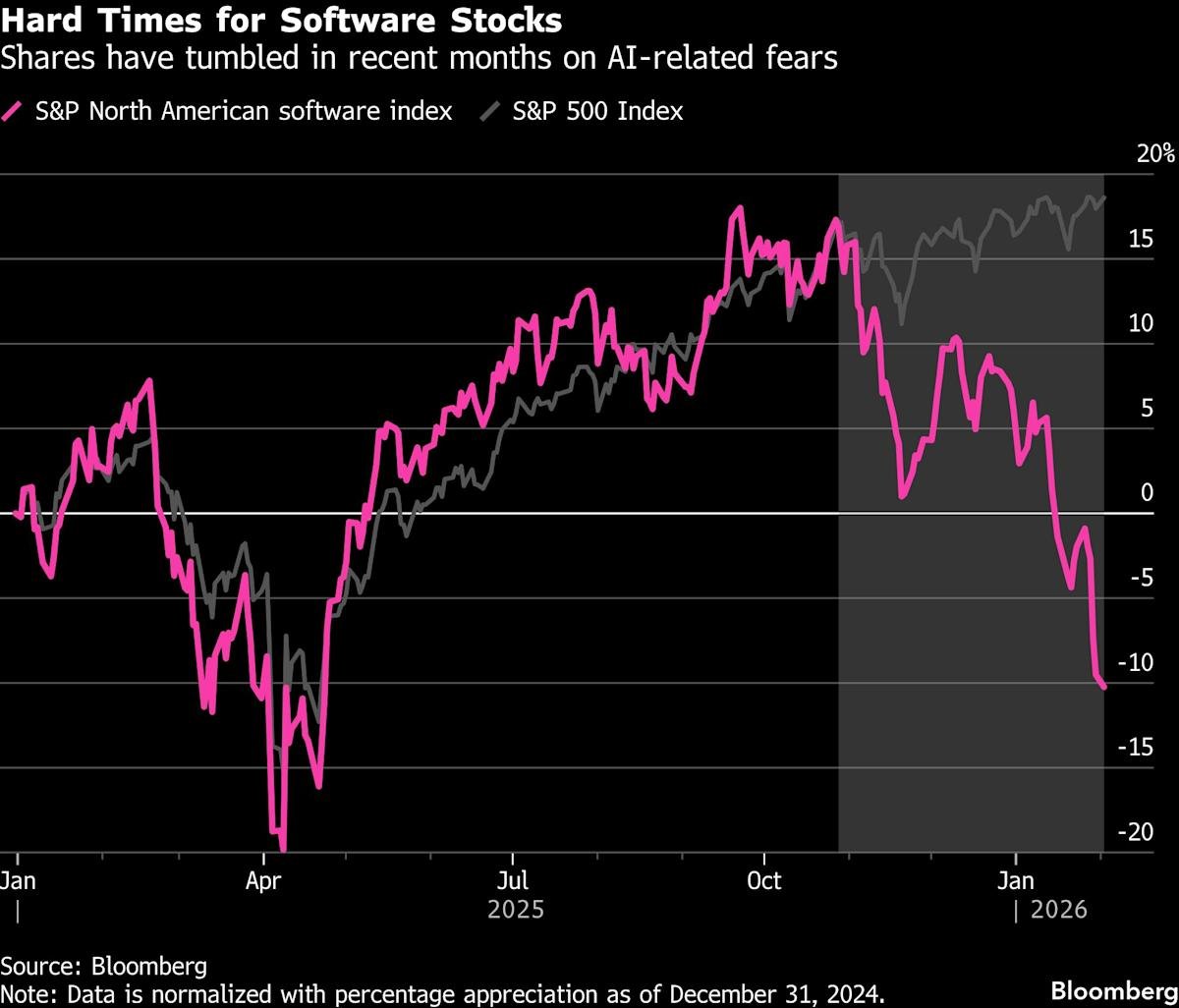
(Bloomberg) — Wall Street has been skeptical of software stocks for some time, but sentiment has shifted from pessimistic to apocalyptic lately, with traders dumping shares of companies in the sector as fears about destruction wrought by artificial intelligence mount.
“We call it the ‘SaaSpocalypse,’ an apocalypse for software-as-a-service stocks,” said Jeffrey Favuzza, who works on the equities trading desk at Jefferies. “Trading is largely ‘take me out’ style selling.”
The concern was underscored Tuesday after AI startup Anthropic released a productivity tool for corporate lawyers, sending shares of legal software and publishing companies tumbling. Selling pressure was evident across the sector, with London Stock Exchange Group Plc, which has a large data analytics business, down 13%, while Thomson Reuters Corp.SORTING) plunged 16%. CS Disco Inc. (LAW) sank 12%, and Legalzoom.com Inc. (L.Z.) fell by 20%.
Perceived risks for the software industry have been brewing for months, with the January release of Anthropic’s Claude Cowork tool supercharging fears of disruption. Video game stocks were caught up in the slide last week after Alphabet Inc. began rolling out Project Genie, which can create immersive worlds with text or image prompts. Overall, the S&P North American Software Index is on a three-week losing streak that pushed it down 15% in January, its biggest monthly decline since October 2008.
“I ask clients: ‘What is your mouth-nose level?’ “And even with all the capitulations, I haven’t heard any conviction as to where that is,” Favuzza said. “People sell everything and don’t care about the price. »
Concerns are also being felt in the private equity industry, with firms like Arcmont Asset Management and Hayfin Capital Management hiring consultants to audit their portfolios for companies that might be vulnerable, according to people with knowledge of the matter. Apollo has reduced the software exposure of its direct lending funds by almost half in 2025, from about 20% at the start of the year.
Among U.S. public companies, so far this earnings season, only 67% of S&P 500 software companies have exceeded revenue expectations, according to data compiled by Bloomberg. This compares to 83% for the tech sector as a whole. Even though all software stocks beat earnings expectations, that matters little in the face of concerns about the long-term outlook.
For example, Microsoft Corp (MSFT). reported strong earnings last week, but investors’ focus on slowing cloud sales growth put a new spotlight on the amount spent on AI, sending the stock down 10% on Thursday. January was the worst month for Microsoft shares in more than a decade. At the same time, earnings reports from ServiceNow Inc. and SAP SE gave investors additional reasons to be cautious about the software companies’ growth prospects.
Microsoft fell 2.9% on Tuesday, its fourth consecutive negative session.
On the other hand, PalantirTechnologies Inc. (PLTR) gave bullish revenue forecasts when it reported results after the bell on Monday. It also reported 70% revenue growth in the fourth quarter, beating Wall Street estimates. Shares rose 6.9%.
“The fear with AI is that there will be more competition, more pricing pressure and their competitive moats have become shallower, meaning they might be easier to replace with AI,” said Thomas Shipp, head of equity research at LPL Financial, which has $2.4 trillion in brokerage and advisory assets. “The range of their growth outcomes has widened, which means it’s harder to assign fair valuations or see what looks cheap.”
These AI fears led Piper Sandler to downgrade software company Adobe Inc. (ADBE), Freshworks Inc. (FRSH) and Vertex Inc. (VERX) on Monday. “Our concern is that stories about seat compression and vibration coding could put a cap on the multiples,” wrote analyst Billy Fitzsimmons. Vibrational coding refers to the use of AI to write software code.
To be sure, some investment professionals view the selloff in software stocks as an opportunity. The Sycamore Sustainable Tech Fund, a European open-end fund that has beaten 99% of its peers over the past three years, has been buying Microsoft shares amid an economic downturn, hoping the company will one day become an AI winner.
It doesn’t hurt that the software giant’s shares look cheap at the moment, trading at less than 23 times estimated earnings, the lowest in about three years. And from a technical perspective, its 14-day relative strength index is at oversold levels. More broadly, the software index multiple is the lowest in years and its RSI indicates that it is oversold.
The software sector is “probably oversold enough to rebound,” Jonathan Krinsky, BTIG’s chief market technician, wrote in a note to clients last week. However, he added, “it will take a long time to repair and build a new base” and that “we haven’t been fans of software for a while given the deterioration in relative strength that really accelerated” in the fourth quarter of last year.
The central problem facing investors looking to buy software stocks is separating the winners from the losers when it comes to AI. Clearly, some of these companies are going to prosper, meaning their shares are effectively on sale after the recent rout. But it may be too early to determine who they are.
“The draconian view is that software will be the next print media or the next department store, in terms of its prospects,” said Favuzza at Jefferies. “The fact that the pendulum has swung so far to the side of selling everything suggests that this is going to result in some very attractive opportunities. However, we are all waiting for an acceleration, and when I look at the numbers for 2026 or 2027, it’s hard to see the upside. If Microsoft is struggling, imagine how bad it could be for companies more in the process of disruption, or without a dominant position.”
—With help from Subrat Patnaik, David Watkins and Stephen Kirkland.
©2026 Bloomberg LP