

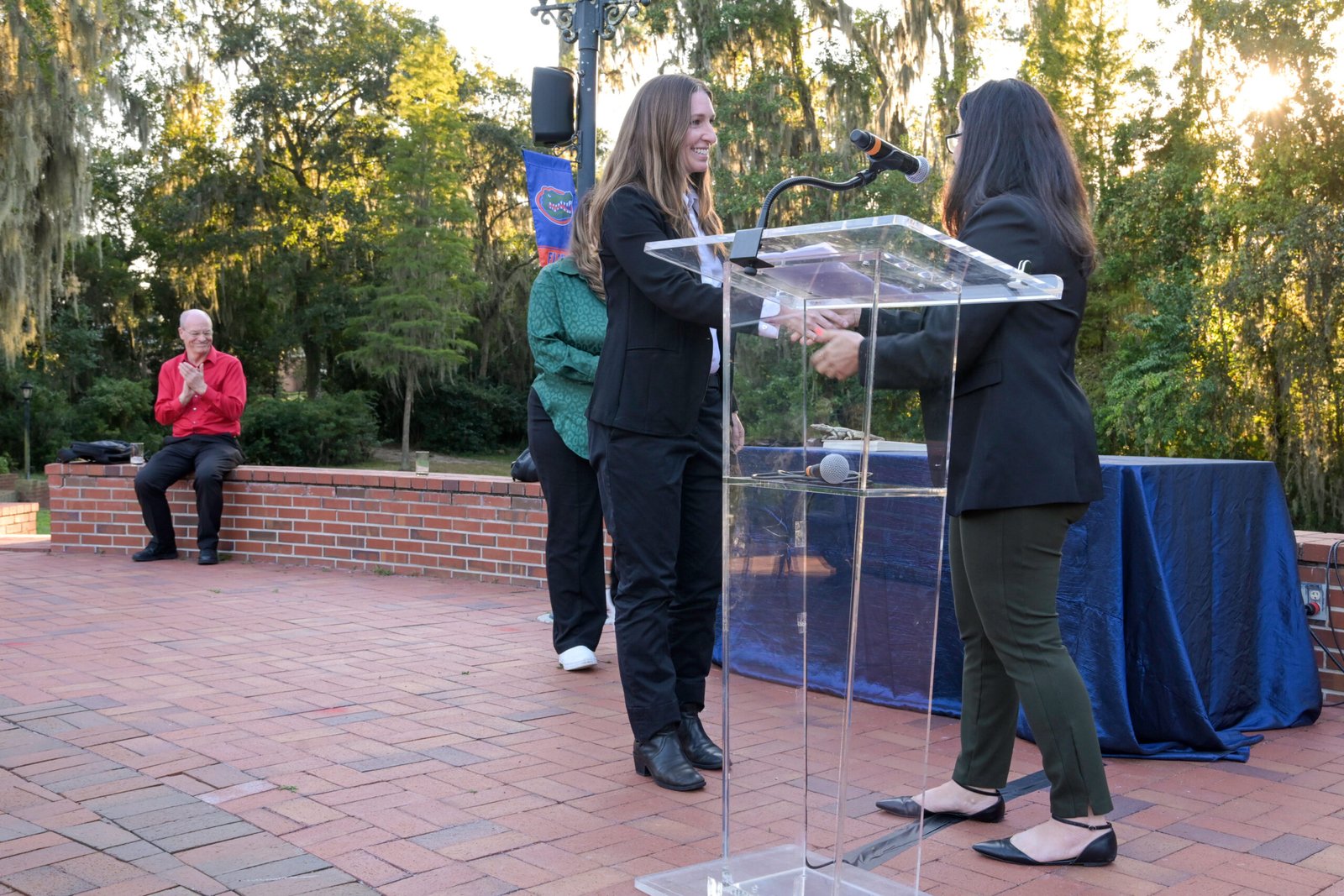
Three University of Florida scientists are redefining what’s possible, from the operating room to the molecular level.
At a ceremony this week at the Earl and Christy Powell University House, UF Artificial Intelligence and Computer Science Research Institute (AIIRI) honored Dr. Adrian Roitberg, Dr. Kiley Graim and Dr. Jeremy Balch with the first ever AI Research Prizerecognizing groundbreaking work that demonstrates how artificial intelligence is transforming science, medicine and engineering.
The event was part of AI Days, a week-long celebration organized by the AI² Center in collaboration with the AI and IT Research InstituteTHE Center for Educational Technology and TrainingTHE Center for Teaching Excellence And UF Information Technology. Sponsors included NVIDIA, Mark III Systems, Vobile, Cisco and Vast Data.
Alina ZarePh.D., director of the Research Institute of AI and Computer Science, presented the awards.
“These are our first awards for the AI and Computing Research Institute, and I can tell you they were incredibly competitive,” Zare said. The awards, she explained, recognize AI research “across a continuum of disciplines and individuals, from emerging researchers to established leaders.”
She then described the evaluation process: “We had a two-stage evaluation process because we had so many applicants and amazing applicants,” she continued. “Faculty from across campus evaluated the nominations based on our rubric, we identified the finalists, and an external committee selected the winners. This was a truly challenging set of incredible nominations.”
Zare presented the first of three research awards from the institute, recognizing scientists whose work illustrates the growing role of AI in discovery and innovation at UF.
Adrian Roitberg: accelerating discoveries at the molecular level
Adrian RoitbergFrank E. Harris Professor of Theoretical Chemistry, received the AI Research Excellence Award for developing neural network models that significantly accelerate molecular simulations. Known as ANI models, these AI tools learn quantum mechanical data to predict molecular behavior with the same accuracy but in a fraction of the computational time. His team’s models have become valuable resources for researchers around the world.
Using UF’s HiPerGator AI supercomputer, Roitberg’s lab recently simulated a primitive Earth atmosphere producing amino acids and other molecules essential for life, a major advance for AI-based chemistry.
Kiley Graim: Making precision medicine more equitable
Kiley GraimPh.D., assistant professor at Herbert Wertheim College of Engineeringwon the AI Research Early Career Award for using AI to advance cancer biology and precision medicine. His work bridges computer science and genetics to make medical AI models more accurate and fair.
Graim leads one of the world’s largest comparative oncology initiatives, analyzing nearly 200,000 tumors across 240 species to uncover shared biological mechanisms that can improve patient outcomes.
Jeremy Balch: Bringing AI into the operating room
Dr. Jeremy Balchresident in general surgery and recent Ph.D. degree in biomedical informatics, received the AI Research Dissertation Award for developing AI tools that improve surgical safety and efficiency. His dissertation applied natural language processing, computer vision, and data modeling to automate tasks such as trauma coding and instrument tracking.
Balch’s work lays the foundation for directly integrating AI into surgical workflows and improving real-time decision-making in hospitals.