

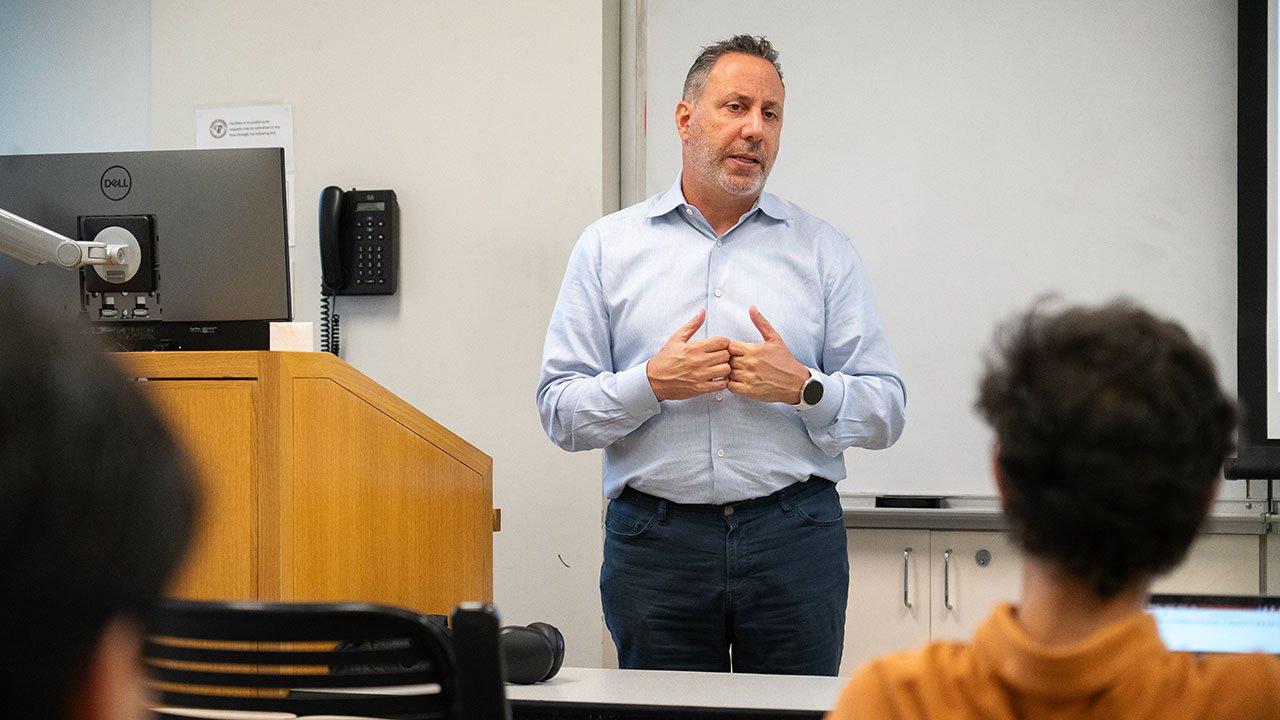
Fordham will create a new fund for the study of artificial intelligence as applied to finance, economics and other fields, thanks to a gift from CFO and investor Peter Zangari, Ph.D., a Fordham alumnus.
The Zangari Family Faculty Research and Innovation Fund will support faculty research projects in AI, some of which will also involve students. The fund is expected to foster more research collaborations with industry, raise Fordham’s profile and help students gain experience leading to internship and job opportunities. Zangari also foresees a “multiplier effect” of research that could influence multiple sectors, from health care to education to business and more.
“This will benefit not only faculty, but also students, and ultimately those who are (impacted by) this research,” he said. Zangari and his wife, Jennifer Zangari, are establishing this fund by donating a total of $1 million to the university over the next several years. The fund is dedicated to interdisciplinary AI research, with a focus on finance, economics, asset management and data science.
Incubate research that matters
Zangari’s gift provides significant seed funding for Fordham’s Transdisciplinary Research Incubator project, which will bring together experts from different fields to focus on the most important research questions, consistent with the University’s strategic plansaid Fordham President Tania Tetlow.
“Fordham is investing in research and innovation to address today’s pressing challenges. It gives us so much encouragement to see an alumnus move forward with such generosity,” she said. “We are honored by Peter’s commitment to Fordham and thank him for supporting our faculty and helping our students become the ethical AI leaders our world needs.”
“A source of talent” for industrial partners
Zangari studied economics at Fordham, from which he graduated in 1989, as well as Rutgers University, where he received his doctorate. Since then, he has held various positions in management, research, investment management, product development and financial technology. It belongs to Fordham University President’s Counciland is also teaching a course at Fordham on AI and financial markets this fall. He has donated to the economics department and established an economics fellowship at Fordham a few years ago.
Zangari is a partner at MDOTM, a financial technology company specializing in AI-driven investments. He plans to work with the University to connect this and other companies with Fordham faculty and students, fostering collaborations, internships and networking. He believes the fund will help ensure that companies “view Fordham as a source of talent” in the field of artificial intelligence.
Accelerate innovation with AI
AI can foster innovation by helping professors from very different fields communicate and work together on problems, in addition to accelerating research in general, Zangari said.
“Maybe this is the time where you really need that speed to take action: rather than waiting five or 10 years, maybe with the help of AI you can get there in two years,” he said.
“The bottom line is that (AI) streamlines so many things that you would otherwise do. And it (allows) people to think about solutions – or think about problems before even coming up with solutions – in a much faster and more efficient way than in the past.”