

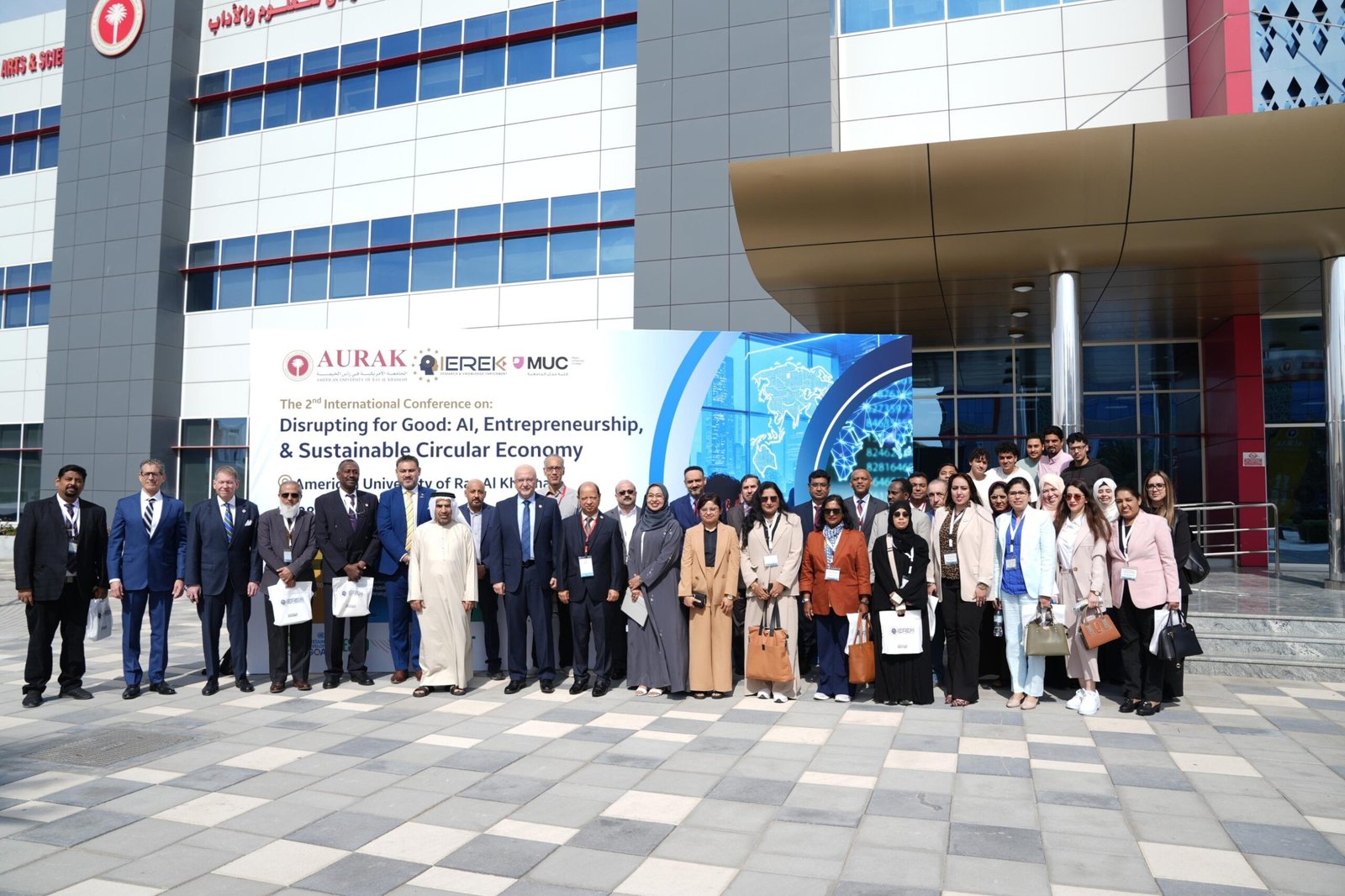
A number of global experts, researchers, practitioners and policy makers from across disciplines highlighted the need to integrate business management practices, entrepreneurship and sustainable circular economy principles at the 2nd International Conference.
The two-day conference, titled “Disrupting for Good: AI, Entrepreneurship and the Sustainable Circular Economy” (AIECE), was organized by the American University of Ras Al Khaimah (AURAK) on its campus.
The aim of the conference was to explore how artificial intelligence, responsible entrepreneurship and circular economy principles can shape a more sustainable and inclusive future through keynote speeches and masterclasses given by international experts.
“AURAK is pleased to host this conference which addresses the intersection of three areas: AI, entrepreneurship and circular economy,” said Professor Khalid Hussain, Dean of AURAK.
“The aim is to drive positive change, promote environmental stewardship and improve economic and social well-being by integrating AI, business management, entrepreneurship and sustainable circular economy practices. »
Professor Tahseen Anwer Arshi, Vice President for Research and Sustainability, Dean of AURAK Business School and Conference Chair, called for a shift from efficiency to ethics, from performance to purpose.
“We propose circular intelligence by design in which AI systems are trained not only on profit, but also on regeneration; algorithms that recognize carbon, waste and social cost as real data; and economic models in which growth is decoupled from depletion. »
Among the keynote speakers, Professor KC Santosh, Professor, Chair and Director of the AI Lab at the University of South Dakota, USA, spoke on the theme “Towards Carbon Neutral Human AI” and provided an overview of the carbon footprint of large research institutions, including technology companies, and the creation of sustainable AI and human ASI solutions. He also discussed liquid neural networks and medical imaging tools.
Dr Jasmina Locke, CEO of the Integrated Development Solutions Group (IDSG), expert and UNWTO auditor, delivered a speech titled “Accelerating systems change for circular growth in the AI era”, highlighting how demand for green talent outstrips supply and highlighting the need for reskilling and upskilling.
She said: “Over the next decade, we can expect to see millions of new jobs created around the world, thanks to new climate policies and commitments, particularly in the areas of renewable energy and the environment. The International Energy Agency (IEA) estimates that green energy infrastructure alone will need to fill 14 million new roles around the world by 2030.”