

There is a number that haunts the field of artificial intelligence: 95%. As in, 95% of generative AI pilots failaccording to an influential, arguably exaggerated, research study from MIT in August 2025. When FortuneDiane Brady spoke with PwC Global Chairman Mohamed Kande Roughly six months later, in Davos, Switzerland, that number was stubbornly high: 56% of CEOs surveyed by PwC were getting “nothing” from their AI adoption efforts.
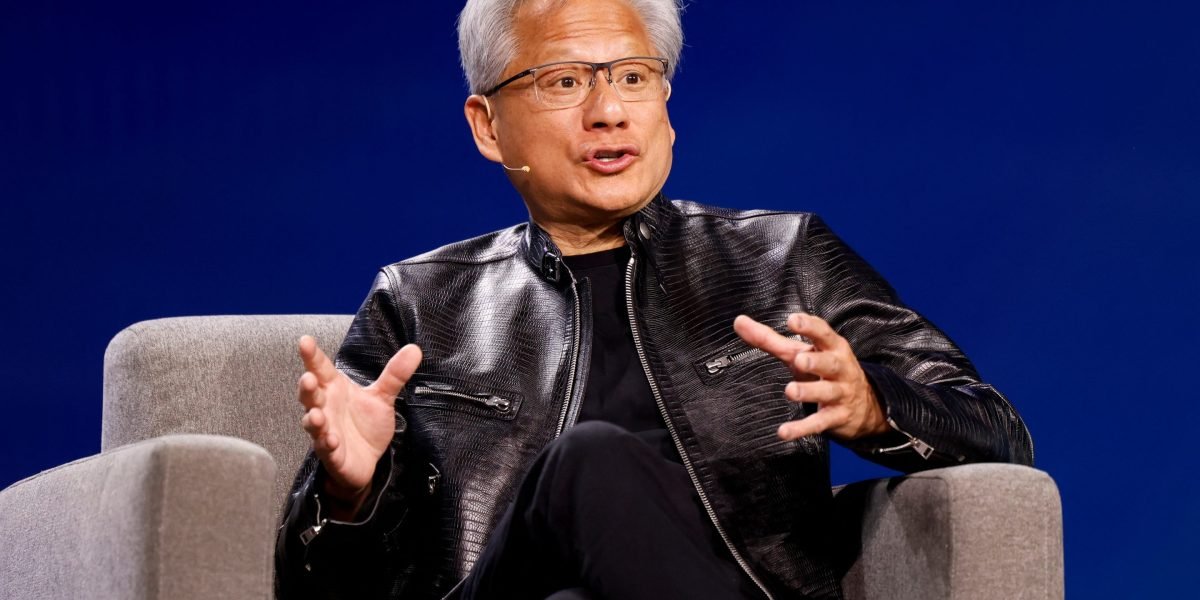
The solution is peace, love, understanding and good parenting skills, according to Nvidia CEO Jensen Huang. The man with a $4 trillion market cap arrived at the Cisco AI Summit with a message that sounded less like Wall Street rigor than a mix of 1960s counterculture and modern parenting: “Let a thousand flowers bloom.”
Meeting with Chuck Robbins, CEO of CiscoHuang addressed the tension faced by business leaders who feel the pressure to adopt AI but fear the lack of immediate, quantifiable results. When Robbins asked what the first steps a company should take were, Huang rejected the immediate fixation on spreadsheets.
“I get questions like…return on investment,” Huang said. “I wouldn’t go there.”
Instead, he argued for a philosophy of abundance and messy experimentation, explicitly comparing corporate innovation to raising children. He argued that requiring proof of financial success before allowing an engineer to try a new AI tool is as stifling as asking a child to justify a hobby with a business plan.
“I want the same thing for my business as I want for my children: to explore life,” Huang explained. When your kids tell you they want to try something, he added, you should say yes. We never ask questions at home like: what is the return on investment here? How will this lead to financial success? How can you prove to me that it’s worth it? “We never do this at home. But we do it at work.”
Innovation needs therapy, not control
This approach requires leaders to relinquish a degree of command that might feel uncomfortable, Huang admitted, arguing that creativity and innovation are worth it. “The number of different AI projects in our company is out of control and it’s great,” he said, noting that innovation doesn’t always happen when you have control. “If you want to have control, first of all, you have to get therapy. But second of all, it’s an illusion. You don’t have control. If you want your business to succeed, you can’t control it.”
Huang argued that to be successful, leaders must seek to influence their businesses rather than controlling them. The logic behind letting “a thousand flowers bloom” is risk management through diversification. Although this method “creates a messy garden,” he says, it avoids the mistake of committing resources – “putting all your wood behind one arrow” – too early in a technological transition where the “winning” tools are not yet obvious.
Lift the hood
While advocating a relaxed approach to ROI, Huang was adamant about the need for “tactile understanding.” He urged executives not to rely solely on cloud rentals or finished products.
Computers are everywhere these days, he said, but if you built one yourself you’d always understand better, just like a good car owner wouldn’t take Uber all the time but would take a close look at his engine. “Lift the hood, change the oil, understand all the components,” he said. “Build something. You may find that you are incredibly good at it. You may find that you need this skill.”
He emphasized that as AI technology is vital for the future, companies need to build on-premises infrastructure to truly understand how the “components” work. It’s about data privacy and what Huang calls the most valuable intellectual property: questions. “The most valuable intellectual property to me is not my answers…it’s my questions,” Huang said, noting that answers are a commodity, but intelligent questions are irreplaceable.
Fortune recently visited KPMG’s Lakehouse in Orlando, where the company was rolling out its AI training framework, first to interns and then company-wide. “Think, Prompt, Check” was how they trained employees to work with AI, emphasizing the first and last points as something not to be taken for granted.
From explicit to implicit
The urgency of this experiment, according to Huang, stems from a “fundamental reinvention of computing.” The industry is moving from “explicit programming” (writing specific lines of code) to “implicit programming,” in which users declare their intentions and AI finds the solution.
In this new world, “typing is a commodity,” Huang noted. The real value lies in the domain expertise required to guide the AI. “You now tell the computer what your intention is, and it goes off and figures out how to solve your problem.”
Huang concluded by overturning the popular “humans in the loop” ethical narrative. The goal, he said, should be “AI in the know.” By integrating AI into every process, companies can capture the “life experience” of their employees, transforming everyday work into permanent corporate intellectual property. In other words, they will let a thousand flowers bloom, but only if they have the right curiosity, the right questions, and the right support from above to think freely.
For this story, Fortune journalists used generative AI as a research tool. An editor checked the information for accuracy before publishing it.